Transition Words and Phrases: 60 Linking Words With Examples
Learn 60 transition words and phrases in nine groups, with example sentences, punctuation rules, memory tricks and a practice set with answers.
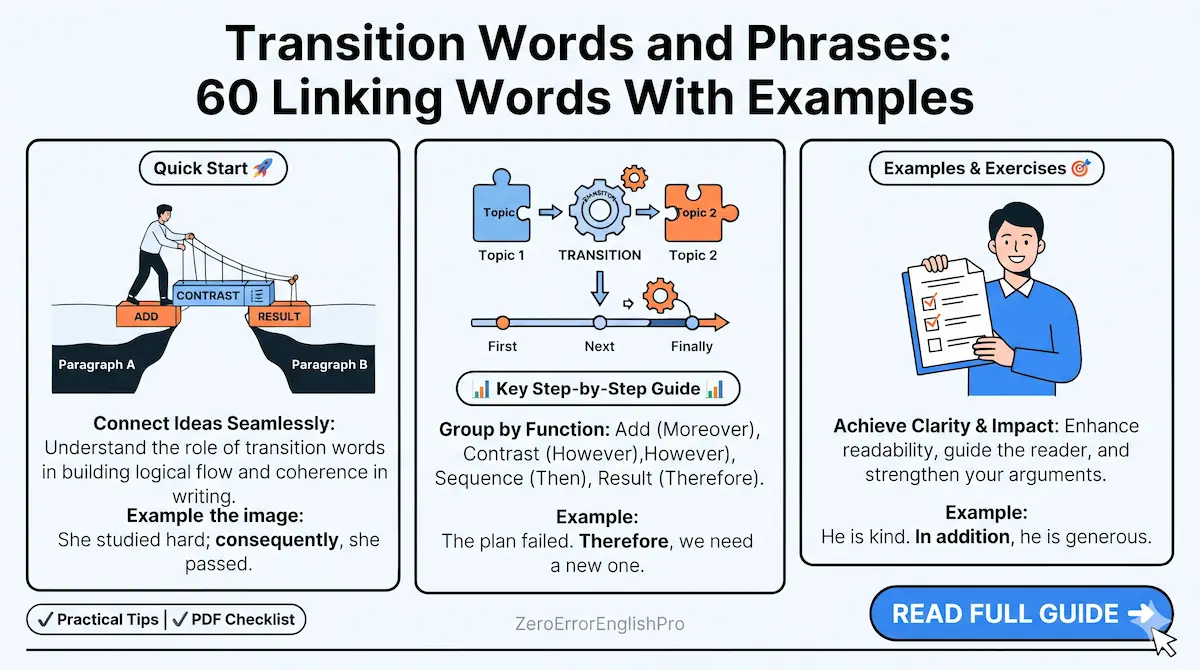
Read these two versions of the same idea. First: “It rained all day. We stayed home. We played cards.” Now: “It rained all day, so we stayed home and played cards.” Same facts, but the second one has a small word, “so,” that tells the reader how the ideas connect.
Words like that are called transition words, and they’re the glue of good writing. Without them, your sentences sit side by side like strangers. With them, your reader moves smoothly from one idea to the next, and your essays, emails and exam answers sound clear and confident.
This guide gives you 60 transition words and phrases in nine groups, each with an example sentence. You’ll also get a three-word routine, three punctuation rules, common mistakes and a twelve-question practice set with answers. I’ve taught English grammar for 22 years, and I can tell you that transitions are the fastest upgrade a writer can make. If you want to practise joining sentences next, try my sentence combining exercises.
- Why transition words matter
- The ASK, PICK, PUNCTUATE routine
- Addition
- Contrast
- Cause and reason
- Result
- Time and sequence
- Example
- Emphasis
- Conclusion
- Condition and comparison
- Three punctuation rules
- Mistakes to avoid
- A short paragraph makeover
- Practice set with answers
- A 5-day plan
- FAQ
- Related articles
Why transition words matter
They show relationships. A transition tells the reader whether the next idea adds, contrasts, explains or concludes.
They improve flow. Readers feel the writing is organised even when the ideas are complex.
They help in exams. Essay, letter and paragraph-writing tasks reward clear links between ideas.
There’s one catch. A transition word only works if it matches the real relationship. “However” in front of an idea that adds to the previous one confuses readers more than no transition at all. So your first job is to name the relationship, then pick the word.
The ASK, PICK, PUNCTUATE routine
“ASK. PICK. PUNCTUATE.”
ASK how the new idea relates to the last one: add, contrast, cause, result, time, example, emphasis, conclusion or condition
PICK a word from that group
PUNCTUATE correctly: comma after an opening transition, semicolon before however-type words that join two sentences
Say the three words whenever you write a sentence that follows another. It takes a few seconds, and it keeps your writing honest.
Group 1: Addition (8 words)
Use these when the new idea adds to the last one.
| Word or phrase | Example |
|---|---|
| and | She sings, and she plays the guitar. |
| also | He is also a skilled painter. |
| in addition | In addition, the hotel offers free breakfast. |
| moreover | The plan is cheap; moreover, it is quick. |
| furthermore | The book is clear. Furthermore, it is short. |
| besides | I don’t want to go. Besides, it’s late. |
| as well as | She teaches maths as well as science. |
| what is more | It’s cheap, and what is more, it’s durable. |
Memory trick: “Add means plus.”
Group 2: Contrast (8 words)
Use these when the new idea goes against the last one.
| Word or phrase | Example |
|---|---|
| but | I tried, but I failed. |
| however | It was late; however, we kept working. |
| although | Although it rained, we played. |
| though | He is rich, though he lives simply. |
| yet | She was tired, yet she smiled. |
| nevertheless | The road was closed; nevertheless, we arrived on time. |
| on the other hand | Tea is cheap. On the other hand, coffee is richer. |
| in contrast | Rahul loves cricket. In contrast, his brother prefers chess. |
Memory trick: “Contrast means but.” Never use although and but together in one sentence.
Group 3: Cause and reason (6 words)
Use these to explain why something happened.
| Word or phrase | Example |
|---|---|
| because | We stayed in because it was raining. |
| since | Since you’re here, let’s begin. |
| as | As it was late, we left. |
| because of | The match was delayed because of fog. |
| due to | The delay was due to fog. |
| owing to | Owing to heavy traffic, he was late. |
Memory trick: “Because of, due to and owing to are followed by a noun. Because, since and as are followed by a clause.”
Group 4: Result (7 words)
Use these to show what happened because of something.
| Word or phrase | Example |
|---|---|
| so | It was cold, so I wore a jacket. |
| therefore | He worked hard; therefore, he passed. |
| thus | The data was incomplete; thus, the result was unclear. |
| as a result | It rained all day. As a result, the match was cancelled. |
| consequently | She missed the bus; consequently, she was late. |
| hence | The tickets are cheap; hence, they sell fast. |
| accordingly | We received the new rules and acted accordingly. |
Memory trick: “Result means so.” Use so, therefore or as a result when one thing causes another.
Group 5: Time and sequence (9 words)
Use these to put events in order.
| Word or phrase | Example |
|---|---|
| first | First, wash the rice. |
| next | Next, add the water. |
| then | Then, cover the pot. |
| after that | After that, wait ten minutes. |
| meanwhile | Meanwhile, prepare the sauce. |
| finally | Finally, serve it hot. |
| before | Check your answers before you submit. |
| after | She called after she reached home. |
| eventually | Eventually, the rain stopped. |
Memory trick: “First, next, then, finally: count on your fingers.”
Group 6: Example (5 words)
Use these to give a case that supports your point.
| Word or phrase | Example |
|---|---|
| for example | Many fruits, for example, mangoes, are seasonal. |
| for instance | Some habits, for instance, reading, take time. |
| such as | I like fruits such as mangoes and guavas. |
| namely | Two cities were hit, namely Pune and Nashik. |
| in particular | I enjoy sports, in particular, cricket. |
Memory trick: “Such as sits inside the sentence. For example needs commas.”
Group 7: Emphasis (5 words)
Use these to stress an important point.
| Word or phrase | Example |
|---|---|
| indeed | It was indeed a difficult exam. |
| in fact | He isn’t lazy. In fact, he works harder than anyone. |
| above all | Above all, stay calm. |
| especially | I love fruits, especially mangoes. |
| clearly | Clearly, the plan needs changes. |
Memory trick: “Emphasis turns up the volume.” Use it once or twice per page.
Group 8: Conclusion (6 words)
Use these to close an argument or a paragraph.
| Word or phrase | Example |
|---|---|
| in conclusion | In conclusion, practice is the key. |
| to sum up | To sum up, plan, practise and revise. |
| overall | Overall, the course was useful. |
| in short | In short, we need more time. |
| all in all | All in all, it was a good trip. |
| in summary | In summary, the results were positive. |
Memory trick: “Conclusion comes last. Don’t introduce new ideas after it.”
Group 9: Condition and comparison (6 words)
Use these to set a condition or show similarity.
| Word or phrase | Example |
|---|---|
| if | If you study, you will pass. |
| unless | Unless you hurry, you will miss the train. |
| similarly | Rahul works hard. Similarly, his sister studies late. |
| likewise | She helped me; likewise, I helped her. |
| in the same way | Plants need water. In the same way, people need rest. |
| otherwise | Leave now; otherwise, you will be late. |
Memory trick: “Unless already means if not, so don’t add another not.”
Three punctuation rules
Rule 1: Comma after an opening transition. “However, we kept working.” “For example, mangoes are seasonal.”
Rule 2: Semicolon before a however-type word that joins two sentences. “It was late; however, we kept working.” A comma alone would create a splice.
Rule 3: Comma before and, but, so and yet when each side is a full sentence. “I tried, but I failed.”
Memory trick: “However needs a semicolon in front and a comma behind.” For more, read my guides on run-on sentences and comma splices, semicolon vs colon and comma rules.
Mistakes to avoid
Using two connectors for one relationship. “Although it rained, but we played” is wrong. Keep one: “Although it rained, we played.”
Joining sentences with however and a comma. “He was tired, however he kept working” is a comma splice. Use a semicolon before however.
Picking the wrong relationship. Moreover adds, and however contrasts. Mixing them confuses the reader.
Overusing transitions. One or two per paragraph is plenty. Too many make writing feel mechanical.
A short paragraph makeover
Here’s a paragraph with no transitions. Read it aloud and notice how it jerks along.
Before: Online classes are convenient. Students attend from home. Some students find it hard to focus. Teachers record the lessons. Students can watch again. Online classes are useful.
Now ask, pick, punctuate. The first two sentences add, the third contrasts, the fourth and fifth add and give a result, and the last concludes.
After: Online classes are convenient because students attend from home. However, some students find it hard to focus. Fortunately, teachers record the lessons, so students can watch them again. Overall, online classes are useful.
Four transitions did the work, and nothing was lost. Notice that I also joined two sentences into one with because and so, which ties back to combining sentences using clauses.
Practice set: choose the best transition
Choose the best word in each sentence. These are original practice sentences written for this guide. Try them before you read the answers.
- It was raining. ____, we played football. (However / Therefore)
- She studied hard; ____, she passed. (therefore / however)
- I like fruits ____ mangoes. (such as / for instance,)
- ____ you hurry, you will miss the train. (Unless / Because)
- He was tired. ____, he kept working. (Nevertheless / Moreover)
- First, mix the flour. ____, add the eggs. (Next / Although)
- The match was cancelled ____ rain. (because of / because)
- The room is cheap. ____, it is clean. (Moreover / However)
- ____ the bus was late, we walked. (Since / Although)
- Study daily; ____, you will forget. (otherwise / therefore)
- He is a good player. ____, he is a great captain. (In addition / In contrast)
- ____, practice is the key. (In conclusion / Meanwhile)
Answers
1. However (contrast: rain, but they played)
2. therefore (result of studying hard)
3. such as (inside the sentence, no comma)
4. Unless (condition: if you don’t hurry)
5. Nevertheless (contrast: tired, but kept working)
6. Next (sequence)
7. because of (followed by a noun: rain)
8. Moreover (adds a second good point)
9. Since (reason: the bus was late)
10. otherwise (condition: if you don’t study daily)
11. In addition (adds to the previous point)
12. In conclusion (closing the idea)
If you got 11 or 12 right, you’re ready to use transitions in your own writing. If you got 7 to 10, revisit the groups you missed. If you got fewer than 7, go back to the routine and retake the set after two days.
A 5-day plan
Fifteen minutes a day is enough if you keep the routine the same: read two groups, say the words in sentences aloud, then write one new sentence for each word.
Day 1: Addition and contrast
Day 2: Cause and result
Day 3: Time and example
Day 4: Emphasis, conclusion, condition
Day 5: Write a 100-word paragraph using six different transitions, then retake the practice set
Frequently asked questions
What are transition words?
Transition words are words and phrases that connect ideas, such as however, therefore and for example. They show the reader how one sentence or paragraph relates to the next.
What is the difference between however and but?
But is a conjunction that joins two clauses in one sentence, as in “I tried, but I failed.” However is an adverb. It can start a sentence, or follow a semicolon, as in “I tried; however, I failed.”
Do I need a comma after a transition word?
Yes, when the transition opens a sentence or joins two sentences after a semicolon, as in “However, we kept working.” Short words like so and then often need no comma.
How many transition words should I use?
One or two per paragraph is usually plenty. Too many make writing feel mechanical, so use them only when the relationship needs to be made clear.
Are transition words useful in exams?
Yes. Essay, letter and paragraph-writing tasks reward clear links between ideas, and sentence-joining questions test them directly. Check the latest official notification for your exam pattern.
Your next step
Pick a paragraph you wrote this week and underline every place where one sentence follows another. Ask how they relate, pick a transition from the right group and punctuate it correctly. That small exercise will teach you more than another page of lists.
When you want every punctuation mark covered with rules, exam-style questions and answer keys in one place, see my ebook Advanced Punctuation Mastery: A Complete Guide to Error-Free English for Competitive Aspirants on Amazon: https://amzn.to/4yXLKMo
Which group of transition words do you use least? Tell me in the comments, and I’ll explain it in more detail.