Semicolon vs Colon: When to Use Which (With Simple Memory Tricks)
Learn semicolon vs colon rules with examples, the SIBLING or CLUE memory trick, a 3-test method, 8 common mistakes and a 10-question practice set.
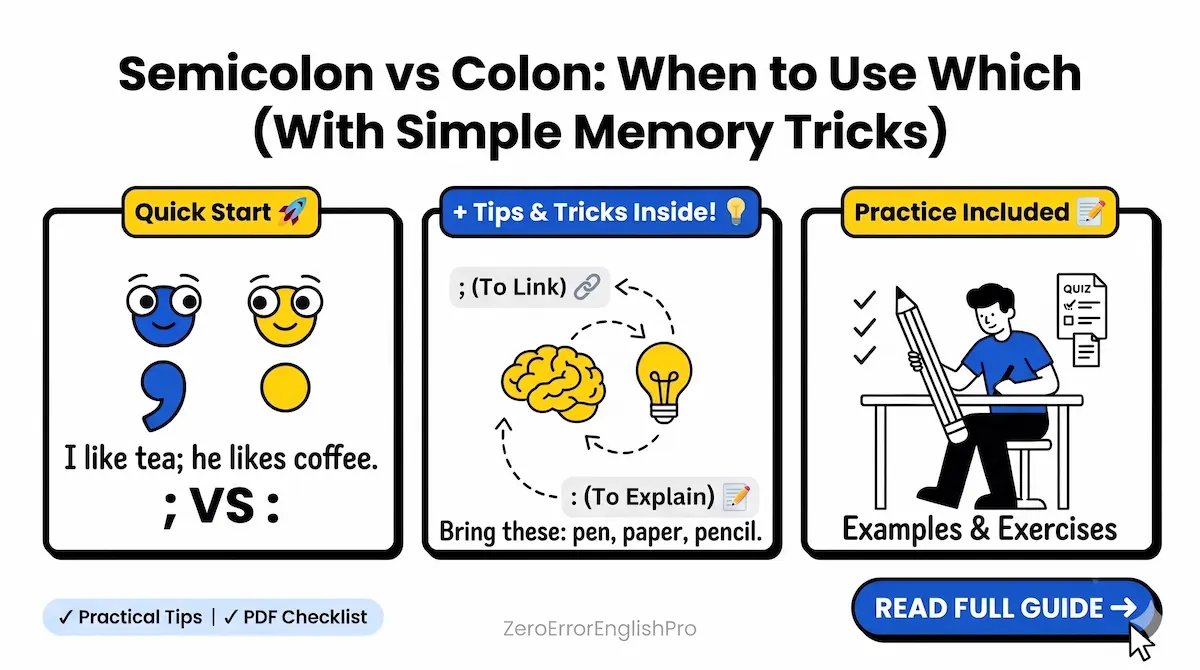
Look at these two sentences. “She had one ambition: to become an officer.” And: “She worked hard; she wanted to become an officer.” Both use a mark that looks like a comma with a dot above or below it, and both are correct. Swap the marks, and both become wrong.
That’s the semicolon and colon problem in one picture. Students know that the two marks exist, and they know they’re “somewhere between a comma and a full stop.” But when an exam sentence puts one in the wrong place, the sentence still sounds smooth, so the error slips past. SSC CGL, bank PO and UPSC papers love this pair, because one wrong dot changes whether a sentence is correct.
The good news is that the two marks do different jobs, and each job is easy to test. In this guide you’ll get the rules, a memory trick, a side-by-side comparison, the traps examiners recycle and a ten-question practice set with answers. If you haven’t read the earlier posts in this series, start with comma rules with examples, because the comma splice from that post is where semicolons begin.
- The memory trick: SIBLING or CLUE
- Semicolon rules with examples
- Colon rules with examples
- Semicolon vs colon: side by side
- The 3-test method
- 8 common mistakes
- Practice set with answers
- FAQ
The memory trick: SIBLING or CLUE
Here’s the whole topic in one line. Learn it, and you’ll be able to choose the right mark in a few seconds.
“A semicolon joins SIBLINGS. A colon gives a CLUE.”
Semicolon = SIBLINGS. Two complete sentences of equal strength, closely related, joined like brother and sister.
Colon = CLUE. A complete sentence, then a pointing finger: here comes the list, the explanation or the quotation.
Before you write either mark, ask yourself: “Am I joining two equals, or am I pointing to something that follows?” Joining equals means a semicolon. Pointing means a colon. If you can’t answer, a full stop or a comma is probably the safer choice.
Every example in this post is an original practice sentence on a common exam pattern. None of them is copied from a particular year’s paper.
Semicolon rules with examples
Rule 1: Join two closely related complete sentences
If two sentences are about the same idea, and a full stop feels too heavy, join them with a semicolon. Each side must be able to stand alone.
✓ My mother is a doctor; my father is an engineer.
This is the clean fix for a comma splice. “The train was late, we missed the meeting” is wrong, and the semicolon repairs it. Memory trick: “Two sentences, one dot above.” Count the subjects and verbs. If each side has its own, a semicolon can connect them.
Rule 2: Use a semicolon before “however,” “therefore,” “moreover” and “thus”
Words such as however, therefore, moreover, hence, thus, otherwise and consequently are not conjunctions like and or but. They can’t join two sentences by themselves, so a semicolon goes before them, and a comma goes after.
✓ The fee has increased; therefore, fewer students applied.
✗ He studied all night, however he still felt nervous. That’s a comma splice in disguise. Memory trick: “Semicolon before, comma after.” The semicolon says stop and join, and the comma after the word is the small breath.
Rule 3: Separate long list items that already contain commas
When the items of a list have commas inside them, plain commas would confuse the reader. Use semicolons between the big items.
The commas inside each item stay as they are, and the semicolons mark the major breaks. Think of semicolons as the stronger commas that carry the list.
What a semicolon cannot do
- It can’t follow a dependent clause. ✗ Although it was raining; the match continued. ✓ Although it was raining, the match continued.
- It can’t introduce a list. ✗ She bought three things; flour, sugar and butter.
- It’s usually not used before a plain FANBOYS word with short clauses. ✗ He was tired; but he continued. ✓ He was tired, but he continued.
- The word after a semicolon takes a small letter, unless it’s a proper noun or I.
Colon rules with examples
Rule 1: Introduce a list after a complete sentence
✓ Remember the three Rs: reading, writing and arithmetic.
The words before the colon must form a complete sentence. Memory trick: “Full sentence first, then colon.” If you read “She bought three things” on its own, it works. That’s why the colon is allowed.
Rule 2: Explain or expand the first sentence
A colon can introduce a statement that explains, proves or sharpens what came before it.
✓ The warning was clear: do not touch the wires.
Here the second part answers the question the first part raises. What ambition? What warning? The colon is the pointing finger.
Rule 3: Introduce a formal quotation or a long statement
For a short, casual quote, a comma is more common (“He said, ‘I will come.’”). Use a colon when a full, formal statement follows a full sentence.
Rule 4: Fixed uses
- Time: 6:45 pm (some Indian styles write 6.45)
- Ratios: 3:2
- Title and subtitle: Advanced Punctuation Mastery: A Complete Guide
- Formal letter greetings: Dear Sir: (common in American style; Indian letters often use a comma)
What a colon cannot do
- It can’t follow a verb or a preposition. ✗ The ingredients are: flour, sugar and butter. ✓ The ingredients are flour, sugar and butter.
- It can’t follow “such as,” “including” or “for example” in the middle of a sentence. ✗ She likes subjects such as: maths and science.
- The words before it can’t be an incomplete thought.
Semicolon vs colon: side by side
| Question | Semicolon | Colon |
|---|---|---|
| What does it do? | Joins two equal, related sentences | Points to what follows |
| What comes before it? | A complete sentence | A complete sentence |
| What comes after it? | Another complete sentence | A list, explanation, quotation or a word group |
| Memory word | SIBLINGS | CLUE |
| Example | It rained; the match continued. | It was clear: the match would continue. |
| Can it follow “although” or “because”? | No | Only if a full sentence comes before it |
Notice the one thing both marks share: a complete sentence always comes before them. That’s why the “complete sentence first” test catches most errors for both. For a quick reference table of every punctuation pair, the quick reference chapter of Advanced Punctuation Mastery has a semicolon vs colon matrix with decision trees, and a full chapter covers when to use which.
The 3-test method
When you meet a semicolon or a colon in an exam sentence, run these three tests in order. It takes about ten seconds.
Test 1: Is the part before the mark a complete sentence? Read it alone. If it isn’t complete, the mark is wrong, whether it’s a semicolon or a colon.
Test 2: What follows the mark? A complete, equal sentence points to a semicolon. A list, explanation or quotation points to a colon.
Test 3: Is a dependent word nearby? If the first part begins with although, because, if, when or since, it can’t take a semicolon. Use a comma.
8 common mistakes (and fixes)
1. A semicolon after a dependent clause. ✗ Because he was late; he missed the train. ✓ Because he was late, he missed the train.
2. A semicolon before a short “but,” “and,” “so.” ✗ She was tired; so she slept. ✓ She was tired, so she slept.
3. A semicolon to introduce a list. ✗ She bought; pens, pencils and erasers. ✓ She bought three things: pens, pencils and erasers.
4. A colon after a verb. ✗ My favourite subjects are: English and maths. ✓ My favourite subjects are English and maths.
5. A colon after “such as” or “including.” ✗ He plays games such as: chess and carrom. ✓ He plays games such as chess and carrom.
6. A comma where a semicolon is needed before “however.” ✗ It rained, however the match continued. ✓ It rained; however, the match continued.
7. A semicolon between unequal parts. ✗ The weather was bad; a terrible storm. ✓ The weather was bad: a terrible storm was coming.
8. A capital letter after a semicolon. ✗ It rained; However, the match continued. ✓ It rained; however, the match continued.
Mistakes 1 and 4 are the favourites in error spotting, because the sentence reads naturally and the wrong mark hides at the end of a part. If you want to revisit the full error spotting method, see my guide to punctuation error spotting.
A pattern I see in almost every batch
Students who confuse the two marks usually think of them as “strong comma” and “stronger comma,” and they place them by feeling. That works about half the time, which is exactly the rate at which examiners can fool you.
The fix is to replace feeling with a job description. A semicolon has one job: join siblings. A colon has one job: give a clue. Take five sentences from any editorial, find every semicolon and colon, and write SIBLINGS or CLUE next to each. Within two weeks, you’ll stop seeing them as dots and start seeing them as jobs.
Expert tips for exam day
Read the part before the mark alone. If it isn’t a complete sentence, the mark is wrong.
Watch the first word of the sentence. Although, because, if and when kill a semicolon.
Spot “however” and “therefore.” They take a semicolon before and a comma after.
When two marks seem possible, remember that the semicolon joins and the colon points. Ask which job the sentence needs.
When in doubt, simplify. A full stop or a comma is almost always correct if the semicolon or colon looks risky.
Practice set: 10 questions
Choose the correct mark for each blank: a comma, a semicolon, a colon or no mark. These are original practice sentences written for this guide.
- She had one aim ___ to clear SSC CGL.
- He studied all night ___ however, he felt nervous.
- The shop sells ___ pens, pencils and erasers.
- Although he was tired ___ he continued working.
- We visited Pune, Maharashtra ___ Nagpur, Maharashtra ___ and Delhi.
- The notice was short ___ no entry after 8 pm.
- The train was late ___ we missed the meeting.
- The ingredients are ___ flour, sugar and butter.
- My mother is a doctor ___ my father is an engineer.
- Before an exam, remember three things ___ rest, revise and relax.
Answers
1. Colon. The second part explains the aim, and “She had one aim” is a complete sentence.
2. Semicolon. “However” can’t join sentences on its own, so a semicolon goes before it.
3. No mark. “The shop sells” is incomplete, and a colon can’t follow a verb.
4. Comma. “Although” starts a dependent clause, which takes a comma, never a semicolon.
5. Semicolons in both blanks. The items already contain commas.
6. Colon. The second part explains the notice.
7. Semicolon. Two closely related, equal sentences.
8. No mark. A colon can’t follow “are.”
9. Semicolon. Two parallel, related sentences.
10. Colon. A complete sentence introduces the list.
If you scored 9 or 10, you’re ready for harder questions. If you scored 6 to 8, revise the rule behind the ones you missed. If you scored below 6, go back to SIBLING or CLUE and the 3-test method, and retake the set after two days. Advanced Punctuation Mastery also includes practice questions, previous-year style exam questions and answer keys after every rule, so you can keep measuring your progress.
Frequently asked questions
What is the difference between a semicolon and a colon?
A semicolon joins two closely related complete sentences. A colon points to what follows: a list, an explanation or a quotation. Both must come after a complete sentence.
Can I use a semicolon instead of a full stop?
Yes, when the two sentences are closely related. If they’re not closely linked, use a full stop.
Do I put a comma after “however”?
Yes, when it begins the second sentence after a semicolon: “It rained; however, the match continued.”
Is a capital letter needed after a colon?
Usually no, for a single sentence or a list. A capital letter is needed for a proper noun, or for a formal quotation that begins a full sentence.
Which is tested more often in exams?
Both appear, but the wrong colon after a verb and the wrong semicolon after a dependent clause are the most common patterns.
Your next step
Semicolons and colons are small, but they’re a reliable source of marks once you stop placing them by feeling. Remember the line: a semicolon joins siblings, and a colon gives a clue. Run the 3-test method on every sentence, and a wrong mark will stand out immediately.
When you want every punctuation mark covered with rules, exam-style questions, memory aids and answer keys in one place, grab Advanced Punctuation Mastery: A Complete Guide to Error-Free English for Competitive Aspirants on Amazon: https://amzn.to/4yXLKMo
Which of the two marks has confused you the most? Tell me in the comments, and I’ll explain it in more detail.
Advanced Punctuation Mastery: A Complete Guide to Error-Free English for Competitive Aspirants
Turn punctuation from an overlooked afterthought into a precise, rule-governed writing skill that strengthens every sentence.