How to Combine Two Sentences Into One Using Clauses
Learn how to combine two sentences into one using clauses. A simple 6-step method with because, although, if and when, plus examples and common mistakes.
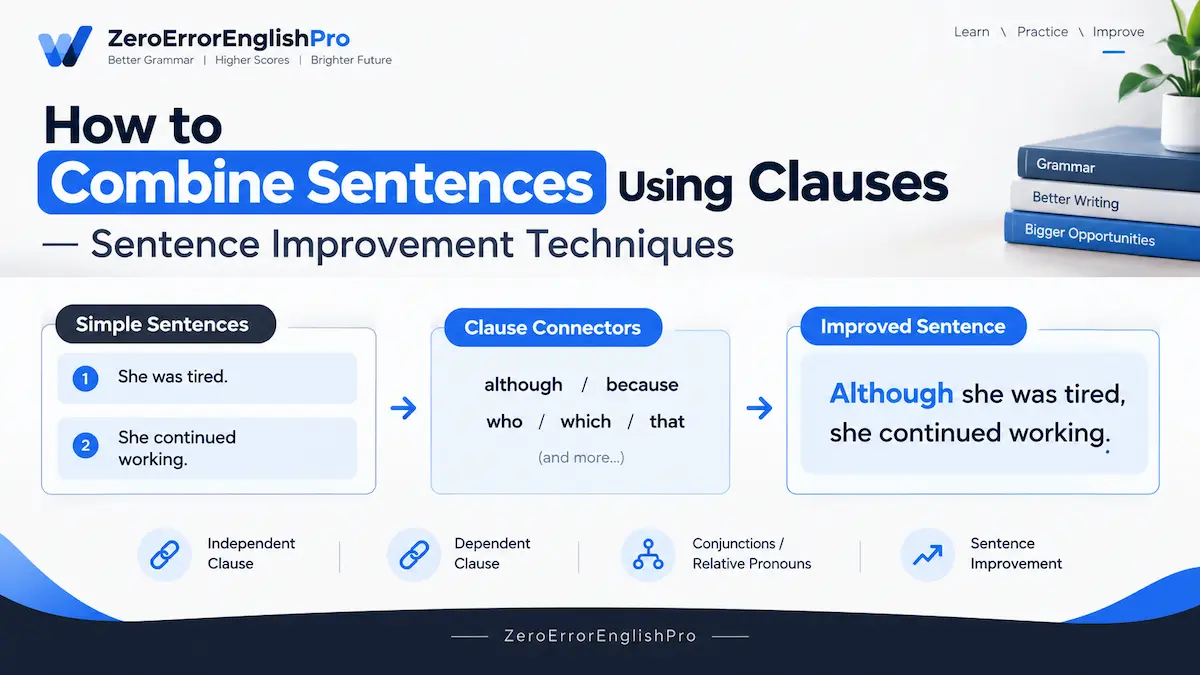
How to Combine Two Sentences Into One (The Right Way)
"He was tired. He continued working." Combine these into one sentence, and most students reach for the first connector that comes to mind — usually "and." But "and" flattens the relationship between the two ideas. The real relationship here is contrast, and the correct combination should show that.
This is exactly what Sentence Improvement questions test: not whether you can join two sentences, but whether you can identify the logical relationship between them and choose the clause type and connector that expresses it precisely.
Quick answer: To combine two sentences into one, identify which of the two sentences carries the less important, supporting idea. Convert that one into a subordinate clause (noun, adjective, or adverb) using a connector that matches its actual logical relationship — reason, contrast, time, or condition — with the main sentence.
In This Guide
- Why Combining Sentences Is Harder Than It Looks
- 5 Mistakes That Are Costing You Marks
- The 6-Step Combination Method (With Real Exam Patterns)
- How Ananya Mastered This in Two Weeks
- Expert Shortcuts Toppers Actually Use
- Final Takeaway
- Frequently Asked Questions
How to Combine Two Sentences Into One
Quick answer: To combine two sentences into one, find the link between the two ideas and join them with the right word: and (addition), but (contrast), so (result), because (reason), or who / which (to describe a noun). Then delete any repeated words.
You don't need a long list of rules to start. Ask one question: how are these two ideas related? The answer tells you the joining word. Here are the five relationships you'll meet most often.
1. Adding an idea: use "and"
✓ She opened the book and started reading.
Notice what happened. The second She disappeared, because the subject is the same. Always drop the repeated subject.
2. Showing contrast: use "but" or "although"
✓ He studied hard, but he failed.
✓ Although he studied hard, he failed.
Use only one of the two. ✗ Although he studied hard, but he failed is a classic exam error.
3. Showing a result: use "so"
✓ It was raining, so we stayed home.
4. Giving a reason: use "because"
✓ We stayed home because it was raining.
Same two ideas as in point 3, with the order flipped. The cause comes after because, and the result comes after so.
5. Describing a person or thing: use "who" or "which"
✓ I have a friend who teaches English.
This is my phone. It was a gift.
✓ This is my phone, which was a gift.
Use who for people and which for things. This is the point where combining sentences turns into combining sentences using clauses, which is what the rest of this guide covers.
3-step check before you finish any combined sentence:
1. Which word shows the link: and, but, so, because, who or which?
2. Did I use only one linking word for that link?
3. Did I delete the repeated subject or pronoun?
6 Easy Ways to Combine Two Sentences Into One
These patterns work in everyday writing and in exam questions. Pick the one that matches how your two ideas are related.
- Add or contrast (and, but, so): "She was tired. She kept working." becomes "She was tired, but she kept working."
- Reason (because): "He missed the bus. He was late." becomes "He was late because he missed the bus."
- Contrast (although): "It was raining. We played football." becomes "Although it was raining, we played football."
- Condition (if): "Study daily. You will pass." becomes "If you study daily, you will pass."
- Describing a person or thing (who, which): "I met a girl. She speaks French." becomes "I met a girl who speaks French."
- Same subject (-ing phrase): "He opened the door. He walked in." becomes "Opening the door, he walked in."
Why Combining Sentences Is Harder Than It Looks
- You default to "and" or "but" regardless of the actual relationship. These coordinate two equal ideas — they don't show reason, time, or condition precisely.
- You don't decide which idea is more important before combining. The main clause should carry the primary idea; the other becomes subordinate.
- You pick the wrong clause type for the relationship. Reason needs "because/since," contrast needs "although/while," condition needs "if/unless" — mixing them up changes the meaning.
- You lose information while combining. A rushed combination sometimes drops a detail that was present in the original two sentences.
- You create an awkward, overly long sentence instead of a clean one. Good combination should read more smoothly than the original two sentences, not less.
I know exactly how this feels — you can see both sentences clearly, and still the combined version comes out sounding forced. It's not a vocabulary gap. It's a missing decision step: which idea leads, and what's the real relationship between them.
But here's what most people get wrong: they focus on grammatical correctness alone and skip checking whether the combined sentence actually preserves the original meaning and relationship.
5 Mistakes That Are Costing You Marks
1. Using "and" to join sentences with a cause-effect relationship.
"He was late. He missed the meeting." → "He was late and missed the meeting" hides the causal link. "Because he was late, he missed the meeting" makes it explicit.
2. Using "but" where the relationship is actually reason, not contrast.
Not every negative-sounding pair is a contrast — check if one sentence explains the other before defaulting to "but."
3. Subordinating the wrong sentence.
The main clause should carry the sentence's primary point. Subordinating the important idea and keeping the minor detail as the main clause inverts the emphasis.
4. Creating a run-on by chaining too many clauses.
Combining three or more simple sentences into one dense sentence often becomes harder to read than keeping two sentences separate.
5. Repeating the subject unnecessarily after combining.
Once combined into one sentence with a shared subject, the subject typically doesn't need to be restated in the subordinate clause.
Common Mistakes Students Make
ebookcharm — English Grammar Made Exam-Ready
These five traps, along with a full connector-logic reference table, are covered in depth in the companion book below.
The 6-Step Combination Method (With Real Exam Patterns)
Step 1 — Read both sentences and identify the actual logical relationship. Reason, contrast, time, condition, or simple addition.
Step 2 — Decide which sentence carries the primary point. That one becomes (or stays close to) the main clause.
SSC CGL Exam Pattern: "He studied hard. He failed the exam." → the surprising result (failed) is the main point, so the effort clause is subordinated: "Although he studied hard, he failed the exam."
Step 3 — Pick the connector that matches the relationship exactly. Because/since/as → reason. Although/though/while → contrast. If/unless/provided that → condition. When/before/after/as soon as → time.
Step 4 — Convert the supporting sentence into the correct clause type. Usually an adverb clause for reason/contrast/time/condition, or occasionally an adjective clause if it's directly describing a noun.
IBPS PO Exam Pattern: "The manager approved the loan. The manager later resigned." → "The manager, who approved the loan, later resigned." (adjective clause)
Step 5 — Remove the repeated subject if both sentences share one. The subordinate clause typically doesn't need to restate it separately from the main clause structure.
Step 6 — Read the combined sentence aloud and check nothing was lost. Every detail from both original sentences should still be present, and the relationship should read naturally, not forced.
Step-by-Step Strategy
Reason, contrast, time, condition, or addition.
SSC CGL Exam Pattern: "He studied hard. He failed the exam."
Because/although/if/when — match precisely.
IBPS PO Exam Pattern: "The manager, who approved the loan, later resigned."
ebookcharm — English Grammar Made Exam-Ready
How Ananya Mastered This in Two Weeks
Ananya could identify individual clause types correctly but struggled when asked to actively combine two given sentences — recognition and production turned out to be different skills for her.
She started practicing with pairs of sentences from her coaching material daily, forcing herself to name the relationship out loud before choosing a connector. Within two weeks, her Sentence Improvement accuracy on combination-type questions matched her already-strong identification accuracy.
You can do the same — here's how to start: write down three pairs of simple sentences today, name the relationship between each pair, then combine them using the six steps above.
Expert Shortcuts Toppers Actually Use
1. Say the relationship out loud before picking a connector. "This is a reason" or "this is a contrast" — naming it first prevents defaulting to "and" or "but."
2. Build a connector-by-function reference list. Group by reason, contrast, time, and condition rather than learning connectors alphabetically.
3. When two options seem equally valid, choose the one that preserves emphasis correctly. The main clause should still carry the sentence's real point.
4. Practice with your own sentences, not just textbook pairs. Writing your own pairs forces you to internalize relationships rather than pattern-matching a memorized answer key.
5. If a combination feels forced, it probably is. A well-combined sentence should read more naturally than the original two, not less.
Final Takeaway
Combining sentences isn't about joining words correctly — it's about correctly identifying the relationship between two ideas and choosing the clause type and connector that expresses it precisely. Name the relationship first, decide which idea leads, then combine.
Frequently Asked Questions
Q: Is it ever correct to use "and" to combine two sentences?
A: Yes — when the two ideas are genuinely equal in importance with no reason, contrast, time, or condition relationship between them. Forcing a subordinate clause onto a simple addition can sound unnatural too.
Q: How many sentences can be combined into one at a time?
A: Two is standard for exam questions. Combining three or more usually creates a run-on sentence that's harder to read, even if each individual connector is used correctly.
Q: What's the difference between combining with a clause versus combining with a phrase?
A: A clause combination keeps both subjects and finite verbs (e.g., "Although he was tired..."). A phrase combination often converts one sentence into a participle or infinitive phrase (e.g., "Being tired, he still..."), which is more compact but works only when the subjects are the same.
Q: How do you combine two sentences into one?
A: First decide how the two ideas are related: addition, reason, contrast, condition or description. Then join them with a matching word such as and, because, although, if or who.
How do you combine two sentences into one?
Find how the two ideas are related, then join them with the matching word: and for addition, but for contrast, so for a result, because for a reason, and who or which to describe a noun. After joining, remove repeated words, such as the second subject when both sentences have the same one.
What is the easiest way to combine sentences in English?
Start with the five basic linkers: and, but, so, because and who or which. Practise with ten short sentence pairs a day and name the link each time. Once these feel natural, move on to clauses such as although, if and that.
Related Articles
Clauses & Phrases Demystified: Fix Errors and Write Confidently
Replace slow, uncertain clause analysis with a fast, repeatable identification system built for exam-timer pressure.