Sentence Combining Practice: 20 Exercises With Answers
Practice combining sentences with 20 exercises and answers. Learn and, but, because, although, if, who and -ing patterns with clear explanations.
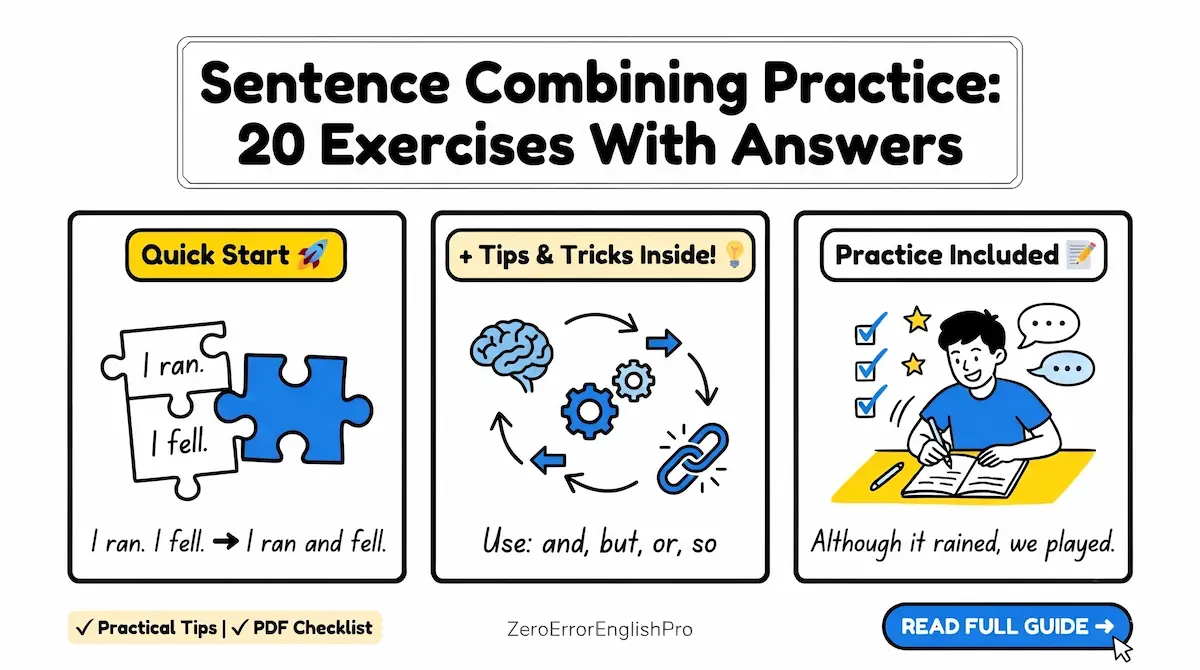
Read these two sentences out loud: “I was hungry. I made a sandwich.” Both are correct, but together they sound like a robot wrote them. Now read this: “I was hungry, so I made a sandwich.” Same facts, same words, and it sounds like a person.
That small jump is what sentence combining teaches. You take short, choppy sentences and join them so the reader can feel how the ideas connect. It’s a skill that improves your essays, your emails, your exam answers and your speaking, and the only way to build it is practice.
This page gives you 20 sentence combining exercises in five groups, with a full answer key and a short reason for every answer. You’ll also get a three-word routine, a connector cheat sheet and a self-check list. I’ve taught English grammar for 22 years, and the students who improve fastest are the ones who try the exercise before reading the answer. If you want the method behind these exercises first, read my guide on how to combine two sentences into one.
- Why practise sentence combining
- Connector cheat sheet
- The Ask, Pick, Join routine
- Group A: and, but, so, or
- Group B: because, although, since
- Group C: time and condition
- Group D: who, which, that, whose
- Group E: -ing, -ed and to phrases
- Answer key with reasons
- Mistakes to avoid
- FAQ
- Related articles
Why practise sentence combining
Most learners write in short sentences because short sentences feel safe. There’s nothing wrong with that, but a page full of them reads like a list. Combining gives you three things at once.
Flow. Connected ideas read smoothly, and your writing sounds more mature.
Meaning. A good connector tells the reader why, when or despite what. Short sentences leave that work to the reader.
Accuracy. Combining forces you to think about clauses, commas and verb forms, which are the places learners make mistakes.
Every sentence in this practice set is original and written for learners at an intermediate level. Several pairs have more than one correct answer, so if yours differs from mine, check it with the self-check list near the end.
Connector cheat sheet
| Relationship | Connectors | Example |
|---|---|---|
| Addition | and, also, as well as | She sings and she dances. |
| Contrast | but, although, though, yet | He is small, but he is strong. |
| Reason | because, since, as | We left early because it was late. |
| Result | so | It was cold, so I wore a jacket. |
| Choice | or | Tea or coffee? |
| Time | when, after, before, as soon as | Call me when you arrive. |
| Condition | if, unless | If it rains, we stay home. |
| Describing | who, which, that, whose | The girl who sang won. |
The Ask, Pick, Join routine
“Ask. Pick. Join.”
Ask how the two ideas are related: addition, contrast, reason, result, time, condition or description
Pick the connector that matches that relationship
Join the sentences, then check the commas and the verb forms
Don’t grab and every time. If you can’t name the relationship, you’re not ready to choose the connector. Name it first, and the connector almost chooses itself.
Group A: and, but, so, or
These connectors join two equal sentences. Use a comma before but, so and or when each side is a full sentence. If both parts share the same subject, you can often drop the second subject and the comma. A classic memory trick is FANBOYS: for, and, nor, but, or, yet, so. For more on commas, see comma rules in English grammar.
Join each pair with and, but, so or or.
- I was hungry. I made a sandwich.
- She likes tea. She doesn’t like coffee.
- You can take the bus. You can walk.
- He opened the window. He turned on the fan.
Group B: because, although, since
These make one idea depend on the other. Because answers the question why. Although and though say despite this. When the connecting clause comes first, put a comma after it. When it comes second, you usually don’t need one. Memory trick: “Because gives a reason. Although gives a surprise.”
Join each pair with because, although, since or though.
- We stayed home. It was raining.
- She was nervous. She spoke clearly.
- The shop was closed. We went to the market.
- He is young. He is very wise.
Group C: time and condition
Time words (when, after, before, as soon as) and condition words (if, unless) also make one clause depend on another. Remember that the future doesn’t take will in these clauses: say “when I reach home,” not “when I will reach home.” For harder if-patterns, see third and mixed conditionals. Memory trick: “If-clause first, comma next.”
Join each pair with when, after, as soon as, if or unless.
- Finish your homework. Then you can play.
- Leave now. You will miss the train.
- I will call you. I reach home.
- The bell rang. The students ran out.
Group D: who, which, that, whose
These connectors turn the second sentence into a description of a noun in the first. Use who for people, which for things, that for either when the information is essential, and whose for ownership. If the extra detail isn’t essential, put commas around it. For the full rules, read relative clauses: who, which and that. Memory trick: “Who for people, which for things.”
Join each pair with who, which, that or whose.
- I know a teacher. She teaches music.
- This is my laptop. It was a gift.
- The book is on the table. It belongs to Rahul.
- My neighbour is a doctor. His clinic is nearby.
Group E: -ing, -ed and to phrases
When both sentences share the same subject, you can turn one into a short phrase. Use an -ing phrase for something happening at the same time or just before, having plus a past participle for something finished first, and to plus a verb for purpose. Read more about these in types of phrases. One warning: the doer of the phrase must be the subject of the main sentence. Memory trick: “Same doer, or don’t use it.”
Join each pair by turning the first or second sentence into a phrase.
- She finished her work. She went home.
- He was tired. He fell asleep quickly.
- She wanted to relax. She switched off her phone.
- The thief was caught. He was running away.
Answer key with reasons
Cover this section until you’ve tried all 20. Your wording can differ from mine, as long as the relationship and the punctuation are right.
1. I was hungry, so I made a sandwich. (result, so with a comma)
2. She likes tea, but she doesn’t like coffee. (contrast, but with a comma)
3. You can take the bus, or you can walk. (choice, or with a comma)
4. He opened the window and turned on the fan. (same subject, so no second he and no comma)
5. We stayed home because it was raining. (reason, no comma when because comes second)
6. Although she was nervous, she spoke clearly. (contrast, comma after the opening clause)
7. Since the shop was closed, we went to the market. (reason, comma after the opening clause)
8. Though he is young, he is very wise. (contrast, comma after the opening clause)
9. You can play after you finish your homework. (time, and no will or future form needed)
10. If you don’t leave now, you will miss the train. (Or: Unless you leave now, you will miss the train.) (condition, comma after the if-clause)
11. I will call you when I reach home. (time, present tense after when)
12. As soon as the bell rang, the students ran out. (time, comma after the opening clause)
13. I know a teacher who teaches music. (who for a person, no comma)
14. This is my laptop, which was a gift. (which for a thing, with a comma for extra information)
15. The book that is on the table belongs to Rahul. (that for essential information, no commas)
16. My neighbour, whose clinic is nearby, is a doctor. (whose for ownership, commas for extra information)
17. Having finished her work, she went home. (earlier action, same doer)
18. Tired, he fell asleep quickly. (Or: Being tired, he fell asleep quickly.) (reason shortened, same doer)
19. To relax, she switched off her phone. (purpose, same doer)
20. The thief was caught running away. (two actions at once, same doer)
How to check your own answer
1. Relationship. Does your connector match how the ideas relate?
2. Meaning. Is every detail from both sentences still there?
3. Punctuation. Do you have a comma after an opening clause, and none where you don’t need one?
4. Verb forms. Did you avoid will after when, if and before?
If you got 17 or more right, you’re ready for harder material such as the difference between a clause and a phrase, which is explained in phrase vs clause. If you scored below 12, re-read the group introductions and retry only the groups you missed.
Mistakes to avoid
Using and for everything. And hides reasons, contrasts and results. Name the relationship first.
Making a run-on sentence. Two full sentences joined by only a comma is a comma splice. Add a connector or use a full stop. See punctuation error spotting for more.
Dangling phrases. “Walking to school, the rain started” says the rain was walking. The doer of the phrase must be the subject.
Losing information. A neat sentence that drops a detail has changed the meaning.
A pattern I see in almost every batch
Learners can usually recite the connector lists. Where they struggle is the choice. Give them “It was raining. We played football,” and half will write “It was raining and we played football.” It’s grammatical, but it hides the surprise. The fix is simply to say the relationship aloud first: “That’s a contrast.” Then although appears on its own.
Expert tips for practice
Write your own pairs. Take any news headline and split it into two short sentences, then rejoin them three different ways.
Read your answer aloud. If you run out of breath, the sentence is too long.
Practise one group a day. Four exercises, then check, then stop. Five days gets you through all 20.
Keep a mistake list. Write down the connector you used wrongly and revise it the next day.
Frequently asked questions
What is sentence combining?
It’s joining two or more short sentences into one longer sentence so that the relationship between the ideas is clear. You can use connectors, relative pronouns or short phrases.
Should I always use a comma when I combine sentences?
Not always. Use a comma after an opening clause and before but, so or or when each side is a full sentence. You usually don’t need one when the connecting clause comes second, as in “We stayed home because it was raining.”
Can there be more than one correct answer?
Yes. Many pairs can be joined in several correct ways. What matters is that the connector matches the relationship, no detail is lost and the punctuation is right.
How many sentences should I combine at once?
Two is a good start. Joining three or more often makes a sentence that’s hard to read, even when each connector is correct.
Is sentence combining useful for exams?
Yes. Sentence improvement and sentence transformation questions test the same skill. Always check the latest official notification for your exam pattern.
Your next step
Pick one group and try the four exercises today, before you look at the answers. Ask how the ideas relate, pick the connector, then join and check. That’s the whole routine.
When you want a fast, repeatable way to handle clauses and phrases, my ebook Clauses & Phrases Demystified: Fix Errors and Write Confidently is on Amazon: https://amzn.to/4ibEcP9
Which group felt hardest? Tell me in the comments, and I’ll explain it in more detail.
Related Articles
Clauses & Phrases Demystified: Fix Errors and Write Confidently
Replace slow, uncertain clause analysis with a fast, repeatable identification system built for exam-timer pressure.