Fill in the Blanks with Prepositions: 5 Tricks to Pick the Right Answer Fast
Learn 5 simple tricks to solve preposition fill in the blanks fast, with examples, a 20-second exam routine, a cloze passage and a 10-question practice set.
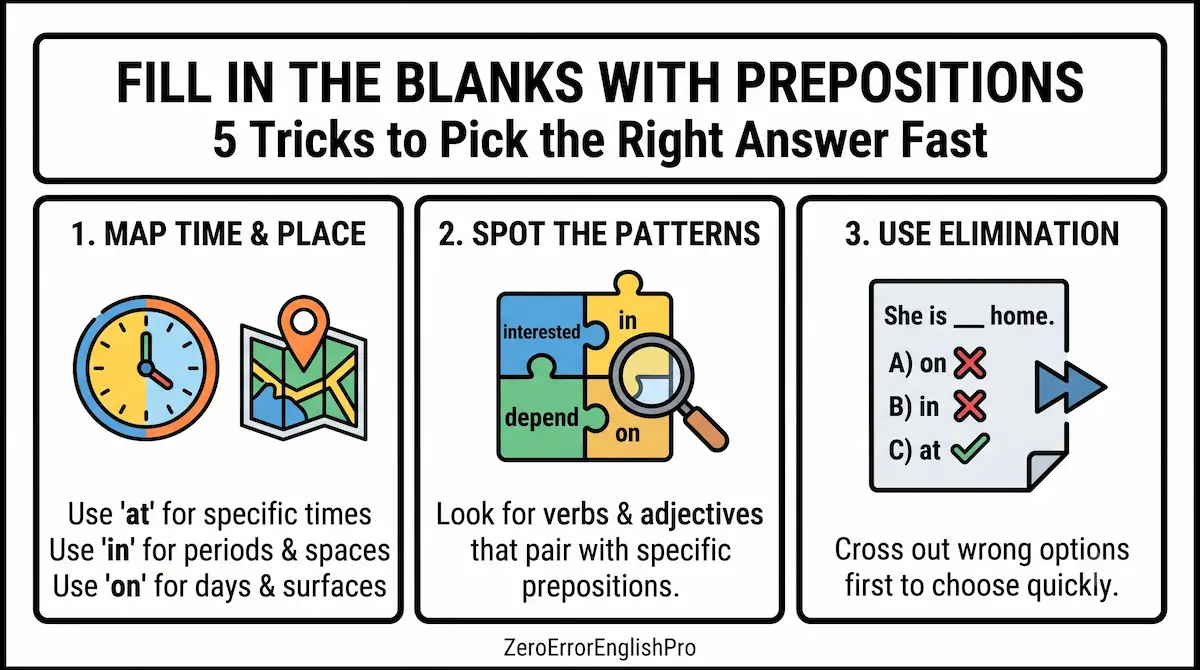
Here's a question that looks easy: "She has been waiting ___ her friend since morning." The options are (a) on, (b) for, (c) to, (d) at. Four real prepositions, one correct answer, about twenty seconds on the clock. How many students do you think pick "at" because it sounds familiar?
More than you'd expect. Fill-in-the-blank questions feel hard because every option looks like a possible answer, and guessing by sound is the default habit. But there's a way out. These questions follow patterns, and once you see the patterns, you stop guessing and start solving.
Over 22 years of coaching, I've boiled the method down to five tricks. They work for SSC, bank, railway and state exams, and for Class 12 grammar too. Each trick comes with examples, and the article ends with a cloze passage, a 10-question practice set and answers with reasons.
- Read the word before the blank. It's usually the partner.
- Read the word after the blank. It tells you the type of preposition.
- Run the meaning test for look-alike pairs (since/for, between/among, by/with).
- Eliminate two options in five seconds.
- Check for a fixed phrase or idiom first.
In This Guide
- Why fill-in-the-blank questions feel so tricky
- Trick 1: Read the word before the blank
- Trick 2: Read the word after the blank
- Trick 3: Use the meaning test for look-alike pairs
- Trick 4: Eliminate two options in five seconds
- Trick 5: Check for fixed phrases and idioms first
- Memory shortcuts you can save
- Your 20-second exam-hall routine
- Cloze passage practice: using all five tricks together
- 5 mistakes students make in fill-in-the-blanks
- Practice set: 10 questions to solve with the 5 tricks
- A 10-minute daily practice habit
- Frequently asked questions
- Solve, don't guess
Why fill-in-the-blank questions feel so tricky
Examiners don't hide the answer among strange words. They put the right preposition next to three common ones that nearly fit. If you read the sentence once and go with your ear, you'll often pick the wrong one. And many of us learned English from a mix of classroom, films and conversation, so our ear has heard "wait on", "different than" and "discuss about" often enough to accept them.
The fix is to replace the ear with a routine. Spend five seconds on each trick below, and the right option usually stands out. A note on examples: the sentences here are common exam patterns, not questions from a particular year's paper.
Trick 1: Read the word before the blank
Most prepositions are tied to the word just before them. That word might be a verb, an adjective or a noun. Find it first, and ask what preposition it normally takes.
| Partner word | Sentence | Answer |
|---|---|---|
| fond | She is fond ___ classical music. | of |
| depend | Success depends ___ regular practice. | on |
| apologise | He apologised ___ his mistake. | for |
| belong | This pen belongs ___ my sister. | to |
| interested | We are interested ___ this course. | in |
| comply | All drivers must comply ___ the rules. | with |
If the partner word is a pair you know, you're done in three seconds. If you don't recognise it, move on to Trick 2. My guide to the appropriate prepositions list covers more than 80 such pairs with examples.
Trick 2: Read the word after the blank
The word after the blank tells you what kind of preposition the sentence is asking for.
| What comes after the blank | Likely preposition | Example |
|---|---|---|
| A clock time | at | The train leaves ___ 6:30 pm. (at) |
| A day or date | on | My exam is ___ 14 October. (on) |
| A month, year or season | in | It rains heavily ___ July. (in) |
| A period of time (duration) | for | He has worked here ___ six years. (for) |
| A starting point in time | since | He has worked here ___ 2020. (since) |
| A person who receives something | to | She gave the book ___ me. (to) |
| A surface | on | The keys are ___ the table. (on) |
| A city, country or enclosed space | in | They live ___ Nagpur. (in) |
One more thing to check after the blank: if the next word ends in -ing, the preposition may be one of those that must be followed by a gerund. Say "good at swimming", "insisted on paying", "interested in learning". And watch the famous trap: in "look forward to meeting you", the word to is a preposition, not part of an infinitive, so we use "meeting", not "meet".
For the time and place rules in detail, see my guide on in, on and at.
Trick 3: Use the meaning test for look-alike pairs
When two options are close cousins, ask a simple question about the meaning. This is the trick that rescues students on the hardest questions.
| Pair | The meaning test | Example |
|---|---|---|
| since / for | Is there a starting point (since) or a length of time (for)? | I've known her since 2019 / for five years. |
| between / among | Two things (between) or three or more (among)? | Divide the sweets among the three children. |
| by / with | Is it the doer (by) or the tool (with)? | The letter was written by the principal with a blue pen. |
| in / into | Is the person already inside (in) or moving inside (into)? | The cat jumped into the box and stayed in it. |
| beside / besides | Next to (beside) or in addition to (besides)? | Besides English, she teaches maths. She sat beside me. |
Ask the question out loud (or in your head) and the answer almost announces itself. This is far faster than trying to recall a rule from memory.
Trick 4: Eliminate two options in five seconds
You don't have to know the right answer. You only have to know that two options are wrong. Let me show you how it works on the question from the start.
Question 1. She has been waiting ___ her friend since morning. (a) on (b) for (c) to (d) at
The partner word is "waiting". "Wait to" is never followed by a person like this. "Wait at" is used for a place ("wait at the gate"), but here the blank is followed by a person, so it's out. "Wait on" means to serve someone, as a waiter does. That leaves for.
Question 2. The film starts ___ 8 pm. (a) on (b) in (c) at (d) by
A clock time follows the blank. "On" is for days and "in" is for longer periods. "By" means "not later than" and doesn't fit "starts". The answer is at.
Question 3. He is married ___ a teacher. (a) with (b) to (c) by (d) for
"Married with" doesn't work in this sense, and "by" and "for" don't fit at all. The pair is "married to", so the answer is to.
See the pattern? Each time, you cross out two options quickly, and then you're choosing between two, not four. As a rule of thumb, aim for about twenty seconds a blank in an exam. If you can't decide, eliminate, pick the best remaining option and move on.
Trick 5: Check for fixed phrases and idioms first
Some prepositions appear in fixed expressions where logic doesn't help at all. If you spot one of these in the sentence, take the answer from memory and skip everything else.
| Phrase | Example |
|---|---|
| by heart | She learned the poem by heart. |
| by mistake / by chance | I took your pen by mistake. |
| on purpose | He didn't break it on purpose. |
| on foot | We went to the market on foot. |
| on time / in time | The bus arrived on time. We reached in time for the show. |
| at last / at least | At last, the results are out. |
| in vain | All our efforts were in vain. |
| in a hurry | He left in a hurry. |
| in charge of | Who is in charge of the department? |
| in favour of | Most members voted in favour of the plan. |
| on behalf of | I'm speaking on behalf of my team. |
| out of order | The lift is out of order. |
| under pressure | She works well under pressure. |
| beyond doubt | His honesty is beyond doubt. |
A quick method: when you read the sentence, ask, "Does any part of this sound like a ready-made phrase?" If yes, check it against this list before you apply any rule.
Memory shortcuts you can save
Tricks work better when they stick. Here are the shortcuts I give my students. Screenshot this table and revise it before every test.
| Topic | Memory shortcut |
|---|---|
| The 5 tricks | B-A-M-E-F: "Be A Master, Eliminate Fast" |
| at / on / in (time) | Clock, calendar, years: AT the clock, ON the calendar day, IN the long stretch |
| since / for | Since = Start point. For = Fixed length. |
| between / among | BeTWeen has TWo. Among means many. |
| by / with | By = Boss (the doer). With = Weapon (the tool). |
| in / into | IN + TO = INTO. Into is movement towards the inside. |
| beside / besides | Beside = by the side. Besides has an extra S for extra things. |
| look forward to ___ | "If TO is a preposition, -ING is the condition." (looking forward to meeting) |
Pick two shortcuts a day and use each in one sentence of your own. Your own sentence will stay in memory far longer than mine.
Your 20-second exam-hall routine
Let's put the five tricks into one routine you can run on every blank.
| Seconds | Step | Question to ask |
|---|---|---|
| 0 to 3 | Read the sentence | What is it saying? Form your own guess before looking at the options. |
| 3 to 8 | Partner and object | What's before the blank? What's after it? |
| 8 to 12 | Fixed phrase check | Is there a ready-made phrase like "on foot" or "in charge of"? |
| 12 to 17 | Eliminate | Which two options clearly fail? |
| 17 to 20 | Meaning test | Between the last two, which one matches the meaning? |
You won't hit exact timings at first, and that's fine. Speed comes after accuracy. Practise the routine slowly on ten questions a day, and within two weeks it will run on its own.
Cloze passage practice: using all five tricks together
In a cloze passage, the blanks sit inside a paragraph, and that actually helps you, because the surrounding sentences give extra clues. Try this one. Write down your seven answers before you look.
Answers: (1) at (2) about (3) about (4) on (5) on (6) with (7) on.
Which trick solved which blank? Blank 1: Trick 2 (clock time → at). Blanks 2 and 3: Trick 1 (excited about, worried about). Blanks 4 and 5: Trick 5 (on foot, on time). Blank 6: Trick 1 (pleased with). Blank 7: Trick 1 (congratulate on). Once you see which trick you used, you'll start choosing them automatically.
5 mistakes students make in fill-in-the-blanks
- Reading the options before the sentence. The options bias you. Read the sentence with the blank first, and form your own guess.
- Ignoring the word after the blank. That word often decides everything.
- Forgetting the -ing rule. After a preposition, the verb takes -ing: "insists on paying", not "insists on pay".
- Mixing since and for. A starting point takes since. A duration takes for.
- Going by the ear. If a phrase "sounds fine", check it against the pair. "Discuss about" sounds fine to many people.
Practice set: 10 questions to solve with the 5 tricks
- The meeting is scheduled ___ Friday. (a) in (b) at (c) on (d) by
- She has been living in Mumbai ___ 2018. (a) for (b) since (c) from (d) in
- He is loyal ___ his friends. (a) with (b) for (c) to (d) at
- The prize was divided ___ the four winners. (a) between (b) among (c) by (d) with
- We are looking forward ___ meeting you. (a) to (b) for (c) at (d) on
- The letter was written ___ the principal. (a) with (b) by (c) from (d) of
- She is weak ___ geography. (a) at (b) in (c) on (d) with
- She is capable ___ handling the project. (a) to (b) of (c) at (d) for
- The team is responsible ___ the final report. (a) for (b) of (c) to (d) on
- He was absent ___ school yesterday. (a) from (b) of (c) at (d) in
1) c, on (day takes on)
2) b, since (starting point 2018)
3) c, to (loyal to)
4) b, among (four winners, more than two)
5) a, to (look forward to, followed by -ing)
6) b, by (the doer of the action)
7) b, in (weak in a subject)
8) b, of (capable of)
9) a, for (responsible for)
10) a, from (absent from)
Your score: 9 or 10 means you're exam-ready. 6 to 8 means revisit the trick where you slipped. Below 6, reread Tricks 1 and 2 and try again after two days.
A 10-minute daily practice habit
Tricks only work if you use them regularly. Here's the habit I recommend to my batches. Pick ten fill-in-the-blank questions from any source, whether a practice paper, a mock test or the sets in this series. Solve them without a timer first, and write the trick you used next to each answer. Then check your score and note any slip in a small notebook: the sentence, the correct preposition and the trick you missed.
After a week, you'll notice that your slips cluster around one or two tricks, perhaps the meaning test or fixed phrases. Those are your weak spots, and now you know exactly where to spend your time. This is much better than doing a hundred random questions and hoping something sticks. If you also want practice on spotting mistakes, my guide on preposition error spotting uses the same pair-by-pair approach.
Frequently asked questions
How much time should I spend on each blank?
As a rule of thumb, aim for about twenty seconds. If you can't decide, eliminate the clearly wrong options and move on. You can come back if time remains.
Should I read the options before reading the sentence?
No. Read the sentence first and think of your own answer. Then look at the options. This stops the options from steering you in the wrong direction.
Why are prepositions hard in cloze tests?
Because the blank depends on one small word, and the passage gives only indirect clues. The surrounding sentences help, so read one sentence before and one after the blank.
Do I need to learn all the appropriate prepositions?
It helps a lot, but the five tricks let you solve many questions even when a pair is unfamiliar. Learn pairs daily and use the tricks for the rest.
What if two options both sound correct?
Run the meaning test from Trick 3. Ask what the sentence is really saying: a point or a length, two or many, the doer or the tool. The meaning decides which one is correct.
Solve, don't guess
The next time a fill-in-the-blank question shows up, don't reach for the option that "sounds right". Read before the blank, read after the blank, run the meaning test, eliminate and check for a fixed phrase. That routine takes less time than guessing and gives you a reason for every answer.
For the complete system, my ebook Preposition in English Grammar: Your Confident Path to Exam Mastery for 12th Graders & Competitive Aspirants brings the rules, fixed pairs and exam-style practice together in one place.
Preposition in English Grammar: Your Confident Path to Exam Mastery for 12th Graders & Competitive Aspirants
Replace memorized guesswork with a reliable, pattern-based approach to choosing the correct preposition every time.