Appropriate Prepositions List: Verb, Adjective and Noun + Preposition with Examples
Learn the appropriate prepositions list with 80+ verb, adjective and noun pairs, examples, a 7-day plan and a 12-question quiz with answers for exams.
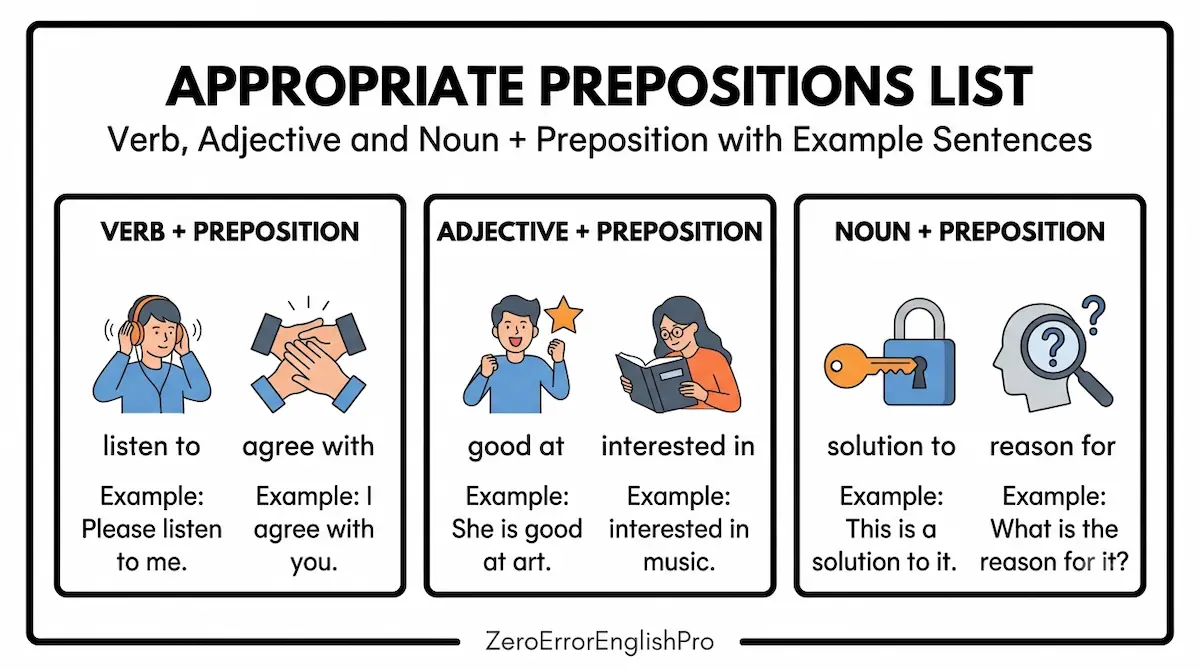
Ask a Class 12 student to complete "She is good ___ maths" and almost everyone writes at. Now ask for "She is jealous ___ her friend's success" and the room goes quiet. Same type of word, same type of sentence, but one pair feels familiar and the other doesn't.
That's the whole story of appropriate prepositions. There's no hidden logic. Some words simply belong together, the way tea belongs with a cup. Examiners know that, and they test it in error spotting, fill in the blanks and sentence improvement year after year.
The good news is that you don't need to learn 500 pairs in random order. In 22 years of teaching, I've found that students remember them best when they're grouped by word type (verbs, adjectives and nouns) and then by the preposition itself. That's exactly how this list is built. Each pair has an example sentence, because a pair on its own is easy to forget and a sentence is not.
In This Guide
- What are appropriate prepositions?
- Verb + preposition list with examples
- Adjective + preposition list with examples
- Noun + preposition list with examples
- Words that change meaning with the preposition
- Using these pairs in your own writing
- 5 ways to memorise appropriate prepositions
- Three exam traps to watch for
- A 7-day plan to learn the whole list
- Quick quiz: 12 fill-in-the-blanks
- Frequently asked questions
- Make these pairs yours
What are appropriate prepositions?
An appropriate preposition (also called a dependent preposition) is the preposition that must follow a certain word to make the phrase correct. We say "depend on", never "depend from". We say "afraid of", never "afraid from". The word before the preposition decides which one is right.
The three most common patterns are:
- Verb + preposition: listen to, believe in, wait for
- Adjective + preposition: proud of, interested in, responsible for
- Noun + preposition: reason for, solution to, increase in
If you're still unsure about the small time and place words, my guides on in, on and at and on preposition error spotting are good companions to this one.
Verb + preposition list with examples
Verbs cause the most trouble, so let's start here. The table is sorted by preposition so you can revise one family at a time.
| Pair | Example |
|---|---|
| of: accuse of | He was accused of cheating. |
| of: approve of | My parents approve of my plan. |
| of: consist of | The team consists of eleven players. |
| of: remind of | This song reminds me of my school days. |
| of: think of / dream of | She dreams of becoming an officer. |
| to: belong to | This bag belongs to Riya. |
| to: listen to | Please listen to the instructions. |
| to: refer to | The speaker referred to a recent survey. |
| to: adhere to / object to | Candidates must adhere to the rules. |
| to: look forward to | We look forward to meeting you. |
| to: contribute to / lead to | Hard work leads to success. |
| with: comply with / deal with / cope with | How do you deal with exam stress? |
| with: interfere with | Noise interferes with my concentration. |
| with: provide (someone) with | The school provides students with books. |
| with: charge (someone) with | The police charged him with theft. |
| from: suffer from | She suffers from back pain. |
| from: prevent / prohibit from | Rain prevented us from playing. |
| from: protect from / escape from | Wear a cap to protect yourself from the sun. |
| from: recover from / benefit from | He has recovered from his illness. |
| on: depend on / rely on | You can rely on me. |
| on: insist on | He insisted on paying the bill. |
| on: focus on / concentrate on | Focus on your weak areas. |
| on: congratulate on / comment on | We congratulated her on her promotion. |
| in: believe in | I believe in hard work. |
| in: succeed in / persist in | She succeeded in clearing the exam. |
| in: participate in / specialise in | Many students participated in the debate. |
| for: wait for / look for | We are waiting for the results. |
| for: apply for / ask for | He applied for a bank job. |
| for: blame for / thank for | Don't blame others for your mistakes. |
| at: laugh at / smile at | Don't laugh at anyone's mistakes. |
| at: aim at / glance at | He aimed at the target. |
Adjective + preposition list with examples
Adjectives are a bit kinder. Many of them follow the same prepositions again and again, so patterns appear quickly.
| Pair | Example |
|---|---|
| of: afraid of / fond of | She is afraid of heights but fond of travelling. |
| of: proud of / ashamed of | We are proud of our team. |
| of: aware of / conscious of | Are you aware of the deadline? |
| of: capable of / guilty of | He is capable of solving it. |
| of: jealous of / tired of | I'm tired of waiting. |
| of: full of | The hall was full of students. |
| to: married to | She is married to an engineer. |
| to: senior to / junior to | He is junior to me in service. |
| to: superior to / inferior to | This brand is superior to that one. |
| to: similar to / loyal to | Your idea is similar to mine. |
| with: satisfied with / pleased with | The manager was pleased with our work. |
| with: familiar with | Are you familiar with this topic? |
| with: angry with (person) | She was angry with her brother. |
| at: good at / bad at | He is good at mental maths. |
| at: surprised at / shocked at | We were shocked at the news. |
| in: interested in / weak in | I'm interested in journalism. |
| in: rich in / deficient in | Spinach is rich in iron. |
| from: free from / safe from | The area is free from pollution. |
| from: different from / absent from | Two students were absent from class. |
| on: keen on / dependent on | She is keen on learning French. |
| for: famous for | Pune is famous for its educational institutions. |
| for: responsible for | He is responsible for the final report. |
| for: ready for / late for | Are you ready for the interview? |
| for: suitable for / necessary for | This book is suitable for beginners. |
Noun + preposition list with examples
Nouns are the most ignored group, and that's why they surprise students in sentence improvement questions. Spend extra time here.
| Pair | Example |
|---|---|
| reason for | What is the reason for the delay? |
| cause of | Carelessness is the main cause of errors. |
| need for / demand for | There is a growing demand for skilled workers. |
| respect for / love for | He has great respect for his teachers. |
| solution to | We need a solution to this problem. |
| answer to / reply to | She knew the answer to every question. |
| key to | Practice is the key to success. |
| invitation to / reaction to | What was your reaction to the news? |
| increase in / decrease in | There was a sharp increase in prices. |
| interest in | He shows a keen interest in sports. |
| belief in / faith in | Have faith in your preparation. |
| confidence in | I have full confidence in her ability. |
| difficulty in | She had difficulty in finding the address. |
| advantage of | Take advantage of every chance to practise. |
| difference between | What is the difference between these two words? |
| possibility of / chance of | There's a chance of rain tonight. |
Words that change meaning with the preposition
This is where examiners get creative. The same word takes different prepositions, and the meaning shifts.
| Word | What changes |
|---|---|
| look at / look for / look after / look into | look at = see; look for = search; look after = take care of; look into = investigate |
| agree with / agree to / agree on | agree with a person or opinion; agree to a plan or request; agree on a matter that people decide together |
| angry with / angry at | angry with a person; angry at a thing or situation |
| arrive at / arrive in | arrive at a station, airport or small place; arrive in a city or country |
| result in / result from | The rain resulted in a delay (effect). The delay resulted from the rain (cause). |
| compare with / compare to | compare with = examine differences in detail; compare to = point out a likeness |
Don't try to memorise every row at once. Pick two rows a day, write one sentence for each version, and say them aloud.
Using these pairs in your own writing
Fixed prepositions don't only help in objective questions. They show up in letters, essays and emails, where a wrong pair quietly lowers the impression your writing makes. A formal letter that says "I am interested to this post" or "I am looking forward for your reply" looks careless, even if everything else is neat.
Here's a simple habit. After you finish writing, scan only for prepositions. Circle each one, look at the word before it, and ask: is this a pair I know? It takes less than a minute, and it catches the errors your eyes skip while reading for meaning. Correct versions of the two examples above are "I am interested in this post" and "I am looking forward to your reply".
5 ways to memorise appropriate prepositions
- Learn by family. One day for the "of" family, one day for "to", one for "with" and "from", and so on. Your brain remembers patterns better than loose items.
- Group by meaning. Communication verbs often take "to" (reply to, listen to, refer to). Verbs of blame and thanks take "for". Verbs of belief and success take "in".
- Always learn the pair with a sentence. "Fond of" is forgettable. "She is fond of classical music" sticks.
- Five pairs a day, not fifty. Revise yesterday's five before you add today's. In three weeks you'll have covered the whole list in this article.
- Read and mark. Take one newspaper editorial and underline every verb, adjective or noun followed by a preposition. You'll be surprised how often you've already met these pairs.
Three exam traps to watch for
- "Than" instead of "to". Senior, junior, superior, inferior and prefer all take "to". Example: "I prefer tea to coffee."
- An extra preposition. Discuss, comprise, mention and reach take no preposition at all. "We discussed the plan" is right, and "discussed about" is wrong.
- The look-alike pair. Thank for, congratulate on. Blame for, accuse of. Suffer from, die of. Slow down and check the pair before you decide.
For a full set of these mistakes, with corrections and a test, read my guide on 15 common preposition mistakes in SSC CGL and bank exams.
A 7-day plan to learn the whole list
Lists are only useful if you finish them. Here's a plan I give my batches, with about fifteen minutes a day.
| Day | What to learn | What to do |
|---|---|---|
| 1 | Verbs with "of" and "to" | Write one new sentence for each pair |
| 2 | Verbs with "with" and "from" | Revise Day 1, then repeat the same routine |
| 3 | Verbs with "on" and "in" | Cover the right column and test yourself |
| 4 | Verbs with "for" and "at" | Say five sentences aloud without looking |
| 5 | Adjective pairs | Make cards with a gap sentence on the back |
| 6 | Noun pairs and the meaning-change table | Write a short paragraph using eight pairs |
| 7 | Revision day | Take the 12-question quiz and fix your weak families |
If you slip on a day, don't restart. Just carry on from where you stopped. Consistency matters more than perfect streaks.
Quick quiz: 12 fill-in-the-blanks
Fill in each blank with the correct preposition. Don't peek at the answers until you've tried all twelve.
- She is proud ____ her daughter.
- He has been suffering ____ fever for two days.
- The teacher congratulated him ____ his success.
- This house belongs ____ my uncle.
- We are looking forward ____ the holidays.
- She is fond ____ classical music.
- The doctor prevented him ____ going out.
- Are you satisfied ____ your results?
- He is responsible ____ the whole project.
- The government is trying to find a solution ____ this problem.
- He apologised ____ his mistake to the teacher.
- The new rule resulted ____ a lot of confusion.
Your score: 11 or 12 means you're in great shape. 8 to 10 means revise the families where you slipped. Below 8, go back to the verb table and try again after two days.
Frequently asked questions
Is there a rule to find the right preposition?
Not a single rule. Most pairs come from usage, so you learn them as pairs. But patterns help: communication verbs lean towards "to", and verbs of blame and thanks take "for".
Is it "depend on" or "depend upon"?
Both are correct. "Upon" is a little more formal. In an exam, if both appear in different options, check the rest of the sentence for the real error.
How many appropriate prepositions should I learn each day?
Five is a good number. Revise the previous day's five first, then add the new ones. This keeps your revision light and your memory strong.
Do appropriate prepositions change between British and American English?
A few do, like "different from" and "different than", but the standard pairs in exam syllabi follow the traditional forms. When in doubt, choose the classic pair.
Which list should I learn first?
Start with verbs, because they appear most often in error-spotting and fill-in-the-blank questions. Then move to adjectives, and finally nouns.
Make these pairs yours
You've now got more than 80 pairs, each with an example. That's a serious toolkit, but only if you use it. Choose one family today, write a sentence for each pair, and say them aloud. Tomorrow, move to the next family. Three weeks from now, these pairs will feel as natural as your own phone number.
For the complete system, with more pairs, confusing combinations and exam-style practice, my ebook Preposition in English Grammar: Your Confident Path to Exam Mastery for 12th Graders & Competitive Aspirants keeps everything in one place.
Preposition in English Grammar: Your Confident Path to Exam Mastery for 12th Graders & Competitive Aspirants
Replace memorized guesswork with a reliable, pattern-based approach to choosing the correct preposition every time.