In, On, At Prepositions of Time and Place: Rules, Examples and Exam Tricks
Learn the rules of in, on and at for time and place with simple examples, exam tricks, common mistakes and a 15-question practice set with answers.
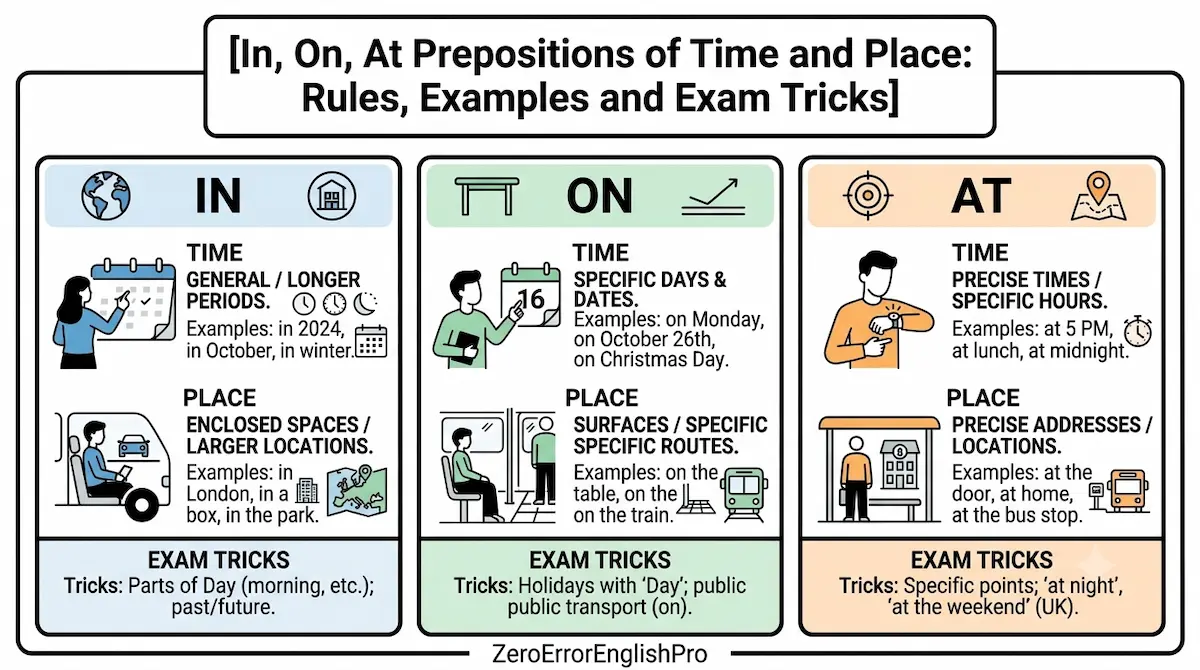
Let me start with a sentence you might have written in a test: "My brother was born in 5 May."
Looks fine, doesn't it? It isn't. That one tiny word, in, is enough to cost you a mark in error spotting, fill in the blanks or sentence improvement.
In, on and at are three of the smallest words in English. They're also three of the most tested. Why do so many of us slip? Because in our own languages, one small marker often does the job of all three. English wants us to choose, and when we're not sure, we guess. Guessing is expensive in an exam.
I've taught English grammar for 22 years and coached competitive exam students for more than 15. This is the topic where I see students lose marks they should already be earning. The good news is that the rules fit on one page and the exceptions fit on half a page. In this guide you'll get both, plus tricks for the exam hall, the mistakes examiners love to set, and a 15-question practice set with answers.
| Preposition | For time | For place |
|---|---|---|
| AT | exact points: at 6 pm, at noon, at night | specific points: at the bus stop, at the door, at home |
| ON | days and dates: on Monday, on 15 August | surfaces: on the table, on the wall, on the first floor |
| IN | longer periods: in March, in 2026, in summer | enclosed or large spaces: in the room, in Pune, in India |
In This Guide
- What are prepositions of time and place?
- Prepositions of time: at, on, in
- Prepositions of place: at, on, in
- The one mental picture that makes it easy
- The exceptions you must learn by heart
- 6 exam tricks for in, on and at
- Common mistakes: the exam pattern
- When time and place appear in the same sentence
- Practice set: 15 questions
- Frequently asked questions
- Stop Losing Marks on Small Words
What are prepositions of time and place?
A preposition is a small linking word that connects a noun or pronoun to the rest of the sentence. When it tells us when something happens, it's a preposition of time. When it tells us where, it's a preposition of place.
Look at this sentence: "The class starts at 9 am on Monday in the main hall." Three prepositions, three jobs. At 9 am gives the exact time, on Monday gives the day, and in the main hall gives the place. If you can say why each word is right, you've already understood half of this topic.
Prepositions of time: at, on, in
For time, think of a zoom lens. The smaller the time, the more likely you need at. The bigger the time, the more likely you need in. Days and dates sit in the middle with on.
1. Use AT for exact times and points
- The train leaves at 6:45 pm.
- We eat lunch at noon.
- He studies at night.
- She called me at midnight.
- I can't talk at the moment.
- He started working at the age of eighteen.
- Let's decide at the end of the day.
2. Use ON for days and dates
- My exam is on Monday.
- She was born on 12 March.
- We hoist the flag on Independence Day.
- They are coming on my birthday.
- I'll see you on Friday evening.
- The result came on a rainy afternoon.
Notice the last two. When you name a day and then add a part of the day, the day wins. So it's "on Friday evening", not "in Friday evening". The same goes for "on a rainy afternoon", because that afternoon belongs to one particular day.
3. Use IN for months, years, seasons and longer periods
- The session begins in July.
- He joined the company in 2019.
- It rains heavily in the monsoon.
- Many inventions happened in the twentieth century.
- I go for a walk in the morning.
- She will call you back in an hour.
That last example needs a small note. "In an hour" means after an hour from now. If you mean "before an hour is over", use within. Examiners don't test this too often, but you'll use it in real writing.
Prepositions of place: at, on, in
For place, use a simple picture: AT is a point, ON is a surface, IN is a space with boundaries.
1. Use AT for a specific point or location
- I'm waiting at the bus stop.
- Someone is standing at the door.
- She is at home.
- He is at work till six.
- We met at the airport.
- The students are at school.
- They live at 25 Park Street.
- He sits at the back of the class.
With "school", "college" and "work", at tells us the activity or the place as a point on the map. "He is at school" means he's attending it, not that he's inside a particular room.
2. Use ON for surfaces and lines
- The keys are on the table.
- There is a map on the wall.
- Don't leave your bag on the floor.
- Their flat is on the third floor.
- Turn left. The pharmacy is on your right.
- I met her on the bus.
- The match is on TV tonight.
- Your answer is on page 42.
- He is on the phone.
3. Use IN for enclosed spaces, cities, states and countries
- My mother is in the kitchen.
- The pencils are in the box.
- We live in Pune.
- Pune is in Maharashtra.
- Maharashtra is in India.
- Birds are flying in the sky.
- I read it in the newspaper.
- She is standing in the queue.
- He came in a taxi.
The one mental picture that makes it easy
If you only remember one thing from this post, remember this:
| Idea | Time | Place |
|---|---|---|
| Tiny and exact | AT (clock time) | AT (point) |
| Flat and specific | ON (day, date) | ON (surface) |
| Wide and inside | IN (month, year, season) | IN (room, city, country) |
Before you pick a preposition, ask yourself one question: "Is the thing after the blank a point, a surface or a space?" For time, ask: "Is it a clock time, a day, or a long period?" That single pause takes two seconds and saves you from most mistakes.
The exceptions you must learn by heart
Every rule has a few naughty students. These are the ones examiners like.
| Expression | Why it surprises us |
|---|---|
| at night, but in the morning / afternoon / evening | Night is the odd one out. Learn it as a fixed phrase. |
| on Monday morning | When a day is named, the whole phrase takes ON. |
| on time / in time | On time = at the planned time. In time = early enough to do something. "We reached the station in time to catch the train." |
| at the end / in the end | At the end of the film = at that point. In the end = finally. |
| at the corner / in the corner | At the corner of the street (outside). In the corner of the room (inside). |
| on the bus, train, plane / in a car, taxi | You can stand or walk inside big vehicles, so we use ON. Small vehicles take IN. |
| at the weekend / on the weekend | Both are used. British English prefers "at", American English prefers "on". Don't panic if you see either one. |
| in hospital / at home | These are fixed expressions. No article with "home", and "in hospital" is common in British English. |
Also remember that we don't use a preposition before this, last, next, every, today, tomorrow and yesterday in time expressions. We say "I'll see you next Monday", not "on next Monday". That is a classic trap.
6 exam tricks for in, on and at
Rules are good. Speed is better. Here's how I teach my students to solve these questions without panic.
- Classify the noun first. Look at the word after the blank. Clock time goes with AT. A day or a date goes with ON. A month, year, season or century goes with IN. This one habit solves nearly half the questions.
- Spot the "day + part of day" combination. If you see Sunday morning, Friday night or Monday afternoon, the answer is ON. Students often jump to IN because they spot "morning" first.
- Picture the place. Is it a dot on a map (AT), a flat surface (ON) or a container you can be inside (IN)? Draw it quickly in your head.
- Hunt for fixed phrases. At night, at noon, in time, on time, on foot, in a hurry, at home. If one of these fits, don't overthink it.
- Watch for words that kill the preposition. If the sentence has next, last, this, every, today, tomorrow or yesterday, there should be no in/on/at before it.
- Use elimination in MCQs. If an option says "in 5 May", cross it out at once. Dates take ON. You often only need to remove two wrong options to be safe.
Common mistakes: the exam pattern
I'm not quoting any particular year's paper here. These are the common exam patterns that appear in error spotting, sentence improvement and fill in the blanks across SSC, banking and school-level tests. Learn the pattern, and you'll recognise a new question at once.
| Wrong | Right | Why |
|---|---|---|
| She was born in 12 March. | She was born on 12 March. | Dates take ON. |
| The meeting is at Wednesday. | The meeting is on Wednesday. | Days take ON. |
| We reached the station in 5 pm. | We reached the station at 5 pm. | Clock time takes AT. |
| I'll see you on next Monday. | I'll see you next Monday. | No preposition before "next". |
| He studies in night. | He studies at night. | "At night" is a fixed phrase. |
| There is a poster in the wall. | There is a poster on the wall. | Surface takes ON. |
| My uncle lives on Nagpur. | My uncle lives in Nagpur. | Cities take IN. |
| She met him in the Sunday morning. | She met him on Sunday morning. | Day + part of day takes ON. |
When you see an error-spotting sentence, read the preposition and the noun together as a pair. If the pair sounds odd ("in 12 March", "at Wednesday"), your ear has already found the error. Train your ear by reading a short English paragraph aloud every day. It sounds old-fashioned, but it works.
When time and place appear in the same sentence
Real sentences rarely use just one of these. In writing tasks, letters and speaking, you'll often need time and place together. Here's the order that sounds natural: place first, then time.
- We'll meet at the station at 6 pm.
- The seminar is in the main hall on Saturday.
- She was born in Nagpur on 3 June in 2003.
- The workshop will be held at our college in September.
Look at the third example. It has three prepositions, and each one follows its own rule: city takes IN, date takes ON, year takes IN. Students who panic see a messy sentence. Students who break it into pieces see three easy decisions.
A quick habit for letters and emails: when you write an invitation or a notice, check three things in order. Where? Which day or date? What time? Choose the preposition for each piece separately, and the sentence will almost always come out correct.
Practice set: 15 questions
Fill in each blank with in, on or at. Try it first without looking at the answers, then check yourself. Be honest. Nobody is watching, and that's exactly why it helps.
- The train leaves ____ 6:45 pm.
- My exam is ____ 12 December.
- She was born ____ 2004.
- We usually go for a walk ____ the evening.
- I will meet you ____ Sunday morning.
- He is waiting ____ the bus stop.
- The keys are ____ the table.
- My mother is ____ the kitchen.
- Many students study ____ night.
- The meeting will start ____ an hour.
- There is a map ____ the wall.
- They live ____ Nagpur.
- The bus arrived ____ time, so nobody was late.
- He studied ____ the library all afternoon.
- She was ____ home when I called.
Your score: 13 to 15 means you're exam-ready on this topic. 9 to 12 means you know the rules but need to revise the exceptions. Below 9 means go back to the "mental picture" table and the flashcard habit, then try again after two days.
If you'd like more practice sets like this one, with mixed prepositions and exam-style questions, you'll find them in my Preposition ebook on Amazon.
Frequently asked questions
Is it "in the morning" or "at the morning"?
It's "in the morning". The same applies to "in the afternoon" and "in the evening". The odd one is "at night". But if you name the day, use ON: "on Monday morning".
Do we say "on weekends" or "at weekends"?
Both are correct. British English usually says "at the weekend" or "at weekends". American English usually says "on the weekend" or "on weekends". In an exam, you'll rarely have to choose between the two, because only one of them will appear in the options.
What is the difference between "in time" and "on time"?
"On time" means punctual, exactly at the planned time. "In time" means early enough to do something. "The train arrived on time" is about punctuality. "We got there in time to see the start" is about being early enough.
Why do we say "on the bus" but "in a car"?
The traditional explanation is size. Buses, trains and planes are large, and you can stand or walk inside them, so we use ON. Cars and taxis are small, so we use IN. It's a convention, so just learn it as a pair.
Do I need a preposition before "next Monday" or "last year"?
No. Words like next, last, this, every, today, tomorrow and yesterday already tell us the time, so we skip the preposition. "On next Monday" is a very common mistake in Indian classrooms.
How can I remember in, on and at permanently?
Use the point-surface-space picture for place and the small-medium-big idea for time. Then practise with a short daily quiz. Ten questions a day for a week usually fixes the habit. Reading English newspapers aloud also helps your ear catch what looks wrong.
Stop Losing Marks on Small Words
In, on and at are only the beginning. Appropriate prepositions, error spotting, fill in the blanks and confusing pairs like between and among all follow their own patterns, and each one gets easier when you learn it step by step.
My ebook Preposition in English Grammar: Your Confident Path to Exam Mastery for 12th Graders & Competitive Aspirants brings the rules, examples and exam-style practice together so you can revise in one place.
Preposition in English Grammar: Your Confident Path to Exam Mastery for 12th Graders & Competitive Aspirants
Replace memorized guesswork with a reliable, pattern-based approach to choosing the correct preposition every time.