Preposition Error Spotting: 15 Common Mistakes in SSC CGL and Bank Exams
Learn 15 common preposition mistakes in SSC CGL and bank exam error spotting, with corrections, a 5-step checking method and a 10-question test with answers.
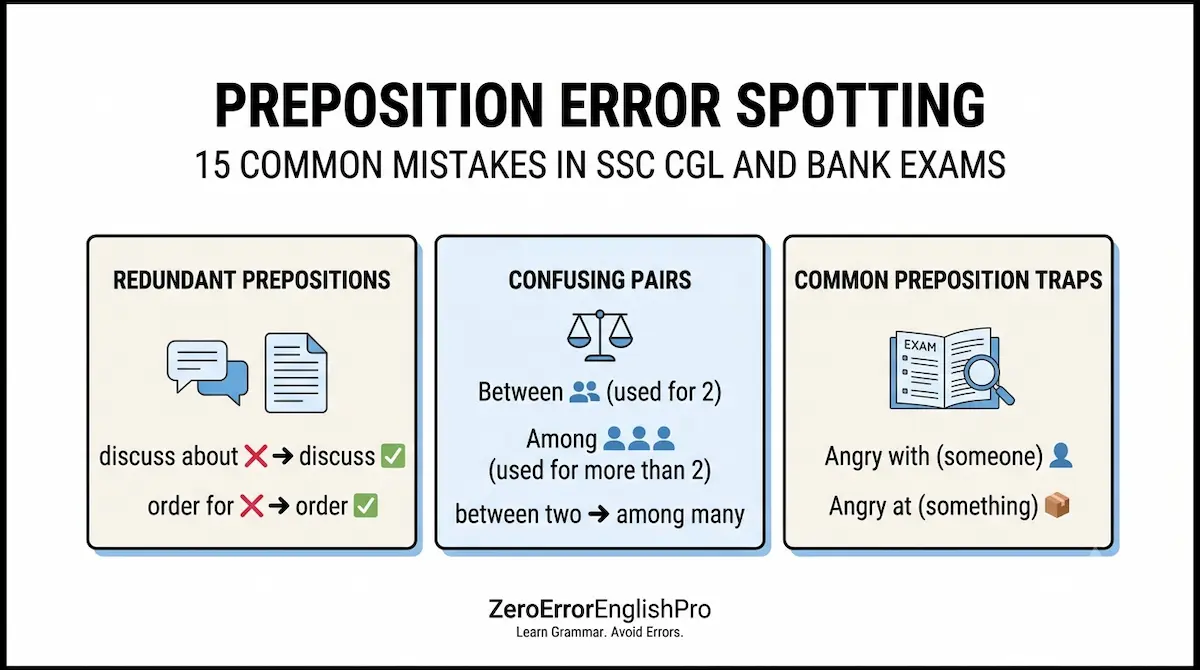
Open any SSC CGL or bank exam English paper and you'll spot the same quiet pattern. A sentence is split into three or four parts. Most of them look fine. The mistake hides in one tiny word, and that word is very often a preposition.
Why? Because prepositions can't be worked out by logic alone. Nobody can explain why we say "married to" and not "married with". We simply do. Examiners know this. They also know that students who think in Marathi, Hindi or another language are the most likely to pick the wrong word and feel sure about it.
I've coached exam students for more than 15 years, and the 15 mistakes below walk into my classroom again and again. Learn them as pairs and read each example aloud twice. By the end you'll also have a five-step checking method, a revision table of fixed pairs and a ten-question test with answers.
One honest note: these are common exam patterns, not questions copied from a particular year's paper. Don't memorise the sentences. Memorise the pairs.
| No. | Wrong | Right |
|---|---|---|
| 1 | discuss about | discuss |
| 2 | senior than | senior to |
| 3 | prefer A than B | prefer A to B |
| 4 | married with | married to |
| 5 | comprise of | comprise / consist of |
| 6 | reply the letter | reply to the letter |
| 7 | explain me | explain to me |
| 8 | angry on | angry with / at |
| 9 | different than | different from |
| 10 | cope up with | cope with |
| 11 | despite of | despite / in spite of |
| 12 | congratulate for | congratulate on |
| 13 | suffer with | suffer from |
| 14 | insist for | insist on |
| 15 | accused for | accused of |
In This Guide
- How examiners hide preposition errors
- Group 1: The extra word (mistakes 1, 5, 10, 11)
- Group 2: The "to" family (mistakes 2, 3, 4, 6, 7)
- Group 3: The wrong swap (mistakes 8, 9, 12, 13, 14, 15)
- Why smart students still miss these
- The 5-step preposition check (20 seconds)
- Fixed pairs for quick revision
- Build a mistake notebook (it takes five minutes a day)
- Mini test: 10 error-spotting questions
- Frequently asked questions
- Turn these 15 into a lifelong habit
How examiners hide preposition errors
In a typical error-spotting question, the sentence is cut into parts marked (A), (B), (C) and (D), where (D) usually says "No error". Preposition mistakes come in three shapes, and knowing the shape tells you where to look:
- The extra word. The verb doesn't need a preposition, but the sentence adds one (discuss about).
- The "to" family. A special word needs to, but the sentence uses than, with or nothing at all (senior than).
- The wrong swap. The word needs a fixed preposition, and the sentence uses a close cousin (angry on, suffer with).
That's why I tell my students to read the prepositions first, before the whole sentence. If time and place words like in, on and at are still shaky, spend ten minutes on my guide to in, on and at prepositions first, then come back here.
Group 1: The extra word (mistakes 1, 5, 10, 11)
These verbs and words are complete on their own. Adding a preposition is like putting a second hat on someone who's already wearing one.
1. Discuss about
The panel discussed about the new policy.
The panel discussed the new policy.
"Discuss" already means "talk about", so "about" says the same thing twice. Watch for the same trap with mention, attend, reach and enter: we say "reached the station" and "entered the room", never "reached to" or "entered into the room". The noun is different, though: "a discussion about the policy" is fine.
5. Comprise of
The committee comprises of seven members.
The committee comprises seven members.
"Comprise" takes its object directly, just like "discuss". If you want the word "of", switch to "consists of" or "is composed of". In an exam, if you see "comprises of", mark it.
10. Cope up with
She couldn't cope up with the pressure.
She couldn't cope with the pressure.
"Cope" pairs with "with" and nothing else. There's no "up" in it. The same family of extra words includes "return back", "repeat again" and "revert back". Whenever a small word adds nothing to the meaning, suspect it.
11. Despite of
Despite of the rain, the match continued.
Despite the rain, the match continued.
"Despite" and "in spite of" mean the same thing. You can use either, but you can't mix them into "despite of". A neat way to remember: "in spite of" has its own "of" already, and "despite" has none.
Group 2: The "to" family (mistakes 2, 3, 4, 6, 7)
This is the group that catches the most students, because "than", "with" and "for" feel natural and "to" feels odd.
2. Senior than
He is senior than me in the office.
He is senior to me in the office.
Words like senior, junior, superior, inferior, prior and preferable come from Latin and take "to", not "than". "Than" is for ordinary comparatives like taller or older. Say it aloud: "This plan is preferable to that one."
3. Prefer A than B
I prefer coffee than tea.
I prefer coffee to tea.
"Prefer" always uses "to". Even with -ing words: "She prefers walking to driving." The phrase "would rather" is different. It takes "than": "I would rather walk than drive." Examiners love to test this contrast.
4. Married with
She is married with a lawyer.
She is married to a lawyer.
"Married to" and "engaged to" are the correct pairs. And if you use the verb "marry", you need no preposition at all: "She married a lawyer." "Married with" is only correct in a different sense: "married with two children" (meaning she has children).
6. Reply the letter
He replied the letter at once.
He replied to the letter at once.
"Reply" needs "to". Its cousin "answer" doesn't: "He answered the letter at once." Same meaning, different pattern, so examiners enjoy placing one inside the other's sentence. Also remember "respond to".
7. Explain me
Please explain me this rule.
Please explain this rule to me.
The thing you explain comes first. The person comes after "to". The same pattern works for describe, suggest and announce. "He suggested me a book" is wrong. Say "He suggested a book to me."
Group 3: The wrong swap (mistakes 8, 9, 12, 13, 14, 15)
Here the word needs a preposition, but we pick a cousin. Learn each pair as one unit, like a phone number.
8. Angry on
She was angry on her brother.
She was angry with her brother.
Use "angry with" for a person and "angry at" or "angry about" for a thing or situation: "He was angry at the delay."
9. Different than
His answer is different than mine.
His answer is different from mine.
"Different from" is the traditional form, and it's the one exam answer keys follow. You may see "different than" in American writing, but in an SSC or bank paper, "from" is the safe choice. The verb works the same way: "differ from".
12. Congratulate for
I congratulate you for your success.
I congratulate you on your success.
You congratulate someone on something, but you thank someone for something. Both sentences look alike, which is exactly why examiners put them side by side.
13. Suffer with
He is suffering with a high fever.
He is suffering from a high fever.
"Suffer from" is the fixed pair for illness, hardship or a problem. Say it as one phrase: suffer from, suffer from, suffer from.
14. Insist for
She insisted for a refund.
She insisted on a refund.
"Insist" takes "on". Its family: depend on, rely on, focus on, congratulate on. With a clause, no preposition is needed: "She insisted that he should pay."
15. Accused for
He was accused for theft.
He was accused of theft.
The "of" family for crime and charge words: accused of, suspected of, convicted of, guilty of. Watch the exceptions. "Charged with" takes "with", and "blamed for" takes "for".
Why smart students still miss these
Here's something I notice in every batch. The students who miss these questions are rarely the weak ones. They're often the fluent ones, the students who speak well and read a lot. Why? Because fluent speakers trust their ear, and an ear trained on casual English or on a mix of languages will happily accept "discuss about" or "prefer than". These phrases are everywhere in daily conversation, in office emails and even in some newspaper headlines.
The exam doesn't care how often you've heard a phrase. It cares whether the phrase follows the standard rule. So the fix isn't to read more. The fix is to switch from "does this sound right?" to "does this pair match the rule?" That small change in question is what separates a 70 percent score from a 90 percent one in this section.
Also, don't panic about speed. A preposition check takes a few seconds once the pairs are in your head, and every question you secure here gives you more time for harder parts of the paper such as reading comprehension.
The 5-step preposition check (20 seconds)
Knowing 15 mistakes is great. Having a method for the 16th is better. Here's the routine I teach.
- Underline every preposition first. Don't read the whole sentence yet.
- Find its partner. Which verb, adjective or noun comes just before it?
- Ask: does this word need a preposition at all? Discuss, comprise, despite, reach and enter don't.
- Recall the fixed pair. Does it match? Senior to, married to, angry with, suffer from?
- Hunt for extra words. Up, back, again and off next to a verb are suspects.
Only after these five steps should you select "No error". Treat "No error" as a conclusion, never as a default. Students who pick it because "nothing jumped out" lose marks they could have earned.
Fixed pairs for quick revision
Revise these in families. Five new pairs a day for a week is far better than one long weekend of cramming.
| Pair | Example |
|---|---|
| good at / weak in | She is good at maths but weak in history. |
| afraid of / proud of | He is proud of his team. |
| interested in / keen on | I'm interested in journalism. |
| capable of / aware of | She is aware of the risks. |
| belong to / object to | This book belongs to my sister. |
| depend on / rely on | You can rely on him. |
| wait for / look for | We are waiting for the bus. |
| apologise to (person) for (thing) | He apologised to her for the delay. |
| blame (person) for (thing) | Don't blame him for the mistake. |
| thank (person) for (thing) | I thanked her for her help. |
Build a mistake notebook (it takes five minutes a day)
Every time you get a preposition question wrong, in a mock test, in a practice set or in a conversation, write it in a small notebook in three columns: the wrong version, the right version and the pair in one line. Don't copy the whole explanation. Just the pair.
Once a week, cover the right column and test yourself. You'll find that you keep making the same four or five mistakes, and those are the ones worth your time. By the third week, the notebook usually becomes the most useful revision material you own, because it's built from your own errors and not from somebody else's list.
Mini test: 10 error-spotting questions
Each sentence has four parts. Find the part with the error, or choose (D) if there's none. Try it first, then check the answers.
- She was angry (A) / on her brother (B) / for breaking the vase. (C) / No error (D)
- The committee discussed about (A) / the budget (B) / for two hours. (C) / No error (D)
- He prefers walking (A) / than driving (B) / on short trips. (C) / No error (D)
- Despite of (A) / heavy traffic, (B) / we reached on time. (C) / No error (D)
- The manager congratulated (A) / the team on (B) / their excellent performance. (C) / No error (D)
- I could not reply (A) / his letter (B) / because I was travelling. (C) / No error (D)
- Please explain me (A) / the meaning of (B) / this phrase. (C) / No error (D)
- She is suffering (A) / with a severe headache (B) / and cannot attend class. (C) / No error (D)
- The two sisters are (A) / completely different than (B) / each other. (C) / No error (D)
- He insisted (A) / on paying the bill (B) / for everyone. (C) / No error (D)
Your score: 9 or 10 means you're exam-ready on this topic. 6 to 8 means revise the group where you slipped. Below 6, go back to the 5-step check and try again after two days.
Frequently asked questions
Why do preposition errors appear so often in error spotting?
Because the right preposition is usually a matter of fixed usage, not logic. That makes it hard to guess and easy to test. Examiners can build a convincing wrong sentence by changing just one word.
Should I memorise a long list of prepositions?
Learn them in families (to, with, from, of, on) and attach a short sentence to each pair. A sentence you can say aloud sticks far better than a bare list.
Is "different than" ever correct?
You'll see it in some American writing, especially before a clause. But exam answer keys follow the traditional "different from", so choose that in SSC and bank papers.
If I'm unsure, should I pick "No error"?
Not automatically. Run the 5-step check first. If a preposition fails the check, that part is your answer. If all five steps pass, then "No error" is a safe conclusion.
How long does it take to master these 15?
Most students I teach get comfortable in about a week with ten minutes a day: five pairs, two sentences each, plus one mini test on the weekend.
Turn these 15 into a lifelong habit
Fifteen mistakes won't cover every preposition question, but they cover the patterns behind most of them. Once you see the three shapes (the extra word, the "to" family and the wrong swap), new questions stop looking new.
If you want the complete system, my ebook Preposition in English Grammar: Your Confident Path to Exam Mastery for 12th Graders & Competitive Aspirants puts the rules, fixed pairs and exam-style practice together in one place.
Preposition in English Grammar: Your Confident Path to Exam Mastery for 12th Graders & Competitive Aspirants
Replace memorized guesswork with a reliable, pattern-based approach to choosing the correct preposition every time.