Zero Article: When English Needs No Article at All
Know when no article is needed. Learn zero article rules with examples: meals, languages, transport, places, abstract nouns and exam-style traps for SSC.
The Rule Everyone Forgets: Sometimes, No Article Is the Right Answer
Most article revision focuses on choosing between a, an and the. But a large share of exam mistakes come from a fourth option students forget exists: no article at all. Adding an unnecessary article is just as wrong as choosing the wrong one, and it's a mistake that sounds deceptively natural.
This guide covers when English drops the article entirely, why certain institutions and transport phrases behave differently depending on meaning, and the traps that catch students who assume every noun needs some article. By the end, you'll have a clear checklist for recognising when leaving the blank empty is the correct choice.
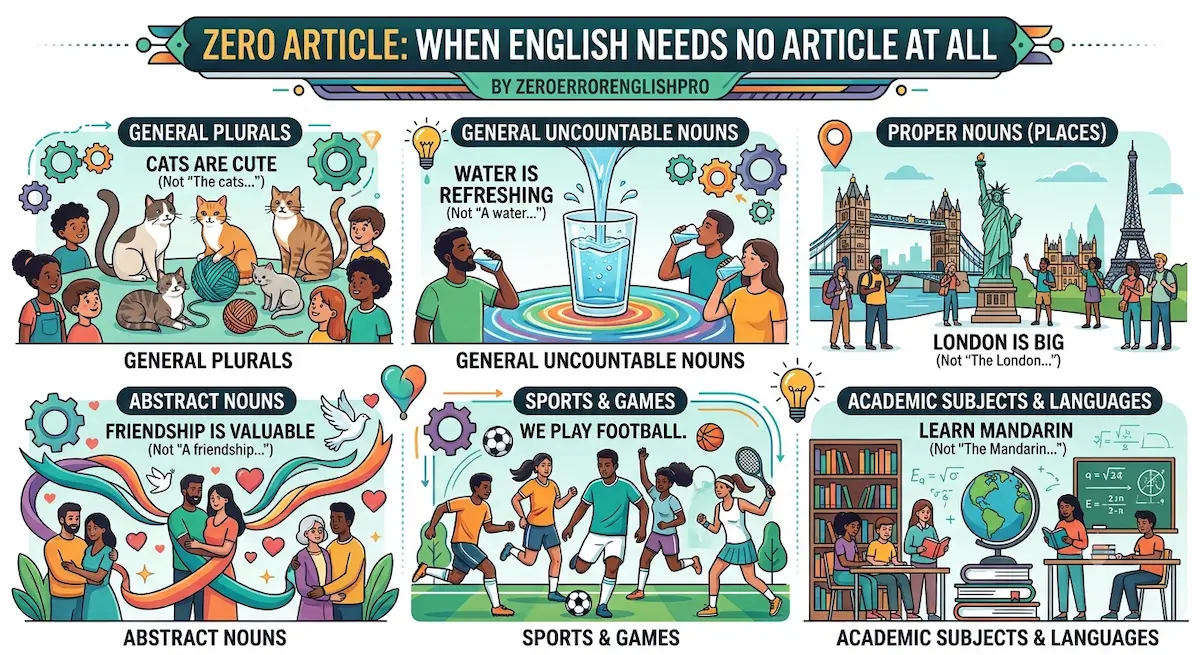
Quick answer: Use no article with plural and uncountable nouns in a general sense, with meals, languages and sports, with most proper nouns, and in fixed phrases like "by bus" or "go to school" as a student. The moment the noun becomes specific, an article returns.
In This Guide
- What "zero article" means
- Plural and uncountable nouns in general
- Meals, languages, subjects and sports
- Institutions: purpose vs building
- Transport and time expressions
- Names, titles and abstract nouns
- No double determiners
- Exam traps
- 10 SSC-style practice questions
- Quick revision
- Frequently asked questions
What "Zero Article" Means
It's worth being precise about terminology here, since "zero article" sometimes gets confused with simply forgetting to write an article. It isn't an omission or an error; it's an active, correct grammatical choice, exactly like choosing a, an, or the. Treating it as a genuine fourth option, rather than a default fallback, is what helps it stick in memory.
Zero article simply means a noun appears with no article at all, not a, not an, not the. This isn't an error or an omission; it's the grammatically correct choice in specific, well-defined situations. English uses zero article mainly when a noun is being discussed in a general sense rather than as one specific, identified thing.
The core test is the same one used throughout this series: is the sentence talking about the idea in general, or about one particular instance? Zero article applies to the general case, provided the noun is plural or uncountable, or falls into one of the fixed categories covered below.
Plural and Uncountable Nouns in a General Sense
When a plural or uncountable noun is used to make a general statement, it takes no article.
- "Books are a source of knowledge." (books in general, not specific ones)
- "Water is essential for life." (water as a concept, not a specific quantity)
- "Honesty is valued everywhere." (an abstract idea in general)
- "Students should practise daily." (students as a category, not one identified group)
The moment any of these becomes specific, the article returns: "The books on my desk are new." "The water in this bottle is warm." The noun hasn't changed; only its specificity has.
Meals, Languages, Subjects and Sports
Several everyday categories take no article by default, and these are worth memorising as fixed groups rather than deriving them from a general rule each time.
- Meals: have breakfast, eat lunch, skip dinner. Exception: a specific meal is described, "The dinner at the wedding was excellent."
- Languages: speak Hindi, learn French, study English. No article, even though a language is technically one specific thing.
- Academic subjects: study Mathematics, teach History, prefer Physics.
- Sports and games: play cricket, play chess, play football. Contrast this with musical instruments, which do take the, as covered in our guide to the rules of the definite article.
Institutions: Purpose vs Building
This is the single trickiest category in zero article rules, because the same word can take an article or not, depending entirely on meaning.
| Word | No article (purpose) | With article (building/place) |
|---|---|---|
| School | go to school (as a student) | go to the school (to visit, drop something off) |
| Hospital | admitted to hospital (as a patient) | go to the hospital (to visit someone) |
| Bed | go to bed (to sleep) | sit on the bed (referring to the furniture) |
| Prison | sent to prison (as a convict) | visited the prison (as a journalist or visitor) |
| Church | go to church (to worship) | visited the church (as a tourist) |
The pattern behind every row is the same: no article when the noun refers to the institution's core purpose, and the when it refers to the physical building or place as such.
Try it: "My brother is a doctor. He works at ___ hospital." versus "I visited ___ hospital to meet him."
The first describes his workplace in a general professional sense, so it takes no article. The second describes visiting a specific building, so it takes the.
Transport and Time Expressions
"By" plus a mode of transport takes no article: by bus, by train, by car, by air, by sea. This holds even though a specific bus or train is technically involved; the phrase describes the method of travel, not one identified vehicle.
Several fixed time expressions also take no article: at night, at noon, by day, at dawn, at dusk. Compare this with "during the night", which is specific to one particular night and does take the.
- "She travels to work by metro every day." (no article, method of travel)
- "The train she took was delayed by an hour." (the, one specific train)
- "Owls are active at night." (no article, general time)
- "He couldn't sleep during the night before his exam." (the, one specific night)
Names, Titles and Abstract Nouns
Most personal names, city names and country names take no article: Ramesh, Pune, India, Japan. A handful of country names are exceptions and do take the, usually because the name itself contains a plural or descriptive word: the United States, the Philippines, the United Kingdom, the Netherlands.
Titles used with a name also typically take no article: President Kalam, Doctor Sharma, Professor Rao. But the same title used without a name, referring to the role in general or a specific holder of it, may take the: "The President addressed the nation."
Abstract nouns discussed in general, honesty, courage, patience, freedom, take no article, as covered earlier in this guide and in our page on the rules of the definite article, which covers the reverse case when these same abstract nouns do take the.
A Note on Plural Family and Group Names
Plural family names, when referring to the whole family as a unit, sometimes take the: "The Sharmas are coming for dinner tonight" means the Sharma family as a group. This differs from a single name used generally, which takes no article: "Sharma works in the finance department." The plural form signals a group, which is why the definite article applies here even though most proper nouns don't take one.
No Double Determiners
Words like my, your, his, her, its, our, their, this, that, these and those already function as determiners, pointing to a specific noun on their own. English never places an article in front of them.
- Incorrectthe my book, a this pen, the his idea
- Correctmy book, this pen, his idea
This is one of the simplest rules in this series to apply correctly, yet it appears often in error spotting precisely because it's easy to overlook when the sentence is long.
A Closer Look: "Bed" and Other Small Nouns
Beyond the major institutions already covered, a handful of everyday nouns follow the same purpose-versus-object pattern on a smaller scale. "Go to bed" means to sleep, and takes no article. "Sit on the bed" refers to the furniture itself, and takes the. Similarly, "in prison" as a convict takes no article, while "in the prison" describing a location, such as a scene in a story, takes the. Recognising this pattern once makes it far easier to apply to new institution-like nouns you haven't specifically memorised.
Uncountable Nouns Revisited
A related, frequently tested case involves uncountable nouns discussed generally: advice, furniture, luggage, information, news. These take no article by default, just like plural nouns used generally.
- "Furniture is expensive these days." (general statement)
- "The furniture in this office is new." (specific, identified furniture)
Because these nouns have no plural form, students sometimes mistakenly add a or an instead of recognising that zero article is the correct general-use choice, a mistake also covered from the a/an side in our guide to a and an rules with examples.
Exam Traps
Trap 1: Adding an article to a meal in general use
IncorrectWe usually have the dinner at nine o'clock.
CorrectWe usually have dinner at nine o'clock.
Why: Meals in a general, everyday sense take no article.
Trap 2: Confusing institution purpose with the building
IncorrectHe goes to the school every day as a student.
CorrectHe goes to school every day as a student.
Why: "As a student" signals the purpose sense, which takes no article.
Trap 3: Adding an article before "by" plus transport
IncorrectShe prefers to travel by the train rather than by the bus.
CorrectShe prefers to travel by train rather than by bus.
Why: "By" plus a mode of transport is a fixed phrase that takes no article.
Trap 4: Stacking an article with a possessive
IncorrectHe forgot the his umbrella at the office.
CorrectHe forgot his umbrella at the office.
Why: "His" already functions as a determiner and cannot combine with an article.
Trap 5: Adding "the" before a language
IncorrectShe speaks the Marathi and the Hindi fluently.
CorrectShe speaks Marathi and Hindi fluently.
Why: Language names take no article in ordinary use.
Common Confusion: Zero Article vs "Some" or "Any"
Students sometimes wonder whether zero article means the sentence is missing a word. It doesn't. English is comfortable with an empty slot where other languages might insert a word like "some" or "any". "I need advice" is complete on its own; adding "some" ("I need some advice") is optional and changes emphasis slightly, but the version with zero article is equally correct and often preferred in formal or exam-style writing.
10 SSC-Style Practice Questions
Choose the correct option: (A) a, (B) an, (C) the, (D) no article. Give yourself six minutes.
- He goes to ___ school by ___ bicycle every morning.
- She was admitted to ___ hospital after the accident.
- ___ honesty is the foundation of trust in any relationship.
- He learned to speak ___ German during his stay abroad.
- We usually have ___ lunch together on Sundays.
- She lost ___ her purse while travelling by train.
- Children play ___ cricket in the park every evening.
- He prefers to travel by ___ air rather than by road.
- ___ Ramesh works in Pune as a software engineer.
- Owls are usually active at ___ night.
Show answers and explanations
- No article / no article. "Go to school" as a student, and "by bicycle" both take no article.
- No article. Admitted to hospital as a patient describes purpose, not the building.
- No article. A general abstract quality, not one specific instance.
- No article. Language names take no article.
- No article. Meals in general use take no article.
- No article. "Her" already functions as a determiner; no article can be added.
- No article. Sports and games take no article.
- No article. "By" plus a mode of transport takes no article.
- No article. Personal names take no article.
- No article. "At night" is a fixed general time expression.
Notice that every answer in this set is "no article", which is intentional; this set is designed to build confidence specifically in recognising when to leave the blank empty. For a mixed set covering all four rule groups together, see our page of articles questions for SSC CGL with exam pattern and practice.
A Quick Test You Can Apply
When you're unsure whether a noun needs zero article, ask: "Am I describing this as a general category or purpose, or as one specific, identified thing?" General and purpose point to zero article. Specific and identified point to an article, usually the. This is the same underlying question used throughout this series, just applied from the opposite direction, since zero article and the are, in a sense, two sides of the same specificity test.
Quick Revision
Use no article for:
- Plural and uncountable nouns used in a general sense.
- Meals, languages, academic subjects and sports.
- Institutions (school, hospital, bed, prison, church) referring to their core purpose.
- "By" plus a mode of transport, and fixed time phrases like "at night".
- Most personal names, city names and country names.
- Any noun already preceded by my, this, that, or a similar determiner.
Frequently Asked Questions
Q: When is no article used in English?
A: No article is used with plural and uncountable nouns in a general sense, with meals, languages, subjects and sports, with most proper nouns, and in fixed phrases such as "by train" and "at night".
Q: Why does "school" sometimes take "the" and sometimes not?
A: It depends on meaning. "Go to school" as a student, referring to the institution's purpose, takes no article. "Go to the school" to visit or collect something, referring to the physical building, takes the.
Q: Do all country names take no article?
A: Most do, such as India, Japan and Kenya. A small group of exceptions take the, usually because the name contains a plural or descriptive word, such as the United States, the Philippines and the United Kingdom.
Q: Can "my" or "this" ever be used together with an article?
A: No. Words like my, your, this and that already function as determiners on their own, so English never places an article directly before them.
Q: Why do languages take no article even though a specific language is meant?
A: This is a fixed convention rather than something derived from the specific-versus-general rule. Language names, along with meals, subjects and sports, are memorised as their own category that always takes no article in ordinary use.
Q: Is "furniture" singular or plural, and why does it take no article?
A: "Furniture" is an uncountable noun. It has no plural form and never takes a or an. When used in a general sense, it takes no article; when made specific ("the furniture in this room"), it takes the.
Q: Does "prison" always take no article?
A: No. "In prison" as a convict, describing the purpose, takes no article. "In the prison", referring to the physical location or building, takes the. The same purpose-versus-place pattern applies here as with school, hospital and bed.
Where to Go Next
Of all four rule groups in this series, zero article is the one most often skipped in casual revision, precisely because "doing nothing" doesn't feel like a rule worth studying. But knowing when to leave a blank empty is just as testable, and just as trap-prone, as knowing when to fill it. Zero article completes the four-part picture covered across this series. With a, an, the and zero article all in place, the next step is applying them under exam conditions. Test yourself with articles error spotting for SSC CGL, or revisit the complete articles guide for a full overview.
Articles For SSC CGL 2026 - Zero Errors
Eliminate one of the most frequently missed, easily fixable error categories from your Error Spotting score.