A vs An Rules with Examples: The Sound Trap in SSC CGL
Learn a and an rules with examples for SSC CGL. Master the vowel sound rule, tricky cases like hour and university, and avoid the most common exam errors.
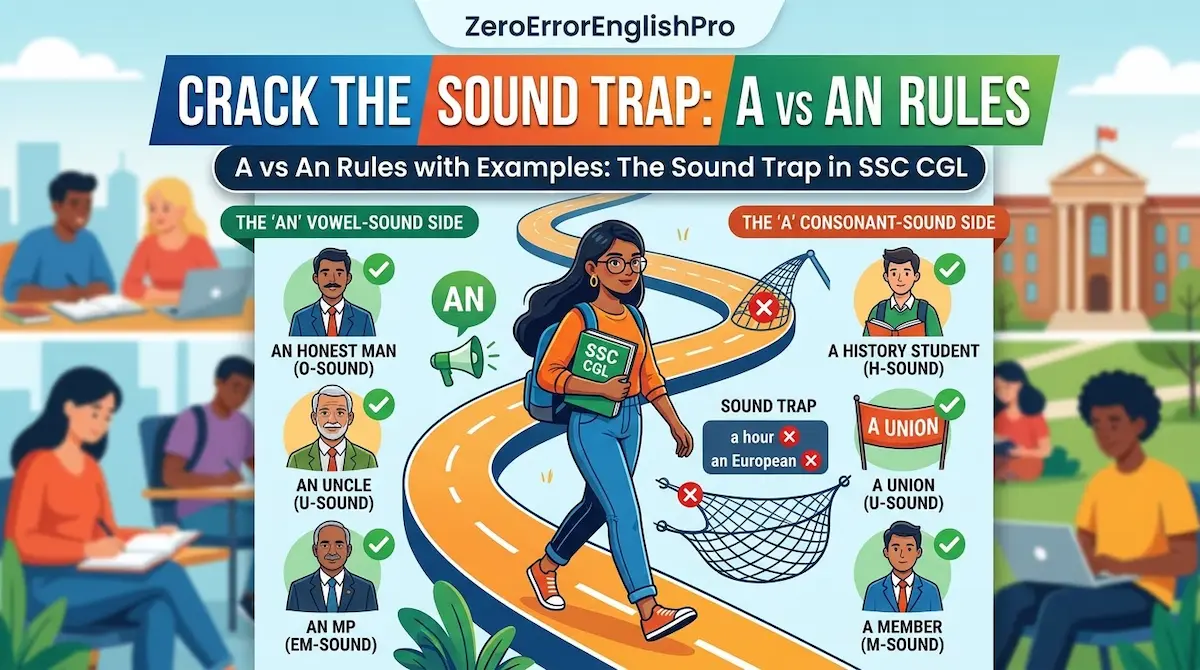
Two Letters, One Rule, and a Trap That Catches Everyone Once
"A" or "an" looks like the easiest choice in English grammar. Most students learn it in school as "a before a consonant, an before a vowel", and move on. Then a sentence like "an honest man" or "a university" shows up in an SSC paper, and the old rule falls apart.
The real rule isn't about letters at all. It's about sound. This guide walks through that one-line rule, the tricky cases where sound and spelling disagree, the other jobs "a" quietly does in English, and where indefinite articles can never appear. You'll also get ten practice questions with full explanations.
Quick answer: Use a before a consonant sound and an before a vowel sound. Always judge by how the next word is pronounced, never by its first letter.
In This Guide
- The one-line rule
- Vowel sound vs consonant sound
- Tricky cases that break the letter rule
- Other jobs "a" and "an" do
- Where a and an can never be used
- Exam traps
- 10 SSC-style practice questions
- Quick revision
- Frequently asked questions
The One-Line Rule
A and an are indefinite articles. They point to any one member of a group, not a specific one you already have in mind: "Give me a pen" could mean any pen in the room. Both words mean the same thing. The only difference between them is sound.
- Use a when the word right after it begins with a consonant sound: a book, a car, a plan.
- Use an when the word right after it begins with a vowel sound: an apple, an idea, an hour.
Notice that both rules say sound, not letter. That single distinction is where most exam mistakes come from, and it's the whole subject of this guide.
Vowel Sound vs Consonant Sound
English has five vowel letters, but far more vowel sounds, and some words that start with a vowel letter are actually pronounced starting with a consonant sound, and the reverse. This table lays out the pattern.
| Case | First letter | Actual sound | Article | Example |
|---|---|---|---|---|
| Ordinary vowel start | Vowel | Vowel sound | an | an apple, an idea |
| Ordinary consonant start | Consonant | Consonant sound | a | a table, a dog |
| Silent h | Consonant (h) | Vowel sound | an | an hour, an honest man |
| "Y" sound from u/eu | Vowel (u) | Consonant sound | a | a university, a European |
| "W" sound from o | Vowel (o) | Consonant sound | a | a one-rupee coin, a one-day match |
Tricky Cases That Break the Letter Rule
Silent "h"
In words like hour, honest, honour and heir, the h is not pronounced. The word effectively starts with a vowel sound, so it takes an: an hour, an honest officer, an heir to the property.
Compare this with words where the h is pronounced: a house, a hospital, a habit. Here the consonant sound is real, so a is correct.
The "yoo" sound from u and eu
Words like university, uniform, union, European and useful start with a vowel letter but are pronounced with a leading "y" sound, which is a consonant sound. So we say a university, a uniform, a European tour, a useful tip.
Contrast this with words like umbrella, uncle and umpire, where the u makes a true vowel sound: an umbrella, an uncle, an umpire.
The "w" sound from o
The word "one" and words built on it, such as one-day and one-sided, begin with a "w" sound: a one-day match, a one-rupee note. The letter is a vowel, but the sound is not.
Abbreviations and acronyms
For abbreviations, ignore the letters entirely and say the abbreviation aloud as it's spoken. "MBA" is spoken "em-bee-ay", starting with a vowel sound, so it's an MBA. "SSC" is spoken "es-es-see", also starting with a vowel sound, so it's an SSC exam. "UPSC" starts with "you", a consonant "y" sound, so it's a UPSC aspirant.
Memory tip: whisper the word to yourself before writing the article. If the whisper starts with a vowel sound, write an. If it starts with a consonant sound, write a. This single habit prevents almost every mistake in this section.
A Note on Numbers and Fractions
Numbers and fractions follow the same sound rule as any other word, which sometimes surprises students who expect a special case. "A hundred" and "a thousand" use a because "hundred" and "thousand" begin with consonant sounds. But "an eighth" and "an eleventh" use an, because "eighth" and "eleventh" begin with vowel sounds. There's no separate rule here, just the same sound test applied consistently.
Other Jobs "A" and "An" Quietly Do
Beyond "any one of a group", the indefinite article carries a few other common meanings in exam sentences. Recognising these helps with both fill in the blanks and reading comprehension.
- One: "I'll be back in a week" means in one week.
- Per, or each: "The bus runs twice a day" means twice per day.
- Any, in a general statement: "A triangle has three sides" describes any triangle, the whole class of triangles.
- With certain numbers: "a hundred", "a thousand", "a dozen" all use a even though the number that follows is large.
Where A and An Can Never Be Used
Indefinite articles only go with singular countable nouns. Three situations rule them out completely.
- Plural nouns: not "a books", but "books" or "some books".
- Uncountable nouns: not "an advice" or "a furniture", but "advice" and "furniture". If you need a countable form, use a phrase like "a piece of advice" or "an item of furniture".
- Proper nouns in general: not "a Ramesh", though there are rare exceptions when a name is used to mean "someone like": "He thinks he's a Sachin Tendulkar" is idiomatic, not the default rule.
Our companion guide on zero article rules covers exactly when plural and uncountable nouns take no article at all.
The Sound That Matters Is the Very Next Word
Here's a detail that trips up even strong students. The article agrees with the sound of the word that comes immediately after it, not with the noun itself. When an adjective sits between the article and the noun, the adjective's sound decides the choice.
- a book, but an old book (the adjective "old" starts with a vowel sound)
- an umbrella, but a black umbrella (the adjective "black" starts with a consonant sound)
- a plan, but an ambitious plan
- an hour, but a full hour (the adjective "full" starts with a consonant sound, even though "hour" alone would take "an")
This is exactly why the four-step method from our complete articles guide tells you to check the word right after the blank, not the main noun further along the sentence. SSC question setters know this rule well, and they often place an adjective right after the blank specifically to test it.
A Quick Note on "A Lot Of", "A Few" and "A Little"
These fixed phrases always use a, regardless of what follows, because "a" here is part of a set expression rather than a standalone article choosing by sound: a lot of students, a few chances, a little time. Don't apply the sound rule inside these phrases; simply memorise them as fixed units.
A Reference List of 20 Tricky Words
Keep this list handy while revising. These are the words that appear most often in SSC-level fill in the blanks and error spotting questions, precisely because their spelling and sound disagree.
| Takes "an" | Takes "a" |
|---|---|
| an hour | a university |
| an honest man | a uniform |
| an honour | a union |
| an heir | a European |
| an MBA | a UPSC aspirant |
| an SSC exam | a useful tip |
| an MLA | a unanimous decision |
| an umbrella | a one-day match |
| an umpire | a one-rupee coin |
| an uncle | a unique idea |
Notice the pattern: the left column is either a genuine vowel sound (umbrella, umpire, uncle) or a silent h (hour, honest, honour, heir), and an abbreviation spoken with a leading vowel sound (MBA, SSC, MLA). The right column is either a genuine consonant sound (university, uniform, union, useful, unanimous) or a "w" sound from "one".
A Short Drill: Say It Aloud First
Before you check an answer key, try this two-second habit on every question: cover the article blank, say the next word softly to yourself, and only then decide. Students who train this habit for a week rarely slip back into judging by spelling, because the ear becomes the actual test instead of the eye.
Exam Traps
Trap 1: Judging by the letter, not the sound
IncorrectShe is a honest and a sincere officer.
CorrectShe is an honest and a sincere officer.
Why: "Honest" has a silent h and a vowel sound; "sincere" starts with a genuine consonant sound.
Trap 2: Missing the "y" sound in u-words
IncorrectHe is an university topper.
CorrectHe is a university topper.
Why: university starts with a "y" sound, a consonant sound.
Trap 3: Using a or an with a plural or uncountable noun
IncorrectHe gave me a useful advices.
CorrectHe gave me useful advice.
Why: advice is uncountable and has no plural form, so it takes neither an article nor an "s".
Trap 4: Getting abbreviations wrong
IncorrectShe is preparing for a SSC exam and an UPSC exam.
CorrectShe is preparing for an SSC exam and a UPSC exam.
Why: "SSC" is spoken "es-es-see" (vowel sound), while "UPSC" is spoken "you-pee-es-see" (consonant "y" sound).
Trap 5: Forgetting the article entirely before a singular noun
IncorrectShe works as engineer in a private firm.
CorrectShe works as an engineer in a private firm.
Why: "Engineer" is a singular countable noun describing her role in a general sense, so it needs an article. Since "engineer" begins with a vowel sound, that article is an, not a.
10 SSC-Style Practice Questions
Choose (A) a or (B) an for each blank. Give yourself five minutes.
- He completed ___ MBA before joining the bank.
- It was ___ historic occasion for the whole nation.
- She lives in ___ one-room apartment near the station.
- He is ___ honourable man, known for his integrity.
- They visited ___ European city last winter.
- This is ___ unique opportunity for every aspirant.
- She works as ___ hotel manager in Pune.
- He needs ___ umbrella; it's about to rain.
- It took ___ hour to finish the paper.
- He gave ___ useless excuse for being late.
Show answers and explanations
- an. MBA is spoken "em-bee-ay", a vowel sound.
- a. Historic is normally pronounced with the h sound audible, so "a historic" is standard in most style guides (though "an historic" appears in older British usage).
- a. "One" begins with a "w" sound.
- an. "Honourable" has a silent h.
- a. "European" begins with a "y" sound.
- a. "Unique" begins with a "y" sound.
- a. "Hotel" has an audible h sound.
- an. "Umbrella" is a true vowel sound.
- an. "Hour" has a silent h.
- a. "Useless" begins with a "y" sound.
For more mixed sets that combine a, an, the and zero article together, see our page of articles questions for SSC CGL with exam pattern and practice.
Quick Revision
Remember before every question:
- Always judge by sound, never by the first letter.
- Silent h words (hour, honest, honour) take an.
- "Y"-sound words (university, European, unique) take a.
- "W"-sound words (one, one-day) take a.
- Abbreviations follow how they're spoken aloud, not spelled.
- A and an never go with plural or uncountable nouns.
Once the sound rule feels automatic, move to the definite article. Our guide to the rules of the definite article "the" covers when to point to something specific instead of any one member of a group.
Frequently Asked Questions
Q: What is the difference between "a" and "an"?
A: Both mean "one of many" and are grammatically identical in meaning. The only difference is sound: a goes before a consonant sound, an before a vowel sound.
Q: Why do we say "an hour" but "a horse"?
A: The h in "hour" is silent, so the word starts with a vowel sound. The h in "horse" is pronounced, so the word starts with a consonant sound.
Q: Why is it "a university" and not "an university"?
A: Although "university" starts with the vowel letter u, it's pronounced with a leading "y" sound, which counts as a consonant sound.
Q: How do I choose a or an before an abbreviation?
A: Say the abbreviation the way it's normally spoken, then apply the sound rule. "MBA" sounds like "em-bee-ay" (an MBA); "UPSC" sounds like "you-pee-es-see" (a UPSC).
Q: Can "a" or "an" be used with plural nouns?
A: No. Indefinite articles only go with singular countable nouns. Plural nouns take no article, or a word like "some" or "many", in a general sense.
Q: Does the article depend on the noun or the word right after it?
A: It depends on whichever word comes immediately after the article. If an adjective sits between the article and the noun, the adjective's sound decides the choice, as in "an old book" versus "a book".
Q: Why do some sources write "an historic" instead of "a historic"?
A: This comes from an older British style where the h in certain words was pronounced softly or dropped. In current standard usage, the h in "historic" is pronounced, so "a historic" is the more widely accepted modern form.
Q: Is there a shortcut for abbreviations, or do I need to memorise each one?
A: There's a shortcut: say the abbreviation exactly as it's spoken aloud, then apply the sound rule. You don't need to memorise a separate list, as long as you know how the abbreviation is normally pronounced.
Q: Why do fixed phrases like "a few" and "a lot of" always use "a"?
A: In these phrases, "a" is part of a set expression rather than a standalone article chosen by sound. They're best memorised as fixed units rather than analysed word by word.
Q: Do numbers like "hundred" and "eighth" follow a different rule for a and an?
A: No. They follow the same sound rule as any other word. "A hundred" takes a because "hundred" starts with a consonant sound, while "an eighth" takes an because "eighth" starts with a vowel sound.
Where to Go Next
Of the four rule groups covered in this series, a and an are the ones most students find easiest to explain and hardest to apply consistently, precisely because the rule depends on sound rather than something you can see on the page. Building the habit of listening before choosing, rather than glancing at a letter, is what closes that gap. The sound rule is the foundation for everything else in this series. Once it feels automatic, move on to the rules of the definite article "the", or test what you've learned in articles error spotting for SSC CGL.
Articles For SSC CGL 2026 - Zero Errors
Eliminate one of the most frequently missed, easily fixable error categories from your Error Spotting score.