Definite Article "The": When to Use It and When to Skip It
Confused about when to use 'the'? Learn definite article rules with examples, exceptions and exam traps, plus SSC-style practice questions with answers.
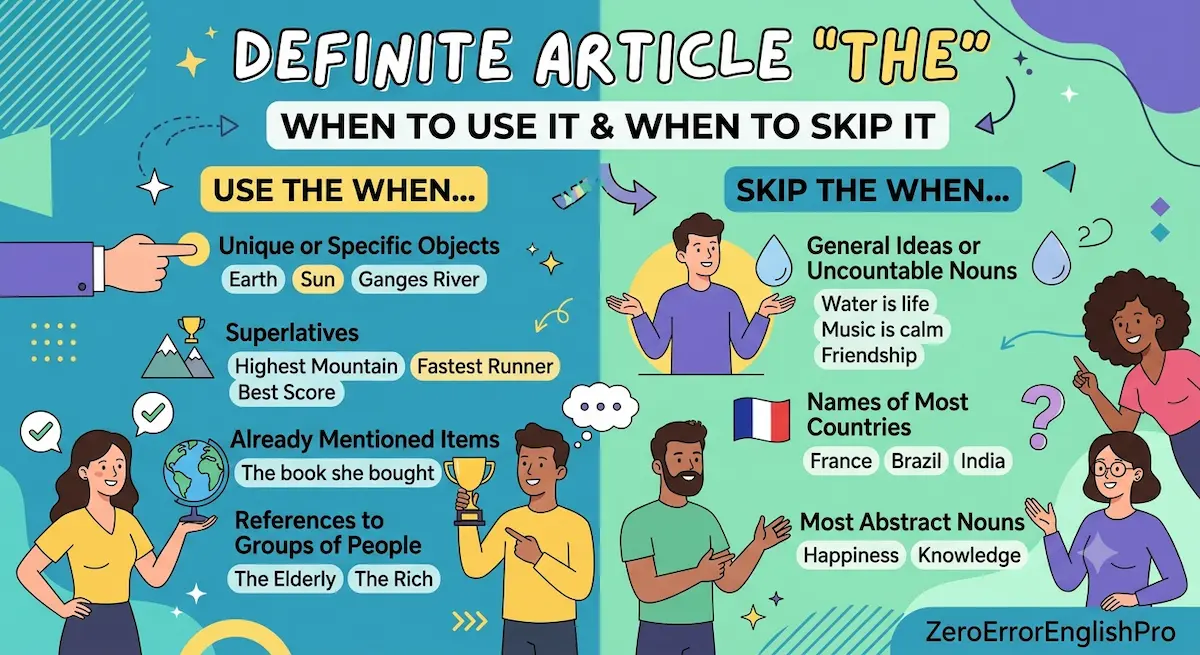
The Smallest Word With the Longest List of Exceptions
Of the four article rules in this series, the is the one students underestimate most. The core idea is simple: use the when the noun is specific, known, or points to something particular. But English has quietly built a long list of exceptions and special categories around that one idea, and SSC question setters know exactly where those exceptions live.
This guide covers the core rule, the major exception categories, where the is wrongly added when it shouldn't be, and the traps that trip up otherwise well-prepared students. By the end, you'll have a working checklist you can run through in seconds during an exam.
Quick answer: Use the when the noun is specific, already known, unique, or marked out by a superlative, an ordinal number, or a phrase like "of the". Learn the fixed exception categories, rivers, mountain ranges, groups and a few others, as a separate list rather than trying to derive them from the core rule.
In This Guide
- What "the" really signals
- Core rules: known, unique, superlative, ordinal
- Geographical names
- Groups, nationalities and classes
- Instruments, newspapers and documents
- Special patterns: the same, the + comparative
- Where "the" is wrongly added
- Exam traps
- 10 SSC-style practice questions
- Quick revision
- Frequently asked questions
What "The" Really Signals
Unlike a and an, which never touch plural or uncountable nouns, the works across all noun types: singular, plural, countable and uncountable alike. That flexibility is exactly why it needs its own dedicated set of rules rather than a single one-line test.
The is the definite article. It tells the listener "you already know which one I mean", either because it was mentioned before, because there's only one of it, or because the sentence itself points it out.
- Already mentioned: "I met a teacher yesterday. The teacher was very helpful." The second sentence points back to the specific teacher from the first.
- Made specific by context: "The door of this room is broken." The phrase "of this room" narrows "door" down to one particular door.
- Unique by nature: "The sun rises in the east." There's only one sun, so no other article makes sense.
Every core rule below is really just one of these three ideas applied to a specific situation.
Core Rules: Known, Unique, Superlative, Ordinal
Something already mentioned or clearly identified
Once a noun has been introduced with a or an, later references to that same noun switch to the: "She bought a laptop. The laptop was expensive."
Unique things
Certain nouns have only one referent in ordinary usage: the sun, the moon, the sky, the earth, the internet, the Constitution (of a specific country). These always take the because there's nothing to distinguish them from.
Superlatives
Words like best, worst, tallest, most and least point to one top example out of a group, so they take the: "He is the best player in the team."
Ordinal numbers
First, second, third and similar ordinal numbers point to one specific position, so they take the: "She secured the first rank in the district."
Compare: "He is a good player" (one of many good players, not specific) versus "He is the best player" (one particular top player, made specific by the superlative).
A Useful Test: "Which One?"
When you're unsure whether a noun needs the, ask yourself: if I said this noun without any article, would the listener know exactly which one I mean? If the answer is yes, because it was mentioned before, because there's only one, or because a phrase pins it down, use the. If the answer is no, the noun is general, and it likely needs no article or an indefinite one instead.
Try it: "He is reading ___ book about Indian history." versus "He is reading ___ book you gave him."
The first is general, any book about Indian history, so it takes a. The second is specific, one particular book identified by "you gave him", so it takes the.
Geographical Names
This is the category most students learn as a memorised list rather than a derived rule, because the underlying logic isn't obvious from everyday usage.
| Takes "the" | Examples | No article | Examples |
|---|---|---|---|
| Rivers | the Ganga, the Yamuna | Most cities | Pune, Mumbai, Delhi |
| Oceans and seas | the Pacific, the Arabian Sea | Most countries | India, Japan, Kenya |
| Mountain ranges | the Himalayas, the Alps | Single mountains | Everest, Kanchenjunga |
| Island groups | the Andamans, the Maldives | Single islands | Sri Lanka, Bali |
| Deserts | the Sahara, the Thar | Lakes | Lake Victoria, Dal Lake |
A rough way to remember this: plural or collective geographical names (a chain of mountains, a group of islands, a body of water made of many parts) tend to take the, while single, standalone named places usually don't.
Why Rivers and Oceans Take "The" but Lakes Sometimes Don't
A useful way to remember the geographical pattern: the tends to apply when the name describes a feature as part of a larger, connected system, a river flowing through many places, an ocean touching many coastlines, a range made of many peaks. Standalone, self-contained features, most lakes, most single mountains, most cities, tend not to need it. This isn't a strict rule you can derive every case from, but it's a helpful memory anchor when a new name doesn't fit neatly into the table above.
Groups, Nationalities and Classes
This category extends the "known group" idea from earlier: instead of one specific person or thing, the here marks out an entire class treated as a single, collective unit.
The plus an adjective can refer to an entire group or class of people, treated as a collective plural: the poor, the rich, the young, the elderly, the unemployed. "The poor need better healthcare access" means poor people as a group, not one specific poor person.
Nationalities used to mean "the people of that nation" as a whole also take the: the French, the Japanese, the British. But an individual person's nationality, used as an adjective or noun, takes no special article: "She is French." "He is a Japanese national."
Instruments, Newspapers and Documents
These categories don't follow from the "known or unique" logic at all; they're simply fixed conventions in English that need to be learned as their own list.
Musical instruments, when talking about playing them in general, take the: play the guitar, play the piano, play the violin. This is a fixed pattern in English and doesn't follow from a deeper logic; it's simply how the language treats instruments differently from sports, which take no article (play cricket, play football).
Newspaper names usually take the: the Times of India, the Hindu. Named historical documents often do too: the Constitution, the Indian Penal Code.
Special Patterns: "The Same" and "The + Comparative"
Two fixed patterns are worth memorising on their own, since they don't map cleanly onto "known" or "unique".
- "The same": "We attended the same college." Here, the marks identity between two things being compared.
- "The + comparative..., the + comparative...": "The more you practise, the better you become." Both halves of this pattern require the, and dropping either one is a common exam trap.
The vs Zero Article: A Quick Contrast
Because the and no-article both apply to plural and abstract nouns in different situations, they're easy to confuse. The difference comes down to specificity, not the type of noun itself.
| Sentence | Article | Why |
|---|---|---|
| Books are a great source of knowledge. | No article | General statement about books as a category |
| The books on that shelf belong to my sister. | The | Specific books, identified by "on that shelf" |
The noun "books" is identical in both sentences. What changes is whether the sentence points to a specific, identified set or speaks about the category in general. This is the single most useful distinction for deciding between the and no article at all.
Where "The" Is Wrongly Added
Just as important as knowing where the belongs is knowing where it doesn't. These are the reverse traps, adding the where English expects none.
- General ideas and abstract nouns: "Honesty is the best policy," not "The honesty is the best policy."
- Most proper nouns: "Ramesh works at Infosys," not "The Ramesh works at the Infosys."
- Plural nouns used generally: "Students need practice," not "The students need practice," unless you mean one specific, already-identified group of students.
- Meals, languages and sports in general use: "He speaks Hindi and plays cricket," not "the Hindi" or "the cricket."
Our companion guide on zero article rules covers this side of the picture in full detail.
Why "The" Feels Harder Than It Is
Compared to a and an, which have a single testable sound rule, and zero article, which follows a handful of fixed categories, the can feel harder because it sits at the intersection of several different ideas: known information, uniqueness, comparison, and a set of memorised categories. The good news is that in exam sentences, you rarely need to identify which specific idea is at play. You only need to answer one question: does the sentence, on its own, tell me exactly which one is meant? If yes, the almost always belongs there.
Exam Traps
Trap 1: Dropping the before a superlative
IncorrectShe secured highest marks in the class.
CorrectShe secured the highest marks in the class.
Why: "Highest" is a superlative, pointing to one top instance, so it needs the.
Trap 2: Missing the before a mountain range
IncorrectHimalayas separate India from Tibet.
CorrectThe Himalayas separate India from Tibet.
Why: Mountain ranges, as a fixed geographical category, take the.
Trap 3: Adding the before a general abstract idea
IncorrectThe patience is a virtue every officer needs.
CorrectPatience is a virtue every officer needs.
Why: "Patience" here is a general quality, not one specific, identified instance of it.
Trap 4: Only half of "the more..., the better..."
IncorrectThe more you revise, better you perform.
CorrectThe more you revise, the better you perform.
Why: This comparative pattern requires the in both halves, not just the first.
Trap 5: Mixing up instrument and sport patterns
IncorrectHe plays guitar and the cricket every weekend.
CorrectHe plays the guitar and cricket every weekend.
Why: Instruments take the; sports, played in general, take no article.
A Sixth Trap: Overcorrecting and Dropping "The" Where It Belongs
IncorrectBook you gave me last week was excellent.
CorrectThe book you gave me last week was excellent.
Why: After learning that plural and general nouns often take no article, some students overcorrect and drop the even when a phrase like "you gave me" clearly identifies one specific book.
10 SSC-Style Practice Questions
Fill each blank with the or leave it blank if no article is needed. Give yourself six minutes.
- ___ Taj Mahal attracts millions of tourists every year.
- He is ___ tallest boy in his class.
- ___ Ganga is considered sacred by millions of people.
- She learned to play ___ sitar as a child.
- ___ poor deserve equal access to good education.
- ___ more you read, ___ wider your vocabulary becomes.
- He was inspired by ___ Constitution of India.
- ___ Himalayas are home to several endangered species.
- She and I studied at ___ same school.
- ___ honesty is valued in every profession.
Show answers and explanations
- The. A specific, uniquely named monument.
- the. Superlative "tallest" points to one specific person.
- The. Rivers take the.
- the. Musical instruments take the in general use.
- The. "The poor" refers to the group as a whole.
- The / the. Comparative pattern needs the in both halves.
- the. A specific, named historical document.
- The. Mountain ranges take the.
- the. "The same school" marks identity between the two people's schools.
- No article. "Honesty" here is a general quality, not a specific instance.
For more mixed practice across all four article rules, see our page of articles questions for SSC CGL with exam pattern and practice.
Quick Revision
Use "the" for:
- Known, already-mentioned or context-specified nouns.
- Unique things: the sun, the sky, the internet.
- Superlatives and ordinal numbers.
- Rivers, oceans, mountain ranges, island groups and deserts.
- Groups described by an adjective, and nationalities as a whole.
- Musical instruments, newspapers, and named historical documents.
- Fixed patterns: "the same", and both halves of "the more..., the better...".
Frequently Asked Questions
Q: What are the rules of the definite article "the"?
A: Use the for nouns that are already known, unique, or made specific by a superlative, ordinal number, or descriptive phrase. It also applies to fixed categories like rivers, mountain ranges, musical instruments, and certain comparative patterns.
Q: Why do rivers and mountain ranges take "the" but cities and countries usually don't?
A: This is largely a fixed convention in English rather than something derived from logic. Collective or "grouped" natural features (a chain of mountains, a system of rivers) tend to take the, while single, standalone named places usually don't.
Q: Is "the poor" grammatically correct?
A: Yes. "The" plus an adjective, with no noun after it, can refer to an entire group treated as a collective plural, such as the poor, the rich or the elderly.
Q: Why is it "play the guitar" but "play cricket"?
A: This is a fixed pattern in English: musical instruments take the in general use, while sports and games take no article. There's no deeper rule to derive this from; it needs to be memorised as its own category.
Q: Do I always need "the" before a superlative?
A: Almost always, when the superlative points to one specific example within a defined group, as in "the best player in the team". The main exception is when a superlative is used without direct comparison, such as "at best", though this is uncommon in SSC-level sentences.
Q: Why do some country names take "the" while most don't?
A: The exceptions, such as the United States, the Philippines and the United Kingdom, usually contain a plural or descriptive word within the name itself. This is best memorised as a short exception list rather than derived from a rule.
Q: Is "the" ever optional, where both choices are technically correct?
A: In a handful of cases, usage varies by region or style guide, such as "in hospital" versus "in the hospital" in different English varieties. For SSC-level exams, it's safest to apply the purpose-versus-building distinction consistently rather than relying on regional variation.
Where to Go Next
The definite article rewards memorising its fixed categories rather than trying to derive every case from first principles. Once these feel familiar, move on to zero article rules to complete the picture, or test yourself with articles error spotting for SSC CGL.
Articles For SSC CGL 2026 - Zero Errors
Eliminate one of the most frequently missed, easily fixable error categories from your Error Spotting score.