Simple, Compound and Complex Sentences: Easy Examples
Learn simple, compound, complex and compound-complex sentences with easy examples, memory tricks and a practice set with answers.
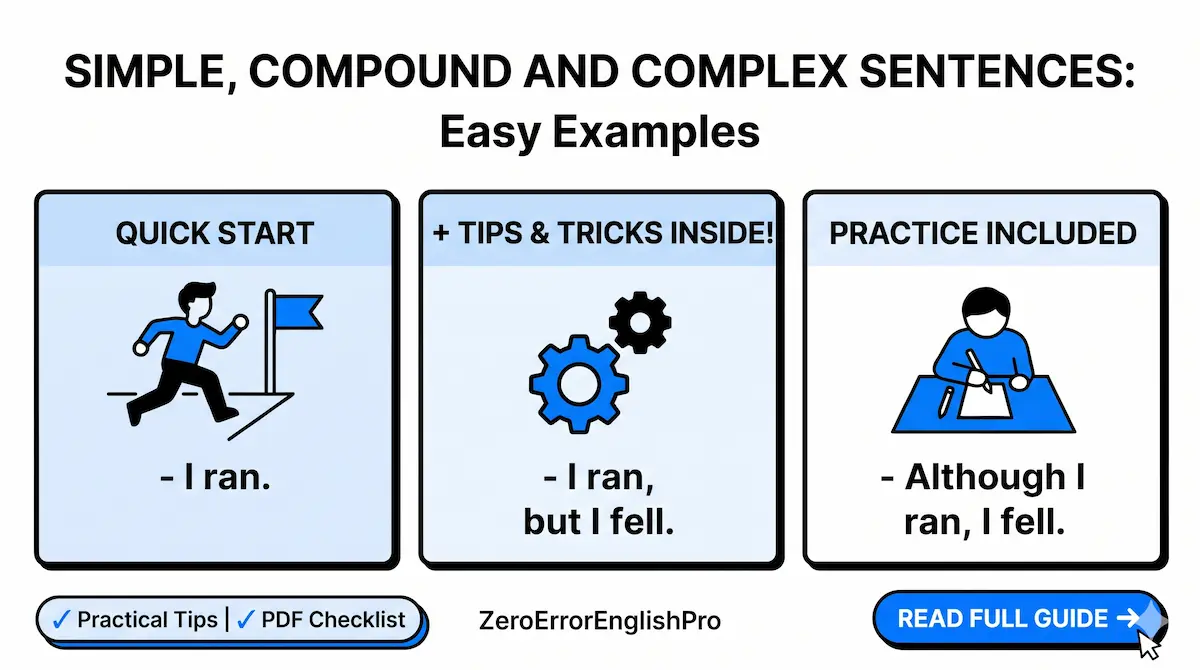
Which of these is a complex sentence? (A) I like tea. (B) I like tea, and she likes coffee. (C) I like tea because it relaxes me.
If you picked (C), you’re right, and you probably felt it before you could explain it. (A) has one idea. (B) has two equal ideas. (C) has a main idea and a second idea that leans on it. That leaning is the whole secret of sentence types, and once you can see it, you can name any sentence in seconds.
This guide explains simple, compound, complex and compound-complex sentences in plain language, with easy examples, memory tricks and a ten-sentence practice set with answers. I’ve taught English grammar for 22 years, and this is one of those topics that looks scary in a textbook and turns out to be easy once you count clauses. If you want the bigger picture on clauses first, read my guide to phrase vs clause.
- The two building blocks: clauses
- The Count and Lean routine
- The four sentence types with examples
- Comparison table
- Connector cheat sheet by type
- When to use each type
- How to identify any sentence in 4 steps
- Three traps that fool learners
- A short paragraph makeover
- Practice set with answers
- Writing practice: change the type
- Changing one type into another
- A 5-day practice plan
- FAQ
- Related articles
The two building blocks: clauses
Every sentence type is built from clauses, so start there. A clause is a group of words with its own subject and verb. There are only two kinds.
Independent clause. It has a subject and a verb and makes complete sense alone. “The bus arrived” is an independent clause.
Dependent clause. It has a subject and a verb but can’t stand alone, because it begins with a word like because, although, if, when or who. “Because the bus arrived” is dependent. It leaves you waiting for the rest.
Sentence types are just different mixtures of these two. If you want a full explanation of dependent clauses and their jobs, see the guide to noun, adjective and adverb clauses.
The Count and Lean routine
You don’t need to memorise four definitions. You need one routine.
“Count and Lean.”
COUNT the independent clauses: one, or two or more?
LEAN check: does any clause lean on another, starting with because, although, if, when, who or that?
Name it: one and no lean = simple; two and no lean = compound; one and a lean = complex; two and a lean = compound-complex
A hook to remember the first three: Solo, Couple, Clinger. A simple sentence is a solo. A compound sentence is a couple of equals. A complex sentence has a clinger, a clause that hangs on to another.
The four sentence types with examples
1. Simple sentence (Solo)
A simple sentence has one independent clause and no dependent clause. It can still be long, and it can have more than one subject or verb.
Memory trick: “Solo means one clause.” Notice the second example: two subjects and two verbs, but only one clause, because they share the same sentence frame.
2. Compound sentence (Couple)
A compound sentence has two or more independent clauses joined by a comma and a FANBOYS word (for, and, nor, but, or, yet, so), or by a semicolon.
Memory trick: “Couple means two equals.” Either one could stand alone as a sentence. Join them badly and you get a run-on, which I explain in run-on sentences and comma splices.
3. Complex sentence (Clinger)
A complex sentence has one independent clause and at least one dependent clause. The dependent clause may start with a subordinating word (because, although, if, when, since, unless, while) or a relative word (who, which, that).
Memory trick: “Clinger means one hangs on the other.” If the dependent clause comes first, add a comma after it. The last example hides a noun clause, “that she is right,” which acts as the object of know. For the full rules on who, which and that, see relative clauses.
4. Compound-complex sentence (Couple plus Clinger)
A compound-complex sentence has two or more independent clauses and at least one dependent clause.
Memory trick: “Couple plus clinger.” Count two equals and one leaner. Use these sparingly. Too many in a row tire the reader.
Comparison table
| Type | Independent clauses | Dependent clauses | Example |
|---|---|---|---|
| Simple | 1 independent | None | The sun rises in the east. |
| Compound | 2 or more independent | None | I was tired, so I went to bed. |
| Complex | 1 independent | 1 or more | When the bell rang, the students left. |
| Compound-complex | 2 or more independent | 1 or more | The teacher smiled, and the students, who had worked hard, felt proud. |
Keep this table in your notebook. It’s the whole topic on one screen.
Connector cheat sheet by type
The joining word often gives the type away, so learn these three groups.
| Group | Words | Usually makes |
|---|---|---|
| Coordinating (FANBOYS) | for, and, nor, but, or, yet, so | Compound |
| Subordinating | because, although, though, if, unless, when, while, since, after, before, until | Complex |
| Relative | who, whom, whose, which, that | Complex |
| Linking adverbs (with a semicolon) | however, therefore, moreover, then | Compound |
One memory hook for the first group: FANBOYS gives equals, and equals make a couple. Words in the second and third groups make one clause lean, which is why they make complex sentences.
When to use each type
Knowing the names is only half the skill. The other half is choosing the right type for the job.
Simple sentences work for facts, instructions and punchy moments. “The door opened.” They create speed and emphasis.
Compound sentences work when two ideas have equal weight. “She wanted to leave, but she stayed.” They create balance.
Complex sentences work when one idea explains another through reason, time, condition or contrast. “She stayed because she promised.” They show relationships.
Compound-complex sentences work for rich, detailed moments. Save them for important points, because they ask the reader to hold several ideas at once.
A good writer shifts between all four, usually without thinking. A good learner practises on purpose until the shifting becomes natural.
How to identify any sentence in 4 steps
Step 1: Find every verb. Each verb with its own subject signals a clause.
Step 2: Mark each clause. Put brackets round every subject-verb group.
Step 3: Test each clause. Can it stand alone? If yes, it’s independent. If it starts with because, although, if, when, who or that and can’t stand alone, it’s dependent.
Step 4: Count and Lean. Use the routine to name the type.
Try it on “Although she was nervous, she spoke well.” Two verbs, so two clauses. “Although she was nervous” can’t stand alone, so it’s dependent. “She spoke well” can. One independent plus one dependent makes it complex.
Three traps that fool learners
Trap 1: Two verbs aren’t two clauses. “He opened the door and walked in” has two verbs but only one subject. It’s a simple sentence, not compound.
Trap 2: Because of isn’t because. “Because of the rain, we stayed home” is simple, since “the rain” is a phrase with no verb. “Because it rained, we stayed home” is complex.
Trap 3: A dependent clause alone isn’t a sentence. “Although it was raining.” is a fragment. It becomes complex only when an independent clause joins it.
Commas don’t decide the type, either. “I know that she is right” has no comma and is still complex. Always count clauses, not commas. For comma rules, see comma rules in English grammar.
A short paragraph makeover
Why does any of this matter? Because mixing sentence types makes your writing sound alive. Here’s a paragraph made only of simple sentences.
Before: The room was dark. I turned on the light. I saw a cat. The cat was sleeping. I smiled.
Each sentence is correct, but the rhythm is flat. Now let’s mix the types.
After: The room was dark, so I turned on the light. I saw a cat that was sleeping, and I smiled.
The first sentence is compound, and the second is compound-complex. Notice that I kept short sentences for punch where they helped. The goal isn’t to make everything long. It’s to vary the length so the reader stays awake. You’ll find drills for this in my sentence combining exercises.
Practice set: name the sentence type
Write simple, compound, complex or compound-complex for each sentence. These are original practice sentences written for this guide. Try them before you read the answers.
- The sun rises in the east.
- I was tired, so I went to bed.
- When the bell rang, the students left.
- Meera sings and dances beautifully.
- He studied hard; he passed the exam.
- The man who lives next door is a doctor.
- Although she was nervous, she spoke well, and everyone clapped.
- Because of the heavy traffic, we were late.
- I think that you are right.
- The teacher smiled, and the students, who had worked hard, felt proud.
Answers
1. Simple (one independent clause, no dependent clause)
2. Compound (two independent clauses joined by so)
3. Complex (“When the bell rang” leans on the main clause)
4. Simple (one subject with two verbs, so one clause)
5. Compound (two independent clauses joined by a semicolon)
6. Complex (“who lives next door” is a dependent clause)
7. Compound-complex (one dependent clause plus two independent clauses)
8. Simple (“Because of the heavy traffic” is a phrase, not a clause)
9. Complex (“that you are right” is a noun clause)
10. Compound-complex (two independent clauses plus “who had worked hard”)
If you scored 9 or 10, you’ve got it. If you scored 6 to 8, revise the traps. If you scored below 6, go back to Count and Lean and retake the set after two days.
Writing practice: change the type
Reading about types helps, but writing them cements the skill. Start from two simple sentences and build upward.
Start: I was hungry. I made a sandwich.
Task A: Make a compound sentence.
Task B: Make a complex sentence.
Task C: Add “It rained. We stayed home. We played cards.” and make a compound-complex sentence.
Answers
A. I was hungry, so I made a sandwich.
B. Because I was hungry, I made a sandwich.
C. Because it rained, we stayed home, and we played cards.
Your answers may differ, and that’s fine if the clause counts match the type you were asked for.
Changing one type into another
Transformation questions ask you to rewrite a sentence in a different type without changing its meaning. The idea is simple: turning a phrase into a clause makes a sentence more complex, and squeezing a clause into a phrase makes it simpler.
Simple to complex: “Because of his illness, he missed the class.” becomes “Because he was ill, he missed the class.”
Compound to complex: “He was tired, but he kept working.” becomes “Although he was tired, he kept working.”
Complex to simple: “When the bell rang, the students left.” becomes “On hearing the bell, the students left.”
Memory trick: “Phrase grows into clause, clause shrinks into phrase.” Check after every change that the meaning stayed the same and that no detail was lost.
A 5-day practice plan
Fifteen minutes a day is enough if you keep the routine the same.
Day 1: Learn clauses and write five independent and five dependent clauses
Day 2: Learn simple and compound, then write three of each
Day 3: Learn complex and compound-complex, then write three of each
Day 4: Label the types in a newspaper paragraph
Day 5: Retake the practice set above without looking at the answers
A pattern I see in almost every batch
Learners can usually recite the four definitions. The slip happens when they count verbs instead of clauses. Show them “He opened the door and walked in,” and half will call it compound because they see and. The fix is a question, not a rule: how many subjects are there? One subject and two verbs is still one clause, so the sentence is simple. Ask that question every time, and the confusion disappears.
Mistakes to avoid
Counting verbs instead of clauses. Two verbs with one subject make one clause.
Trusting commas. Commas can appear in any type, and be missing from complex ones.
Calling a fragment complex. A dependent clause alone isn’t a sentence.
Overusing long sentences. Mix types so your writing keeps a rhythm.
Frequently asked questions
What is the difference between a compound and a complex sentence?
A compound sentence joins two equal independent clauses, such as “I was tired, so I went to bed.” A complex sentence has one independent clause and one dependent clause that leans on it, such as “Because I was tired, I went to bed.”
Can a simple sentence be long?
Yes. A simple sentence has only one independent clause and no dependent clause, but it can include long phrases, several subjects and several verbs.
What is a compound-complex sentence?
It’s a sentence with at least two independent clauses and at least one dependent clause, such as “Although it was late, I kept working, and my friend kept me company.”
Do I always need a comma in a complex sentence?
No. Use a comma when the dependent clause comes first, as in “When it rained, we left.” You usually don’t need one when it comes second, as in “We left when it rained.”
How do I remember the four sentence types?
Use Solo, Couple, Clinger. A simple sentence is a solo, a compound sentence is a couple of equals, a complex sentence has a clinger that leans on another clause, and a compound-complex sentence has a couple plus a clinger.
Are sentence types tested in exams?
Sentence transformation and sentence improvement questions often ask you to change one type into another. Check the latest official notification for your exam pattern.
Your next step
Pick five sentences from anything you read today and run Count and Lean on each one. Name the type, then change one sentence into a different type. That small exercise will teach you more than another page of rules.
When you want a fast, repeatable way to handle clauses and phrases, my ebook Clauses & Phrases Demystified: Fix Errors and Write Confidently is on Amazon: https://amzn.to/4ibEcP9
Which sentence type do you find hardest to spot? Tell me in the comments, and I’ll explain it in more detail.