Types of Phrases in English Grammar — Noun, Adjective, Adverb & Prepositional Phrases for SSC and Bank Exams
Four phrase types, one exam-ready test. Learn to identify Noun, Adjective, Adverb, and Prepositional phrases in seconds, with the exact traps SSC and Bank examiners repeat every year.
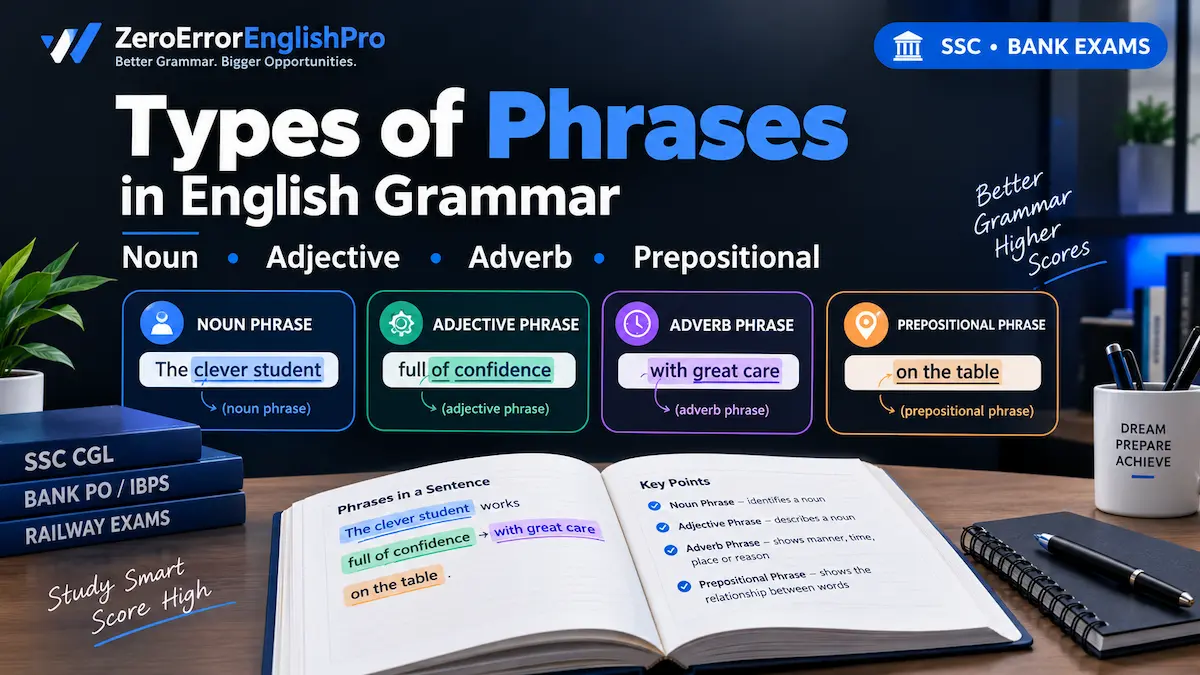
Four Phrase Types, One Question Examiners Keep Asking
"In the garden" — is that describing a place, a thing, or an action? Depending on the sentence, it could be any of the four major phrase types, and SSC and Bank exams build entire Error Spotting and Sentence Improvement questions around exactly this ambiguity.
A phrase is a group of related words without a finite verb of its own, functioning as a single part of speech. What confuses most aspirants isn't the definition — it's telling the four types apart when they all look like ordinary word groups sitting inside a sentence.
This guide gives you one reliable test for each phrase type, plus the specific traps examiners recycle most often.
Unlike single-word grammar categories, phrases can be built in more than one way — a Noun Phrase might be a simple "the tall building" or a more complex "solving this puzzle." Learning to see past the surface structure to the underlying function is exactly what separates fast, accurate identification from slow, uncertain guessing.
Quick answer: Check what the phrase is doing. Naming a person, place, or thing → Noun Phrase. Describing a noun → Adjective Phrase. Describing a verb (when/where/how/why) → Adverb Phrase. Starting with a preposition and ending in a noun → Prepositional Phrase.
In This Guide
- Why the Four Types Get Confused
- 5 Mistakes That Are Costing You Marks
- The 6-Step Identification Method (With Real Exam Patterns)
- How Meera Fixed This Before Her Bank Exam
- Expert Shortcuts Toppers Actually Use
- Final Takeaway
- Frequently Asked Questions
Why the Four Types Get Confused
Unlike clauses, phrases have no subject-verb pair to anchor your analysis — you're judging purely by function, which is inherently more subjective and easier to misjudge under time pressure.
- You judge phrase type by the first word instead of the whole phrase's job. "In the garden" can function as an adverb phrase (where) or an adjective phrase (which one), depending entirely on what it's attached to.
- You mix up prepositional phrases with the category they're acting as. A prepositional phrase can function as a noun, adjective, or adverb phrase — the label "prepositional" describes its form, not always its job.
- You forget that phrases named after one part of speech can be built from a different structure. A noun phrase isn't always just a noun with an article — it can include participles, infinitives, or prepositional add-ons.
- You don't isolate the phrase before analyzing its function. Judging a phrase while still reading the whole sentence blurs its actual boundaries.
- You've never practiced with genuinely ambiguous phrases — most textbook examples are too clean to build real pattern recognition for exam-level tricky sentences.
- You skip checking phrase boundaries in longer, compound sentences. A phrase can be interrupted or extended by commas and connectors, and misreading its edges changes your entire analysis.
I know exactly how this feels — a phrase seems obvious in isolation, but placed in a full sentence, its function suddenly feels uncertain. It's not a vocabulary gap. It's a missing function-first habit.
But here's what most people get wrong: they classify a phrase by its first word or its grammatical form, instead of asking what job it's doing in that specific sentence.
5 Mistakes That Are Costing You Marks
1. Classifying every "in/on/at" phrase as an Adverb Phrase.
Prepositional phrases can just as easily function as adjective phrases, describing a nearby noun instead of the verb.
2. Missing infinitive and gerund phrases functioning as Noun Phrases.
"To finish the project on time" and "Finishing the project on time" can both act as the subject or object of a sentence — exactly like a simple noun phrase would.
3. Assuming Adjective Phrases must come immediately before the noun.
Unlike single adjectives, adjective phrases usually follow the noun they describe, which trips up students expecting pre-noun placement.
4. Confusing an Adverb Phrase of manner with one of time.
"In a hurry" (manner) and "in the morning" (time) share the same prepositional structure but answer completely different questions.
5. Treating a phrase with a verb form inside it as automatically a clause.
"Written in haste" contains a verb form but has no subject of its own — it remains a phrase (specifically a participle phrase acting adjectivally), not a clause.
6. Misjudging phrase boundaries in longer sentences.
When a phrase is interrupted by a comma or extended across a connector, students often analyze only part of it, arriving at the wrong function entirely.
Common Mistakes Students Make
ebookcharm — English Grammar Made Exam-Ready
If these five traps felt familiar, the companion book below drills phrase identification with exam-calibrated practice sets.
The 6-Step Identification Method (With Real Exam Patterns)
Step 1 — Isolate the phrase from the rest of the sentence. Mark its exact boundaries before analyzing anything.
Step 2 — Ask if it names a person, place, thing, or idea. If yes, and it functions as a subject or object, it's a Noun Phrase.
SSC CGL Exam Pattern: "Solving this puzzle took him an hour." → "Solving this puzzle" = Noun Phrase (subject).
Step 3 — Check if it describes a nearby noun. If yes, and it answers "which one" or "what kind," it's an Adjective Phrase.
IBPS PO Exam Pattern: "The report submitted yesterday was rejected." → "submitted yesterday" describes "report" → Adjective Phrase.
Step 4 — Check if it describes the verb. If it answers when, where, why, how, or condition, it's an Adverb Phrase.
Exam Pattern: "She spoke with great confidence." → "with great confidence" tells how she spoke → Adverb Phrase.
Step 5 — If it starts with a preposition, identify what it's modifying next. A prepositional phrase's label describes its form; its true function (noun/adjective/adverb) still needs Steps 2-4 applied.
Step 6 — Confirm there's no subject-plus-finite-verb pair inside it. If you find one, you're looking at a clause, not a phrase — re-check your boundaries from Step 1.
Step-by-Step Strategy
SSC CGL: "Solving this puzzle took him an hour."
IBPS PO: "The report submitted yesterday was rejected."
"She spoke with great confidence."
ebookcharm — English Grammar Made Exam-Ready
How Meera Fixed This Before Her Bank Exam
Meera could name all four phrase types correctly in isolation but kept misclassifying prepositional phrases specifically — she assumed "starts with a preposition" meant "automatically an adverb phrase," missing dozens of adjective-phrase cases.
Her mock test analysis showed the pattern clearly: nearly every phrase-identification error she made involved a prepositional phrase that was actually functioning adjectivally, describing a noun rather than modifying the verb. Once she saw the pattern laid out, the fix became obvious — she just hadn't been checking function separately from form.
She began explicitly running Steps 2 through 4 on every prepositional phrase she found, refusing to stop at "it's prepositional, so it's probably adverbial." Within ten days, her accuracy on phrase-function questions became consistent across all four types, and she stopped dreading this question type in her mocks.
You can do the same — here's how to start: find five prepositional phrases in today's newspaper and determine what each one is actually modifying — a noun, a verb, or acting as a noun itself.
Expert Shortcuts Toppers Actually Use
1. Never stop at "it's a prepositional phrase" as your final answer. That describes its form, not its function — always follow up with what it's modifying.
2. Adjective phrases almost always follow their noun; adverb phrases can move freely. Position alone is a strong, fast clue before you even check meaning.
3. Infinitive and gerund phrases deserve their own separate practice set. They're the most commonly missed Noun Phrase category because they don't look like typical nouns.
4. When a phrase contains a verb form, check for a subject before panicking. No subject inside it means it's still a phrase, not a clause, regardless of the verb form present.
5. Read the full sentence once before isolating the phrase. Context tells you what the phrase is attached to, which is often the fastest way to determine its function.
6. Build a small reference table of common Adverb Phrase sub-types. Manner (with confidence), time (in the morning), place (near the station), and condition (in case of rain) — grouping by sub-type prevents the manner-vs-time confusion that trips up even strong students.
Final Takeaway
Every phrase-type question comes down to one question: what job is this group of words doing? Isolate the phrase, check whether it names something, describes a noun, or describes a verb, and confirm there's no hidden subject-verb pair. That's the entire method.
Frequently Asked Questions
Q: Can a prepositional phrase ever function as a Noun Phrase?
A: Rarely, but "During the meeting is when it happened" shows a prepositional phrase behaving like a noun. In practice, most prepositional phrases function as adjective or adverb phrases in exam questions.
Q: How do I tell an Adjective Phrase from an Adverb Phrase quickly?
A: Check what it's attached to. If it directly follows and describes a noun, it's an Adjective Phrase. If it describes the action of the verb (when, where, how, why), it's an Adverb Phrase.
Q: Is "to win the match" a phrase or a clause?
A: A phrase — specifically an infinitive phrase, since it has no subject of its own. "To win the match, the team practiced daily" uses it functioning like an adverb phrase of purpose.
Q: Can the same phrase function differently in two different sentences?
A: Yes. "In the morning" functions as an Adverb Phrase in "He runs in the morning" (describing when he runs), but could function adjectivally in a sentence like "The meeting in the morning was cancelled" (describing which meeting).
Clauses & Phrases Demystified: Fix Errors and Write Confidently
Replace slow, uncertain clause analysis with a fast, repeatable identification system built for exam-timer pressure.