Confusing Prepositions Explained: Between vs Among, Since vs For, Beside vs Besides
Clear confusing prepositions with simple tests and memory shortcuts: between vs among, since vs for, beside vs besides and more, plus a 12-question practice set.
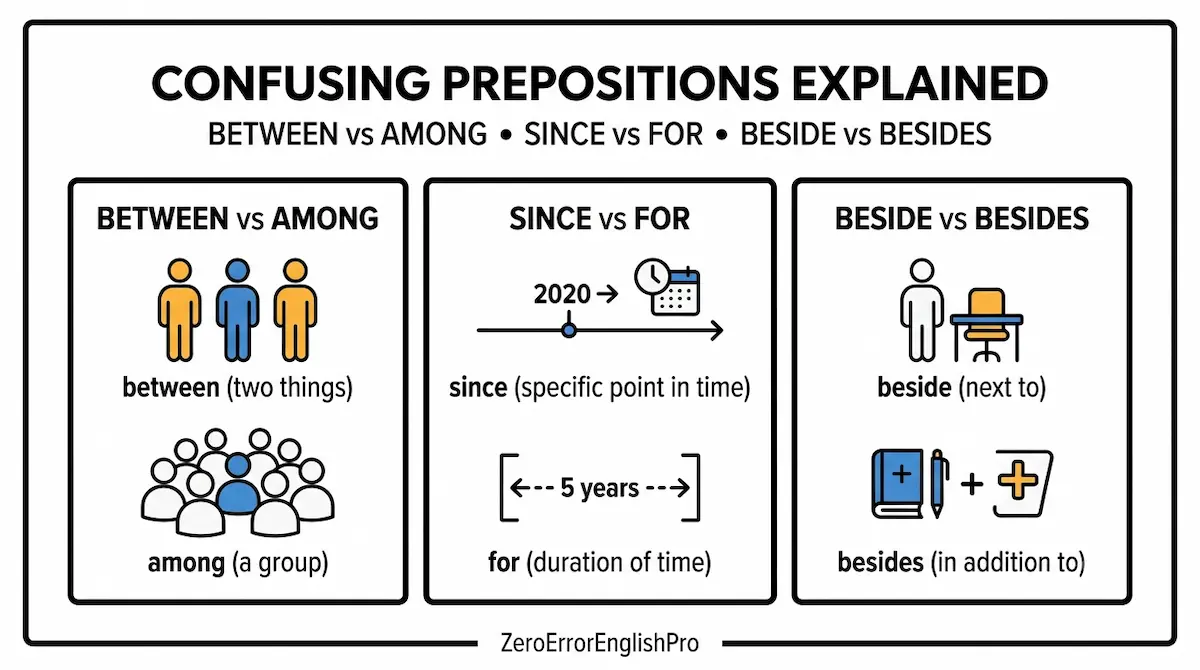
"The sweets were divided between the five children." Sounds fine, right? It isn't. And "I am living in Pune since 2015" has a hidden mistake too. These two sentences are the kind that quietly cost marks in error spotting, sentence improvement and fill in the blanks.
Why do we get them wrong? Because the pairs look alike, they sound alike, and in everyday talk people use them loosely. Between and among. Since and for. Beside and besides. Examiners know that a student who relies on the ear will slip, so they build questions around exactly these pairs.
This guide gives you a clear rule, a simple test and a memory shortcut for each pair. After 22 years of teaching, I've learned that a good shortcut beats a long explanation every time. You'll also find a mid-article cheat sheet to screenshot, a practice set with answers and the traps that examiners love. The examples are common exam patterns, not questions from any particular year's paper.
| Pair | One-line test |
|---|---|
| between / among | Two (between) or more than two (among)? |
| since / for | Starting point (since) or length of time (for)? |
| beside / besides | Next to (beside) or in addition to (besides)? |
| in / into | Already inside (in) or moving inside (into)? |
| by / until | A deadline (by) or a continuing period (until)? |
| in / within | After a time (in) or before it ends (within)? |
| during / while | Followed by a noun (during) or a clause (while)? |
In This Guide
- 1. Between vs among
- 2. Since vs for
- 3. Beside vs besides
- 4. In vs into
- Memory shortcuts cheat sheet (screenshot this)
- 5. By vs until
- 6. In vs within
- 7. During vs while
- The 30-second scan: spot which pair is being tested
- Exam traps with these pairs
- Mini error-spotting set: 6 questions
- Practice set: 12 questions
- A 7-day plan: one pair a day
- Frequently asked questions
- Remember the test, not the rule
1. Between vs among
The rule: Use between for two people or things. Use among for three or more.
- The twins shared the chocolate between themselves.
- The principal distributed the books among the students.
- There is no difference between the two plans.
- She was standing among a crowd of fans.
A note on subtle cases: between is also used for more than two when the items are clearly separate and distinct, as in "a treaty between the three countries" or "the distance between Pune, Mumbai and Nashik". In exam questions, though, the safe rule is two for between and more than two for among, unless the sentence clearly lists separate items.
The classic trap: "Between you and I" is wrong. After a preposition, we use the object form: between you and me. This one shows up again and again.
2. Since vs for
The rule: Use since with a starting point (a date, day, time or event). Use for with a length of time (a number of hours, days or years). Both usually go with perfect tenses.
- I have been learning English since 2022.
- She has been waiting for two hours.
- He has lived here since his childhood.
- We have known each other for ten years.
The classic trap: "I am living in Pune since 2015" is wrong. Since and for with a period up to now need a perfect tense: "I have been living in Pune since 2015." If the period is finished, use from ... to with the simple past: "He worked here from 2010 to 2015."
3. Beside vs besides
The rule: Beside means "next to". Besides means "in addition to" or "apart from".
- She sat beside me during the lecture.
- There is a tall tree beside the temple.
- Besides English, he teaches maths and science.
- Who else is coming besides Rahul?
The word besides can also stand alone as a linking word meaning "also": "I don't want to go. Besides, it's too late." That's a different use, so don't confuse it with the preposition.
4. In vs into
The rule: In tells us where something is. Into tells us movement towards the inside, or a change of state.
- The cat is sleeping in the box.
- The cat jumped into the box.
- Water turns into ice at zero degrees Celsius.
- She came into the room and sat down.
One small point: "log in to your account" is not the same as "into". There, in belongs to the verb "log in" and to is a separate preposition.
Memory shortcuts cheat sheet (screenshot this)
Before we go further, here's every shortcut in one place. Save this table and revise it before a test.
| Pair | Memory shortcut |
|---|---|
| between / among | BeTWeen = TWo. AMONG = a MOB (many). |
| since / for | Number in front? FOR. Date or event? SINCE. |
| beside / besides | BeSIDE = side. BeSIDES = extra S for extra things. |
| in / into | IN + TO = INTO (movement inside). |
| by / until | BY = deadline. UNTIL = UNbroken stretch. |
| in / within | IN = after the time. WITHIN = WITHin the limit, before it ends. |
| during / while | DURING brings a noun. WHILE brings a whole clause (with a verb). |
| between you and ___ | After a preposition, use me, never "I". |
A word about how to use these. A shortcut works best when it feels like yours, so feel free to change mine. If "mob" doesn't ring a bell, pick another image for among, such as a crowd at a railway station. The goal isn't to memorise my words. The goal is to attach each pair to something you'll recall in the middle of an exam when your heart is beating a little faster. I've seen students invent shortcuts in Marathi and Hindi that worked even better than mine, and that's perfectly fine.
5. By vs until
The rule: By means "not later than" a certain time. It marks a deadline. Until (or till) means "continuing up to" a time. It describes something that goes on.
- Submit the form by Friday. (any time before or on Friday)
- Please wait until Friday. (wait continuously up to Friday)
- I will finish the report by evening.
- She studied until midnight.
Ask yourself: is there an action that continues, like waiting, studying or working? That usually takes until. Is there a single action that must be done before a time, like submitting, finishing or arriving? That usually takes by.
6. In vs within
The rule: In a period of time means "after" that period has passed. Within means "before that period is over".
- The train will leave in ten minutes. (after ten minutes)
- Complete the form within ten minutes. (before ten minutes are over)
- The parcel will reach you within three days.
- I'll see you in a week.
7. During vs while
The rule: During is a preposition, so it's followed by a noun. While is a conjunction, so it's followed by a clause (a subject and a verb).
- He fell asleep during the lecture.
- He fell asleep while the teacher was speaking.
- Don't use your phone during the exam.
- Don't use your phone while you are driving.
People also mix up during and for. During says when something happened ("during the summer"). For says how long it lasted ("for three months").
The 30-second scan: spot which pair is being tested
In the exam, you don't have time to think "which of my seven rules applies?" Here's a quick way to let the sentence tell you.
- Look at the options or the underlined word. If you see between, among, since, for, beside, besides, by, until, within, during or while, you already know which family you're in.
- Ask the one-line test from the table at the top. Two or many? Number or date? Noun or clause?
- Check the neighbour. The word right after the blank (a number, a date, a noun, a clause) usually settles it. If the neighbour is "two hours", it's for. If it's "2019", it's since.
This three-step scan takes about thirty seconds on your first few tries and under ten once it becomes a habit.
Exam traps with these pairs
| Wrong | Right | Why |
|---|---|---|
| The prize was shared between the five winners. | The prize was shared among the five winners. | More than two. |
| This is a secret between you and I. | This is a secret between you and me. | Object form after a preposition. |
| I am working here since 2019. | I have been working here since 2019. | Since needs a perfect tense. |
| She has lived here since five years. | She has lived here for five years. | A length of time takes for. |
| Beside English, he teaches maths. | Besides English, he teaches maths. | "In addition to" needs besides. |
| He fell asleep while the lecture. | He fell asleep during the lecture. | While needs a clause. |
If you also want to master fixed pairs like "senior to" and "suffer from", my guides on preposition error spotting and on fill in the blanks with prepositions are the natural next steps.
Mini error-spotting set: 6 questions
Each sentence has three parts, (A), (B) and (C), and (D) means "No error". Find the part with the error.
- The teacher distributed the sweets (A) / between the (B) / twenty students. (C) / No error (D)
- I have been (A) / learning French (B) / for last year. (C) / No error (D)
- Beside her mother, (A) / she has two (B) / sisters and a brother. (C) / No error (D)
- The cat jumped (A) / in the basket (B) / and fell asleep. (C) / No error (D)
- Please finish (A) / the work until (B) / Monday morning. (C) / No error (D)
- He listened to music (A) / while the journey (B) / to Pune. (C) / No error (D)
Practice set: 12 questions
Choose the correct word or write the missing preposition. Try all twelve before you look at the answers.
- The prize money was shared ___ the five finalists. (between / among)
- There is no secret ___ you and me. (between / among)
- I have been learning English ___ 2022. (since / for)
- She has been waiting ___ two hours. (since / for)
- A tall tree stands ___ the temple. (beside / besides)
- ___ English, he speaks German and French. (Beside / Besides)
- The ball rolled ___ the room. (in / into)
- Submit the form ___ Friday at the latest. (by / until)
- Please wait here ___ I return. (by / until)
- Complete the form ___ ten minutes, or you will be disqualified. (in / within)
- He fell asleep ___ the lecture. (during / while)
- She fell asleep ___ she was reading. (during / while)
1) among (five finalists)
2) between (two people: you and me)
3) since (2022 is a starting point)
4) for (two hours is a length)
5) beside (next to)
6) Besides (in addition to)
7) into (movement towards the inside)
8) by (a deadline)
9) until (waiting continues up to the return)
10) within (before ten minutes are over)
11) during (followed by a noun)
12) while (followed by a clause)
Your score: 11 or 12 means you're exam-ready. 8 to 10 means revisit the pair where you slipped. Below 8, reread the cheat sheet and try again after two days.
A 7-day plan: one pair a day
Seven pairs, seven days. Spend about ten minutes a day, and don't skip the sentence-writing step.
| Day | Pair | What to do |
|---|---|---|
| 1 | between / among | Say the shortcut aloud. Write three sentences using each word. |
| 2 | since / for | Write five sentences about yourself, using numbers and dates. |
| 3 | beside / besides | Describe your room with beside. Describe your hobbies with besides. |
| 4 | in / into | Describe three movements and three positions around you. |
| 5 | by / until | Write your deadlines with by. Write your waiting times with until. |
| 6 | in / within, during / while | Write two sentences for each of the four words. |
| 7 | Revision | Cover the table, recall every shortcut and take the 12-question practice set again. |
Don't worry if you miss a day. Pick up from where you stopped.
Frequently asked questions
Can "between" be used for more than two?
Yes, when the items are clearly separate and distinct, as in "the distance between three cities". But in most exam questions, use the simple rule: two for between, more than two for among.
Is "between you and I" ever correct?
Standard grammar, and every exam answer key, says "between you and me". A preposition takes the object form of a pronoun.
Can I use "since" with a simple past tense?
Mostly no, when you are talking about a period up to now. Use a perfect tense: "I have lived here since 2015". A sentence like "It is ten years since I left school" is a special pattern, so treat it as a fixed structure.
Are "beside" and "besides" ever interchangeable?
No. Beside means "next to". Besides means "in addition to". Mixing them up changes the meaning completely, which is why examiners test them.
How do I remember so many pairs?
Use the shortcuts in the cheat sheet. Pick two pairs a day, say each shortcut aloud and write one sentence of your own. Within a week, all seven will feel familiar.
Remember the test, not the rule
These seven pairs look confusing only until you attach a quick test to each one: two or many, number or date, side or extra, still or moving, deadline or stretch, after or before, noun or clause. Five seconds with the right test beats a minute of worry.
For the complete system, my ebook Preposition in English Grammar: Your Confident Path to Exam Mastery for 12th Graders & Competitive Aspirants brings the rules, confusing pairs and exam-style practice together in one place.
Preposition in English Grammar: Your Confident Path to Exam Mastery for 12th Graders & Competitive Aspirants
Replace memorized guesswork with a reliable, pattern-based approach to choosing the correct preposition every time.