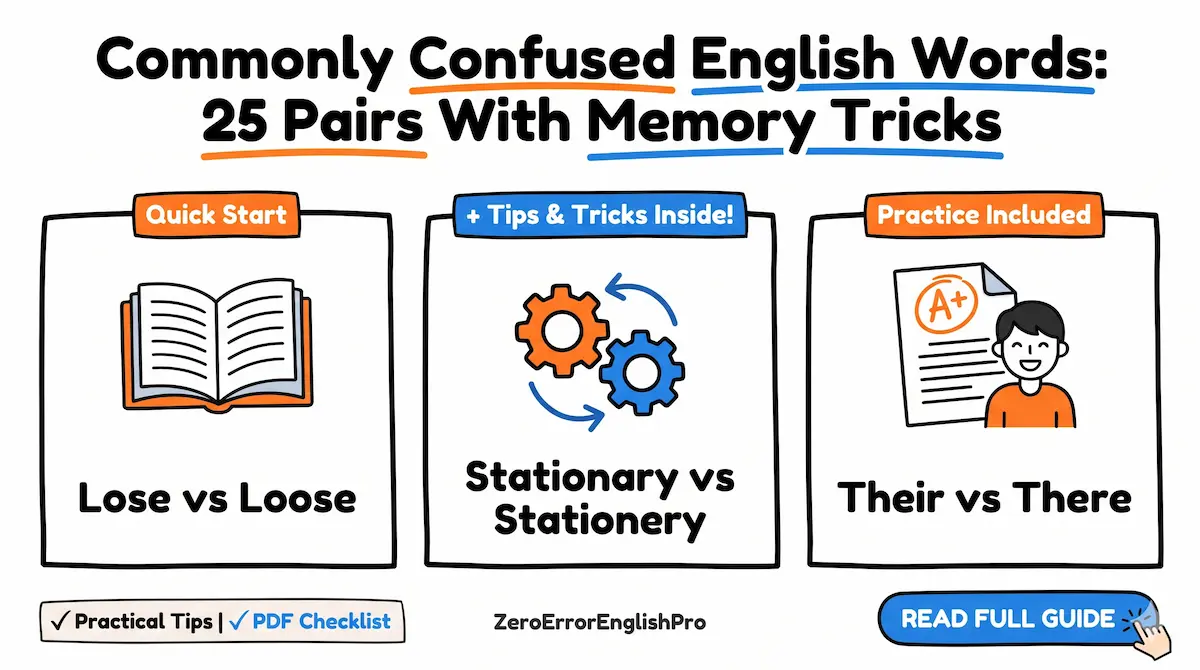
Commonly Confused English Words: 25 Pairs With Memory Tricks
Learn 25 pairs of commonly confused English words, with simple differences, examples, memory tricks and a practice set with answers.
Read this sentence: “The weather didn’t effect our plans, but it did affect our mood.” Spot anything wrong? It’s the other way round. Weather doesn’t effect plans; it affects them. And a change in mood is an effect, not an affect. Two small words, swapped, and the sentence quietly breaks.
Commonly confused words cause more embarrassment than almost any other kind of mistake, because spell-check can’t see them. Both words are spelled correctly, so the red line never appears. The only protection is knowing the difference, and knowing it fast.
This guide gives you 25 pairs of commonly confused English words, each with a plain-language difference, two example sentences and a memory trick. You’ll also get a three-word routine, a twelve-question practice set with answers and a five-day study plan. I’ve taught English grammar for 22 years, and these pairs are the ones my students ask about again and again. If apostrophes cause some of your confusion (its and it’s, your and you’re), my apostrophe rules guide covers them in detail.
- Why we confuse these words
- The ROLE, MEANING, SWAP routine
- Group A: sound-alike words (1 to 8)
- Group B: look-alike words (9 to 16)
- Group C: grammar pairs (17 to 22)
- Group D: meaning pairs (23 to 25)
- Quick-fix cheat sheet
- Practice set with answers
- A 5-day study plan
- FAQ
- Related articles
Why we confuse these words
It isn’t carelessness. There are three real reasons these words trip us up.
They sound alike. We learn English by ear first, so words like there and their feel identical until we see them in writing.
They look alike. Pairs like principal and principle differ by two or three letters, and the eye reads the shape, not the spelling.
They share a root. Words like imply and infer sit in the same area of meaning, so we swap them without noticing.
The good news is that each pair needs only one small hook to separate it forever. That’s what the memory tricks below are for.
The ROLE, MEANING, SWAP routine
You don’t need to memorise fifty definitions. You need a routine that settles any pair in a few seconds.
“ROLE, MEANING, SWAP.”
ROLE: is the word a noun, a verb or something else in this sentence?
MEANING: what do I actually want to say?
SWAP: put the other word in and see whether the sentence still makes sense
Say the three words whenever you hesitate. The swap test is the most powerful one, because a wrong word usually sounds odd the moment you try the other in its place.
Group A: sound-alike words (1 to 8)
These pairs sound the same or nearly the same, so only spelling tells them apart.
1. Peace vs piece
Peace means calm or the absence of war. piece means a part of something.
✓ She ate a piece of cake.
Memory trick: “A piece of pie.” Both piece and pie contain ie.
2. There vs their
There points to a place (or begins a sentence like there is). their shows that something belongs to them.
✓ The students forgot their books.
Memory trick: “There has here inside it, so it’s a place. Their has heir inside it, so it shows ownership.”
3. Your vs you’re
Your shows that something belongs to you. you’re is short for you are.
✓ You’re going to love this book.
Memory trick: “The apostrophe replaces the a in you are.”
4. Whose vs who’s
Whose asks who owns something. who’s is short for who is or who has.
✓ Who’s coming to the meeting?
Memory trick: “If you can say who is, use who’s.”
5. Weather vs whether
Weather describes conditions like rain and sun. whether introduces a choice or doubt.
✓ I don’t know whether he will come.
Memory trick: “Weather has ea, like heat and sea. Whether has he, as in he or she, a choice.”
6. Bear vs bare
Bear is an animal, or a verb meaning to carry or tolerate. bare means uncovered or empty.
✓ The room was bare, with no furniture.
Memory trick: “Bear has ear, and a bear has ears.”
7. Quiet vs quite
Quiet means silent. quite means fairly or completely.
✓ The film was quite good.
Memory trick: “Quiet and silent share the letters i and e.”
8. Than vs then
Than is used to compare things. then is used for time or sequence.
✓ We had lunch, and then we left.
Memory trick: “Then rhymes with when. Than compares.”
Group B: look-alike words (9 to 16)
These pairs look so similar that even good writers swap them. Slow down at each one.
9. Accept vs except
Accept means to receive or agree to. except means to leave out or excluding.
✓ Everyone came except Rahul.
Memory trick: “Except has ex, as in exit and exclude.”
10. Affect vs effect
Affect is usually a verb meaning to influence. effect is usually a noun meaning a result.
✓ The effect of the rain was a delay.
Memory trick: “A for Action, E for End result.”
11. Advice vs advise
Advice is a noun for an opinion you give. advise is a verb for giving that opinion.
✓ I advise you to start early.
Memory trick: “Advice is a thing, like ice. Advise is what you do.”
12. Desert vs dessert
Desert is a dry, sandy region (or the verb to abandon). dessert is a sweet dish after a meal.
✓ We had ice cream for dessert.
Memory trick: “Dessert has two s because you want seconds.”
13. Principal vs principle
Principal is the head of a school, or main. principle is a rule or belief.
✓ Honesty is a principle I live by.
Memory trick: “The principal is your pal. A principle is a rule, and both end in -le.”
14. Stationary vs stationery
Stationary means not moving. stationery means paper, pens and office supplies.
✓ I bought new stationery for school.
Memory trick: “Stationery has e, as in envelope. Stationary has a, as in at rest.”
15. Lose vs loose
Lose is a verb meaning to misplace or not win. loose means not tight.
✓ These shoes are too loose.
Memory trick: “Lose lost one o.”
16. Compliment vs complement
Compliment is praise. complement completes or goes well with something.
✓ The red scarf complements her outfit.
Memory trick: “Compliment has i: I like it. Complement has e: it ends the set.”
Group C: grammar pairs (17 to 22)
These pairs are about grammar, not spelling, so the swap test matters most.
17. Fewer vs less
Fewer goes with things you can count. less goes with things you can’t count.
✓ There is less water in the jug.
Memory trick: “Fewer you can count, less you can pour.” See also my 25 grammar shortcuts.
18. Who vs whom
Who is the subject (the one doing the action). whom is the object (the one receiving it).
✓ To whom did you speak?
Memory trick: “Who = he, whom = him. If him fits, use whom.” Read more in relative clauses.
19. Farther vs further
Farther refers to physical distance. further refers to more, extra or additional.
✓ Please read further for more details.
Memory trick: “Far is inside farther.”
20. Lay vs lie
Lay needs an object, as in to put something down. lie needs no object, as in to rest yourself.
✓ I like to lie on the sofa.
Memory trick: “Lay it, lie yourself.” The past of lay is laid, and the past of lie is lay.
21. Maybe vs may be
Maybe is one word meaning perhaps. may be is a verb pair, as in it may be true.
✓ It may be too late to apply.
Memory trick: “If you can swap in perhaps, it’s one word.”
22. Council vs counsel
Council is a group of people who make decisions. counsel is advice, or the act of giving advice.
✓ She sought counsel from a lawyer.
Memory trick: “A counsellor gives counsel. A council is a committee.”
Group D: meaning pairs (23 to 25)
These pairs are close in meaning, which is why speakers use them interchangeably. Learn the distinction, and your writing sounds sharper.
23. Imply vs infer
Imply means to hint at something without saying it. infer means to work something out from clues.
✓ I inferred that he was upset from his tone.
Memory trick: “A speaker implies. A listener infers.”
24. Emigrate vs immigrate
Emigrate means to leave your own country. immigrate means to enter a new country to live.
✓ Many families immigrate to Canada every year.
Memory trick: “Emigrate is exit. Immigrate is into.”
25. Borrow vs lend
Borrow means to take something temporarily. lend means to give something temporarily.
✓ Could you lend me your pen?
Memory trick: “You send it away when you lend it. Lend rhymes with send.”
Quick-fix cheat sheet (screenshot this)
| Pair | Memory trick |
|---|---|
| peace / piece | A piece of pie. |
| there / their | There has here. Their has heir. |
| your / you’re | You’re = you are. |
| whose / who’s | Who’s = who is. |
| weather / whether | Weather has ea. Whether is a choice. |
| bear / bare | Bear has ear. |
| quiet / quite | Quiet and silent share i and e. |
| than / then | Then rhymes with when. |
| accept / except | Except has ex. |
| affect / effect | Action, End result. |
| advice / advise | Advice is a thing, like ice. |
| desert / dessert | Dessert has two s. |
| principal / principle | Principal is your pal. |
| stationary / stationery | Stationery has e like envelope. |
| lose / loose | Lose lost an o. |
| compliment / complement | I like it. It completes. |
| fewer / less | Count or pour. |
| who / whom | Who = he, whom = him. |
| farther / further | Far is inside farther. |
| lay / lie | Lay it, lie yourself. |
| maybe / may be | Swap in perhaps. |
| council / counsel | Counsellor gives counsel. |
| imply / infer | Speaker implies. Listener infers. |
| emigrate / immigrate | Exit and into. |
| borrow / lend | Lend rhymes with send. |
Copy this table into your notebook, and test yourself by covering the right column. Once you can recite twenty of the tricks without looking, the pairs stop being confusing.
Practice set: choose the right word
Choose the correct word in each sentence. These are original practice sentences written for this guide. Try them before you read the answers.
- The (weather / whether) forecast says it will rain tomorrow.
- Heavy traffic can (affect / effect) your travel time.
- She gave me some useful (advice / advise).
- I think (your / you’re) going to enjoy this film.
- He earned (fewer / less) marks than his sister.
- The new teacher is (to who / to whom) I spoke yesterday.
- Please (lay / lie) the keys on the table.
- The (principal / principle) of the school praised the students.
- I always eat (desert / dessert) after dinner.
- (Maybe / May be) the meeting will start late.
- The hotel is (farther / further) than the museum.
- She paid me a lovely (compliment / complement).
Answers
1. weather (conditions); whether is a choice
2. affect (a verb meaning to influence)
3. advice (a noun)
4. you’re (you are)
5. fewer (marks can be counted)
6. to whom (him fits: I spoke to him)
7. lay (needs an object: keys)
8. principal (the head of a school)
9. dessert (the sweet course)
10. Maybe (swap in perhaps)
11. farther (physical distance)
12. compliment (praise)
If you scored 11 or 12, you’ve got a strong feel for these pairs. If you scored 7 to 10, revisit the groups you missed. If you scored below 7, read each trick aloud and retake the set after two days. You can practise combining your new vocabulary into stronger sentences with my sentence combining exercises.
A 5-day study plan
Fifteen minutes a day is enough if you keep the routine the same: read five pairs, say each memory trick aloud, then write one sentence for every word.
Day 1: Pairs 1 to 5
Day 2: Pairs 6 to 10
Day 3: Pairs 11 to 15
Day 4: Pairs 16 to 20
Day 5: Pairs 21 to 25, then retake the practice set above
Three mistakes to avoid
Learning the pair as one blur. Learn each word on its own meaning, then compare.
Trusting spell-check. It can’t see a correctly spelled wrong word. Always run the swap test.
Learning all twenty-five in one evening. It feels productive and fades by morning. Five a day holds far better.
A pattern I see in almost every batch
Learners can usually recite the difference between affect and effect. The slip happens when they’re writing fast. Their mind is on the idea, so the wrong spelling goes onto the page and nobody notices. The fix is a final read for exactly these pairs, a short checklist you run before sending anything. Search your draft for the twenty-five words in the table above, and run the swap test on each. It takes two minutes.
Frequently asked questions
What are commonly confused words?
They’re pairs of words that sound alike, look alike or have similar meanings, so writers swap them by mistake. Examples include affect and effect, their and there, and principal and principle.
Why doesn’t spell-check catch them?
Spell-check only flags words that aren’t in its dictionary. A confused word, such as effect used where affect belongs, is spelled correctly, so the software doesn’t see a problem.
What is the easiest way to remember the difference?
Attach one memory trick to each pair, such as “A for Action, E for End result,” and run the swap test whenever you hesitate. One short hook is easier to recall than a full definition.
Is there a difference between who and whom?
Yes. Who is the subject, the one doing the action, and whom is the object, the one receiving it. If you can answer the question with him, use whom.
How many pairs should I learn each day?
Five is plenty. A small daily set with one sentence per word holds far better than a long weekend session.
Your next step
Pick one sentence from an email or essay you wrote this week and check every pair from the cheat sheet. Run the swap test on any you’re unsure about, and fix them. That small exercise will teach you more than another page of definitions.
When you want a faster way to handle all kinds of grammar traps, see my ebook 100 English Grammar Shortcuts: Master Key Exam Grammar Shortcuts on Amazon: https://link.amazon/B03rEYi9F
Which pair do you mix up most often? Tell me in the comments, and I’ll explain it in more detail.
Related Articles
100 English Grammar Shortcuts: Master Key Exam Grammar Shortcuts
Compress months of grammar study into 100 instantly applicable shortcuts for rapid pre-exam revision.