Apostrophe Rules with Examples: Its vs It’s, Whose vs Who’s, Plural vs Possessive
Learn apostrophe rules with examples: its vs it’s, whose vs who’s and plural vs possessive, with a memory trick, 3-question check and 10 practice questions.
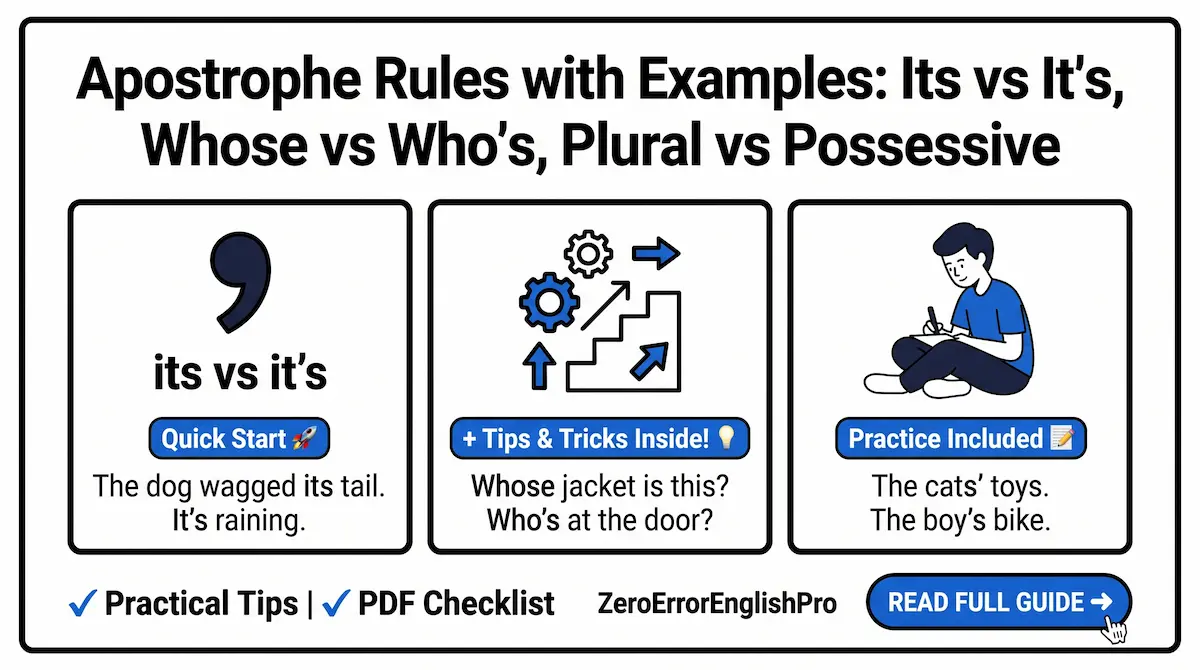
You’ve seen the sign outside a fruit stall: “Banana’s, 40 rupees a dozen.” And you’ve probably written this one yourself in a hurry: “The dog wagged it’s tail.” Both are wrong, and both are wrong in the same way. The apostrophe was added because the word ended in s, not because anything was owned or left out.
The apostrophe is the smallest mark on the keyboard, and it’s one of the most expensive in an exam. SSC CGL, bank PO and UPSC papers keep testing it in error spotting, sentence improvement and cloze passages, because the same five or six confusions trip up even strong students: its and it’s, whose and who’s, plural and possessive, and the apostrophe in decades and numbers.
The good news is that an apostrophe has only two jobs. Learn those two jobs, add one three-question check, and you’ll stop guessing for good. This guide gives you the rules, a memory trick, the exam traps and a ten-question practice set with answers. If you haven’t read the earlier posts in this series, start with comma rules with examples and punctuation error spotting.
- The only two jobs an apostrophe has
- Job 1: showing ownership (the possessive rules)
- Job 2: showing missing letters (contractions)
- Its vs it’s, and the pronoun family
- Whose vs who’s
- Plural vs possessive: no apostrophe for a crowd
- Special cases examiners like
- 8 common apostrophe mistakes
- The 3-question apostrophe check
- Practice set with answers
- FAQ
The only two jobs an apostrophe has
Here’s the whole topic in one line, and it’s the memory trick for this post.
“OWN or OMIT. Never COUNT.”
OWN = the apostrophe shows ownership (the dog’s bowl)
OMIT = the apostrophe shows omitted letters (don’t, it’s)
Never COUNT = the apostrophe never makes a plural (bananas, 1990s, MBAs)
Before you type an apostrophe, ask which of the two jobs it’s doing. If it isn’t owning and it isn’t omitting, delete it. That single question removes most apostrophe errors, because most wrong apostrophes are plural s’s that picked up an apostrophe by habit.
Every example in this post is an original practice sentence on a common exam pattern. None of them is copied from a particular year’s paper.
Job 1: showing ownership
Rule 1: A singular owner takes apostrophe + s
It doesn’t matter how long the word is. One owner, add ’s.
Rule 2: A plural owner ending in s takes only the apostrophe
The plural already has its s, so you only add the apostrophe after it. Memory trick: “Owner first, apostrophe next, s last, unless the owner already ends in s.” Write the owner in full, then decide where the apostrophe goes.
Rule 3: A plural owner not ending in s takes apostrophe + s
Children, men, women and people are plural without an s, so they behave like singular owners. ✗ childrens’ and ✗ mens’ are classic exam errors.
Rule 4: Names ending in s
✓ Charles’s car or Charles’ car
Style guides differ, and both forms are accepted in standard English. For writing, pick one style and stay consistent. In objective exams, the question will almost always test a clearer error, so don’t spend time here.
Rule 5: Joint and separate ownership
✓ Ravi’s and Meera’s houses (each has a different house)
If the owners share one thing, only the last name takes the apostrophe. If each owns a separate thing, every owner takes one.
Rule 6: Time and amount expressions
✓ two days’ notice, three months’ leave
Time expressions behave like owners. One week, so ’s. Two days, so s’. Use the same Rule 1 and Rule 2 logic, and count the number first.
Job 2: showing missing letters
A contraction joins two words and drops some letters. The apostrophe sits exactly where the letters went missing.
| Full form | Contraction | Missing letters |
|---|---|---|
| do not | don’t | o |
| cannot | can’t | no |
| will not | won’t | irregular change |
| they are | they’re | a |
| I have | I’ve | ha |
| who is / who has | who’s | i or ha |
| it is / it has | it’s | i or ha |
Contractions are for speech and informal writing. In a formal essay or letter, many examiners prefer the full forms, so write “do not” instead of “don’t” when the tone is formal.
Its vs it’s, and the pronoun family
This is the single most-tested apostrophe pair, and the rule is simple once you see the pattern.
✓ It’s going to rain today. (it’s = it is)
✓ It’s been a long week. (it’s = it has)
The expansion test: say “it is” or “it has” in the gap. If the sentence still makes sense, write it’s. If it doesn’t, write its.
Why its has no apostrophe: possessive pronouns never take one. His, hers, ours, yours, theirs and its all show ownership without an apostrophe. Memory trick: “Its is like his and hers, and his and hers have no apostrophe.”
| Owns (no apostrophe) | Omits (apostrophe) |
|---|---|
| its | it’s (it is / it has) |
| whose | who’s (who is / who has) |
| your | you’re (you are) |
| their | they’re (they are) |
| hers, ours, yours, theirs | no contractions exist |
Notice the pattern. In every pair, the word that owns has no apostrophe, and the word that omits letters has one. Learn that once, and you’ve covered four exam pairs at the same time.
Whose vs who’s
✓ Who’s coming to the meeting? (who’s = who is)
✓ Who’s finished the report? (who’s = who has)
The test is the same expansion test. Say “who is” or “who has” in the gap. If it fits, use who’s. If it doesn’t, use whose.
A small exam note: “whose” isn’t only for people. “The company whose profits doubled” is correct. Ownership, not personhood, decides it. You can also revisit the relative pronoun rules in my guide to who, which and that.
Plural vs possessive: no apostrophe for a crowd
This is the error behind “Banana’s, 40 rupees.” A plural only tells you there’s more than one. It doesn’t tell you anything is owned. Ask one question: “Does anything belong to this word?”
✓ All the students must submit their forms. (more than one, nothing owned)
✓ The student’s form was incomplete. (the form belongs to one student)
Memory trick: “An apostrophe belongs to an owner, not to a crowd.”
The same rule covers numbers, decades, abbreviations and letters.
✓ In the 1990s, MBAs became popular.
The only common exception is a single letter or a lowercase letter used as a word, where the apostrophe prevents confusion: “mind your p’s and q’s,” “she got three A’s.” You’re unlikely to be tested on this, so don’t let it make you add apostrophes to ordinary plurals.
Special cases examiners like
1. Double possessive. “A friend of my father’s” is correct. The “of” shows a relationship, and the ’s shows ownership, and English allows both together.
2. Possessive before an -ing word. “I appreciate his coming” is formal and correct. “I appreciate him coming” is common in speech. Exam keys usually prefer the possessive form.
3. Compound nouns. The apostrophe goes on the last word: “my mother-in-law’s house,” “the Prime Minister of India’s speech.”
4. Shop names and places. “I’m going to the doctor’s” means the doctor’s clinic. The noun is understood, so it can be dropped.
5. Plural nouns that look singular. Words like “news,” “physics” and “mathematics” are singular, so they aren’t made possessive with a plural pattern.
8 common apostrophe mistakes (and fixes)
1. Its for it’s. ✗ Its raining outside. ✓ It’s raining outside.
2. It’s for its. ✗ The cat licked it’s paw. ✓ The cat licked its paw.
3. Who’s for whose. ✗ Who’s bag is this? ✓ Whose bag is this?
4. An apostrophe in a plain plural. ✗ She bought three apple’s. ✓ She bought three apples.
5. An apostrophe in a decade. ✗ The 1980’s were different. ✓ The 1980s were different.
6. Wrong position for a plural owner. ✗ The two boy’s bags. ✓ The two boys’ bags.
7. Childrens’ or mens’. ✗ The childrens’ park. ✓ The children’s park.
8. An apostrophe in a possessive pronoun. ✗ This book is her’s. ✓ This book is hers.
The 3-question apostrophe check
When you see an apostrophe, or a word that needs one, run these three questions in order.
Question 1: Can I expand it? Try “is,” “has,” “are,” “not” or “have.” If the expansion works, it’s a contraction, and the apostrophe marks the missing letters (it’s, who’s, you’re).
Question 2: Does something belong to it? If yes, it’s ownership. Write the owner, then apply Rule 1, 2 or 3. A singular owner takes ’s, a plural ending in s takes s’, and an irregular plural takes ’s.
Question 3: Is it just more than one? If it’s only a count, it’s a plain plural, and there’s no apostrophe at all.
It takes about five seconds, and it uses the same “OWN or OMIT, never COUNT” logic. If the word fails all three, the apostrophe doesn’t belong. The book Advanced Punctuation Mastery goes deeper with an apostrophe decision tree and a possession versus contraction chapter, so you can see the same logic laid out step by step.
A pattern teachers see every year
Most students who miss apostrophe questions can recite the rules. What they don’t have is a habit of checking. They write its or it’s by feel, add an s’ to anything that ends in s, and rely on “it looks right.”
The fix is a small daily exercise. Take five sentences from a newspaper, circle every apostrophe, and write next to each one the word OWN or OMIT. Then circle every plural noun and ask whether it owns anything. After two weeks, you’ll see apostrophes the way an examiner does, and the unnecessary ones will jump out at you.
Expert tips for exam day
Say the expansion aloud. “It is” or “who is” in the gap settles its/it’s and whose/who’s in two seconds.
Underline every s at the end of a word. Then check whether it’s a plural, a possessive or a contraction.
Don’t add apostrophes to be safe. An extra apostrophe is as wrong as a missing one.
Check the owner’s number first. Singular means ’s. Plural ending in s means s’. Irregular plural means ’s.
Remember “No error.” A correct apostrophe sentence is a valid answer.
Practice set: 10 error spotting questions
Find the part with the error, or choose (D) if there’s none. These are original practice sentences written for this guide.
- The dog wagged (A) / it’s tail (B) / when it saw the owner. (C) / No error (D)
- Who’s coming (A) / to the meeting (B) / tomorrow? (C) / No error (D) (Read this one carefully: it’s correct.)
- The two boy’s (A) / bags were kept (B) / near the door. (C) / No error (D)
- She bought (A) / three apple’s (B) / from the market. (C) / No error (D)
- The childrens’ (A) / playground (B) / is closed today. (C) / No error (D)
- In the 1990’s, (A) / many families (B) / bought their first TV. (C) / No error (D)
- Hers is better (A) / than (B) / their’s. (C) / No error (D)
- We have (A) / a weeks’ holiday (B) / in December. (C) / No error (D)
- Ravi and Meera’s (A) / new house (B) / is near the school. (C) / No error (D)
- Whose (A) / going to (B) / collect the forms? (C) / No error (D)
Answers
1. (B): “it’s” should be “its” (ownership).
2. (D): no error. “Who’s” means “who is,” so the sentence is correct.
3. (A): should be “boys’,” because the owner is plural and ends in s.
4. (B): should be “apples.” It’s a plain plural, so no apostrophe.
5. (A): should be “children’s.” An irregular plural takes ’s.
6. (A): should be “1990s.” An apostrophe never makes a plural.
7. (C): should be “theirs.” Possessive pronouns take no apostrophe.
8. (B): should be “a week’s holiday.” One week means ’s.
9. (D): no error. “Ravi and Meera’s house” shows joint ownership correctly.
10. (A): should be “Who’s,” because you can expand it to “who is.”
If you scored 9 or 10, you’re ready for harder questions. If you scored 6 to 8, revise the rule behind the ones you missed. If you scored below 6, reread the two jobs and the pronoun table, and retake the set after two days. Advanced Punctuation Mastery also includes practice questions, previous-year style exam questions and complete answer keys after every rule, so you can keep measuring your progress.
Frequently asked questions
What is the easiest way to remember its vs it’s?
Say “it is” or “it has” in the gap. If it fits, write it’s. If it doesn’t, write its. Also remember that its follows the same pattern as his and hers, and neither of those has an apostrophe.
Do plurals ever take an apostrophe?
Almost never. Plain plurals (books, cars, MBAs, 1990s) take no apostrophe. The only common exception is a single letter or a lowercase letter used as a word, such as “p’s and q’s.”
Is it “James’s book” or “James’ book”?
Both are accepted. Choose one style and stay consistent. Exam questions rarely hinge on this, so focus on the clearer errors first.
How do I show that two people own something together?
Put the apostrophe on the last name only: “Ravi and Meera’s house.” If each person owns a different thing, use an apostrophe on both: “Ravi’s and Meera’s houses.”
How long does it take to improve at apostrophes?
Most students see a clear change within two weeks of five sentences a day. Label each apostrophe OWN or OMIT, and keep an error log for the patterns you miss.
Your next step
Apostrophe errors survive because the mark looks harmless and we trust our ear. Replace the ear with a routine: OWN or OMIT, never COUNT. Ask which job each apostrophe is doing, run the three-question check, and delete any apostrophe that has no job.
When you want every punctuation mark covered with rules, exam-style questions, memory aids and answer keys in one place, grab Advanced Punctuation Mastery: A Complete Guide to Error-Free English for Competitive Aspirants on Amazon: https://amzn.to/4yXLKMo
Which of the apostrophe traps caught you out? Tell me in the comments, and I’ll explain it in more detail.
Advanced Punctuation Mastery: A Complete Guide to Error-Free English for Competitive Aspirants
Turn punctuation from an overlooked afterthought into a precise, rule-governed writing skill that strengthens every sentence.