Changes in Pronouns, Time and Place Words in Reported Speech: Rules and Examples
Learn how pronouns, time words and place words change in reported speech with the P-T-P method, memory tricks, 12 examples and a practice set with answers.
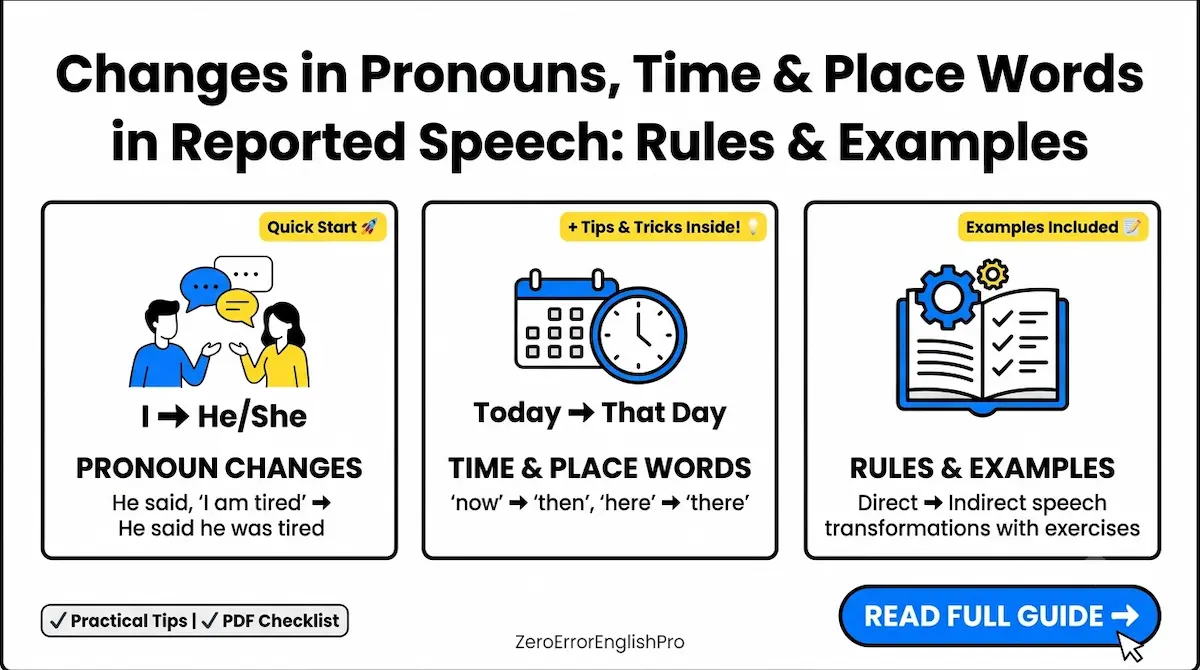
Read this sentence: She said to me, "I will meet you here tomorrow." Now report it. A common attempt looks like this: "She told me that she would meet you here tomorrow."
Count the mistakes. The pronoun is wrong, because "you" now refers to me, the listener, so it must become "me". The place word is wrong, because "here" must become "there". And the time word is wrong, because "tomorrow" must become "the next day". Three small words, three changes, and most students catch only one of them.
The correct answer is: She told me that she would meet me there the next day.
This is the heart of reported speech. Tenses get all the attention, but pronouns, time words and place words decide whether your answer is right or only almost right. In this guide, I'll show you a simple three-check method, the complete lists of changes, the exceptions, the mistakes examiners love and a practice set with answers. If you haven't read the basics, start with my post on direct and indirect speech rules with examples, and my guide to the tense changes chart. The examples here are original sentences on common exam patterns, not questions from a particular year's paper.
- Person: change the pronouns (S-O-N rule).
- Time: change the time words (now to then, tomorrow to the next day).
- Place: change the place words (here to there, this to that).
In This Guide
- Part 1: Pronoun changes in reported speech
- Part 2: Time words in reported speech
- Part 3: Place and demonstrative words
- Memory tricks cheat sheet (screenshot this)
- When time and place words do NOT change
- A step-by-step walkthrough of a harder sentence
- 12 worked examples
- 7 common mistakes with pronouns, time and place
- Practice set: 12 questions
- A 3-day plan to master this lesson
- Frequently asked questions
- Where to go from here
Part 1: Pronoun changes in reported speech
A pronoun in direct speech is chosen from the speaker's point of view. When you report it, you speak from your own point of view, so the pronoun must change to match who is who in the reporting sentence.
The three-part rule
- First person (I, me, my, mine, we, us, our, ours) changes according to the subject of the reporting verb.
- Second person (you, your, yours) changes according to the object of the reporting verb.
- Third person (he, she, it, they, him, her, them, his, their) does not change.
Examples of each rule
| Type | Direct speech | Indirect speech |
|---|---|---|
| First person follows the subject | Ravi said, "I am tired." | Ravi said that he was tired. |
| Second person follows the object | Ravi said to Sunil, "You are late." | Ravi told Sunil that he was late. |
| Third person stays | Ravi said to Sunil, "She is late." | Ravi told Sunil that she was late. |
| Both together | Ravi said to Sunil, "I will help you." | Ravi told Sunil that he would help him. |
The full pronoun table
| Direct speech | Becomes (in indirect speech) |
|---|---|
| I, me, my, mine, myself | he/she, him/her, his/her, his/hers, himself/herself |
| we, us, our, ours, ourselves | they, them, their, theirs, themselves |
| you, your, yours, yourself | I/he/she/they, me/him/her/them, my/his/her/their, and so on (it depends on the listener) |
| he, she, it, they, him, her, them | no change |
Special cases that confuse students
When the speaker is also the reporter. If you're reporting your own words, "I" stays "I": I said to him, "I will help you." becomes I told him that I would help him. The first-person pronoun follows the subject, and the subject is "I".
When the listener is the reporter. You said to me, "You are late." becomes You told me that I was late. The second person "you" follows the object ("me"), so it becomes "I".
When there's no object. If the reporting verb has no listener (He said, "You are late."), the second person depends on the context. It becomes "I", "he", "she", "they" or a name, according to who the speaker meant. Exam questions usually give a clear context.
Part 2: Time words in reported speech
Words that point to a moment close to the speaker also change when the report is made later. Here's the standard list.
| Direct speech | Indirect speech |
|---|---|
| now | then |
| today | that day |
| tonight | that night |
| this morning / this evening | that morning / that evening |
| tomorrow | the next day / the following day |
| tomorrow morning | the next morning |
| yesterday | the previous day / the day before |
| last night | the previous night / the night before |
| last week / last year | the previous week / the previous year |
| next week / next month | the following week / the following month |
| two days ago | two days before |
Part 3: Place and demonstrative words
| Direct speech | Indirect speech |
|---|---|
| here | there |
| this | that |
| these | those |
| come | go (when the movement is away from the reporter's place) |
| bring | take (when the movement is away from the reporter's place) |
Memory tricks cheat sheet (screenshot this)
Here's every shortcut from this guide, plus the earlier ones from this series, in one place.
| What to check | Memory shortcut |
|---|---|
| The order of checks | P-T-P: Person, Time, Place. |
| Pronouns | S-O-N: first person follows Subject, second person follows Object, third person No change. |
| Near and far words | N-F: Near words become Far words (now, then; here, there; this, that). |
| Yesterday and tomorrow | Y-B, T-A: Yesterday means before, tomorrow means after. |
| come and bring | COME GOES, BRING TAKES when the movement is away from you. |
| Tenses (previous post) | ONE STEP BACK, like reversing a car. |
| Tense families (previous post) | SAME FAMILY, PAST ADDRESS and PAST GOES PERFECT. |
When time and place words do NOT change
- The reporting verb is in the present or future tense. He says, "I will come tomorrow." becomes He says that he will come tomorrow. Here, the report is happening now, so "tomorrow" is still tomorrow.
- The report is made on the same day or in the same place. If you're reporting at the same moment and at the same location, the word may stay. For example, "He said that he would come tomorrow" is acceptable if you say it today. But in exams, unless a question says so, change the words by the standard rule.
In practice, treat these two as the only exceptions you need. In most exam questions, the reporting verb is in the past and there's no hint about when and where the report is made, so the standard changes apply.
A step-by-step walkthrough of a harder sentence
Let's apply P-T-P to a longer sentence that mixes everything: Ravi said to Seema, "I lost my pen yesterday, and you can use this one now."
| Check | What changes |
|---|---|
| Reporting verb | said to becomes told, and we add "that". |
| Person | I becomes he (subject, Ravi). my becomes his. you becomes she (object, Seema). |
| Time | yesterday becomes the previous day. now becomes then. |
| Place and demonstrative | this one becomes that one. |
| Tense | lost becomes had lost. can becomes could. |
Final answer: Ravi told Seema that he had lost his pen the previous day and that she could use that one then.
See how the sentence breaks into small, easy decisions? That's the real skill. A long sentence isn't harder than a short one. It just has more small decisions. Take them one by one in the P-T-P order, and the answer builds itself.
12 worked examples
Study each one, and notice which check (person, time or place) is at work. Try converting them yourself before you read the answers.
| No. | Direct speech | Indirect speech |
|---|---|---|
| 1 | He said, "I am busy now." | He said that he was busy then. |
| 2 | She said to me, "I will meet you here tomorrow." | She told me that she would meet me there the next day. |
| 3 | Ravi said to Sunil, "I will help you." | Ravi told Sunil that he would help him. |
| 4 | I said to him, "I will help you." | I told him that I would help him. |
| 5 | You said to me, "I am ready." | You told me that you were ready. |
| 6 | They said, "We are playing here today." | They said that they were playing there that day. |
| 7 | The boy said, "My father came yesterday." | The boy said that his father had come the previous day. |
| 8 | Meena said to her sister, "Your book is on this table." | Meena told her sister that her book was on that table. |
| 9 | He said, "I saw her two days ago." | He said that he had seen her two days before. |
| 10 | She said, "I will come here next week." | She said that she would go there the following week. |
| 11 | Anita said, "I lost my keys last night." | Anita said that she had lost her keys the previous night. |
| 12 | Sunil said, "I am going to Pune tonight." | Sunil said that he was going to Pune that night. |
7 common mistakes with pronouns, time and place
| Wrong | Right | Why |
|---|---|---|
| Rita told Sita that I would help you. | Rita told Sita that she would help her. | First person follows the subject, second person the object. |
| She said that she would come tomorrow. | She said that she would come the next day. | Tomorrow becomes the next day. |
| He told me that he was playing here. | He told me that he was playing there. | Here becomes there. |
| They said that this book was old. | They said that that book was old. | This becomes that. |
| He said that he met her last week. | He said that he had met her the previous week. | Last week becomes the previous week. |
| I said to him that I will help him. | I told him that I would help him. | Said to becomes told, and the tense steps back. |
| She said that she was busy now. | She said that she was busy then. | Now becomes then. |
Practice set: 12 questions
Convert each sentence into indirect speech. Use the P-T-P check on every one, and write your answers in a notebook first.
- He said, "I am leaving now."
- She said to me, "I will see you tomorrow."
- They said, "We live here."
- Mohan said to Sohan, "Your pen is on this desk."
- I said to her, "I will call you tonight."
- The boy said, "I saw a tiger yesterday."
- You said to me, "You are late."
- She said, "I have been waiting here since morning."
- Raj said to Ravi, "I will meet you next Monday."
- Seema said, "These books are mine."
- He said, "I bought this bike two years ago."
- Anil said to me, "My brother will come today."
1) He said that he was leaving then.
2) She told me that she would see me the next day.
3) They said that they lived there.
4) Mohan told Sohan that his pen was on that desk.
5) I told her that I would call her that night.
6) The boy said that he had seen a tiger the previous day.
7) You told me that I was late.
8) She said that she had been waiting there since morning.
9) Raj told Ravi that he would meet him the following Monday.
10) Seema said that those books were hers.
11) He said that he had bought that bike two years before.
12) Anil told me that his brother would come that day.
Your score: 11 or 12 means you're exam-ready on this part. 8 to 10 means revise the pronoun rule and the lists. Below 8, go back to the cheat sheet and try again after two days.
A 3-day plan to master this lesson
| Day | What to do |
|---|---|
| 1 | Learn S-O-N. Write ten sentences with first, second and third person pronouns and convert them. |
| 2 | Learn N-F, Y-B T-A and COME GOES, BRING TAKES. Write five sentences for each. |
| 3 | Retake the 12-question practice set without looking at the answers. |
Frequently asked questions
Why do pronouns change in reported speech?
Because a pronoun is chosen from the speaker's point of view. When you report the sentence, you speak from your own point of view, so the pronouns must match the new situation.
How do I change "you" in indirect speech?
The second person follows the object of the reporting verb. If you say "Ravi said to Sunil, 'You are late'", then "you" refers to Sunil, so it becomes "he". If the listener is the reporter, "you" becomes "I".
Do I always change "now" to "then"?
In exam questions, yes, when the reporting verb is in the past. The exceptions are a present or future reporting verb, and a report made at the same moment and place.
Should I write "the next day" or "the following day"?
Both are correct for "tomorrow". Use whichever you prefer, and be consistent. The same is true for "the previous day" and "the day before" for "yesterday".
When does "come" become "go"?
When the movement is away from the place where the reporter is standing. If the movement is towards the reporter's place, "come" stays "come". Exam questions with "come" and "go" usually follow the first rule.
What is the easiest way to remember all these changes?
Use P-T-P to decide the order of checks (person, time, place), S-O-N for pronouns and N-F for near words. Practise ten sentences a day for a week and the changes become automatic.
Where to go from here
You now have the three checks, the full lists and the memory tricks to handle pronouns, time words and place words in any statement. Practise the twelve questions again in three days, and keep the cheat sheet on your phone. The next posts in this series cover reporting verbs and then questions, commands and exclamations.
If you'd like the complete system in one place, with rules, memory tricks and exam-style practice, my ebook Mastering Direct & Indirect Speech: Ultimate Guide to Confident Reporting: For SSC CGL, IBPS PO, CAT, CUET, UPSC and State PSCs is available on Amazon.
Mastering Direct & Indirect Speech: Ultimate Guide to Confident Reporting
Convert narration from your most error-prone descriptive-paper section into a confidently mastered, rule-driven skill.