Direct and Indirect Speech Rules with Examples: A Simple Guide for Competitive Exams
Learn direct and indirect speech rules with a 5-step method, memory tricks, 10 solved examples, common mistakes and a practice set with answers.
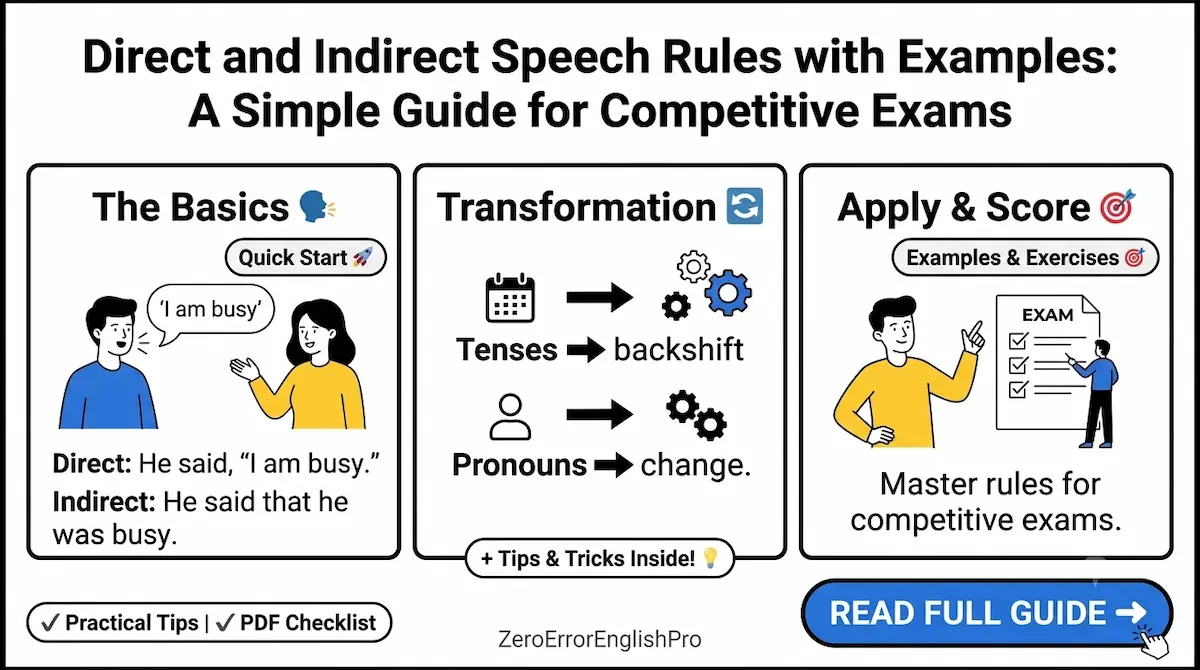
Read this sentence: He said, "I am tired." Now report it. Should you write "He said that he is tired" or "He said that he was tired"?
If you hesitated, you're in good company. This one small question trips up thousands of students every year, because direct and indirect speech looks simple until you try to convert a sentence under exam pressure. Then the tense, the pronoun, the time word and the connector all start fighting for your attention.
Here's the good news. Every conversion follows the same five steps, and once you know them, you can convert almost any statement in under twenty seconds. I've taught this topic for more than 22 years, and I've never met a student who couldn't learn it. The students who struggle are usually the ones who try to memorise sentences instead of learning the method.
In this guide, you'll get the core rules, a five-step method, ten worked examples, the exceptions where tenses don't change, the mistakes examiners love and a practice set with answers. There's also a memory-tricks cheat sheet in the middle, so you can remember the rules without re-reading the whole post. A note on the examples: they're original sentences on common exam patterns, not questions taken from a particular year's paper.
- Remove the quotation marks and add that (for statements).
- Change the pronouns to match the speaker and the listener.
- Move the tense one step back.
- Change time and place words (now to then, here to there).
- Change said to into told.
In This Guide
- What are direct and indirect speech?
- The 5-step method (works for every statement)
- Rule 1: The reporting verb
- Rule 2: Pronoun changes
- Rule 3: Tense changes (one step back)
- Rule 4: Time and place words
- Memory tricks cheat sheet (screenshot this)
- When the tense does NOT change
- 10 worked examples
- 7 common mistakes in reported speech
- Practice set: 10 questions
- A 5-day plan to master the basics
- Frequently asked questions
- Where to go from here
What are direct and indirect speech?
Direct speech gives the exact words of the speaker, inside quotation marks. Indirect speech (also called reported speech) tells us what the speaker said, without quotation marks and with some changes.
- Direct: Rahul said, "I like cricket."
- Indirect: Rahul said that he liked cricket.
Every direct speech sentence has two parts. The first is the reporting clause, which tells us who is speaking (Rahul said). The second is the reported speech, which is the exact words (I like cricket). When we convert, the reporting clause stays almost as it is, and the reported speech changes.
Exams test this topic in several forms: converting a sentence from direct to indirect or the other way, choosing the correct option, and spotting errors in a reported sentence. All of them rely on the same rules.
The 5-step method (works for every statement)
Let's convert this sentence together: Meera said to her friend, "I will send you the notes tomorrow."
| Step | What you do | Result |
|---|---|---|
| 1 | Find the reporting verb and the reported speech | Reporting verb: said to. Reported speech: I will send you the notes tomorrow. |
| 2 | Remove quotes, add "that", change said to into told | Meera told her friend that ... |
| 3 | Change the pronouns | I becomes she. You becomes her. |
| 4 | Move the tense one step back | will send becomes would send |
| 5 | Change the time word | tomorrow becomes the next day |
Final answer: Meera told her friend that she would send her the notes the next day.
Practise this routine on five or six sentences, and it will start to feel automatic. Now let's look at each rule properly.
Rule 1: The reporting verb
If the reporting verb is said with no listener, it stays said. If it's said to (with a listener), change it to told.
- He said, "I am ready." becomes He said that he was ready.
- He said to me, "I am ready." becomes He told me that he was ready.
Examiners love this one. "He said me that he was ready" is wrong, and so is "He told that he was ready". Remember: said goes straight to "that", while told always needs a person after it.
Rule 2: Pronoun changes
Pronouns change according to who is speaking and who is listening. The rule has three parts:
- First person (I, we, my, our) changes according to the subject of the reporting verb.
- Second person (you, your) changes according to the object of the reporting verb.
- Third person (he, she, they, it) doesn't change.
Example: Anil said to Sunil, "I will help you."
"I" is first person, so it follows the subject: Anil becomes he. "You" is second person, so it follows the object: Sunil becomes him. Result: Anil told Sunil that he would help him.
Rule 3: Tense changes (one step back)
When the reporting verb is in the past (said, told), the verb in the reported speech moves one step back into the past. I'll cover the full chart in the next post of this series. Here's the quick version.
| Direct speech | Indirect speech |
|---|---|
| Present simple (He plays) | Past simple (He played) |
| Present continuous (He is playing) | Past continuous (He was playing) |
| Present perfect (He has played) | Past perfect (He had played) |
| Past simple (He played) | Past perfect (He had played) |
| will, can, may | would, could, might |
Rule 4: Time and place words
Words that point to the present moment or the present place also change, because the situation has moved on.
| Direct | Indirect |
|---|---|
| now | then |
| here | there |
| this / these | that / those |
| today | that day |
| tomorrow | the next day / the following day |
| yesterday | the previous day / the day before |
| ago | before |
Memory tricks cheat sheet (screenshot this)
Here's every shortcut from this guide in one place. Save the table, and read it aloud before your next practice test.
| Rule | Memory shortcut |
|---|---|
| Tense changes | ONE STEP BACK, like reversing a car. |
| Pronouns | S-O-N: first person follows Subject, second person follows Object, third person No change. |
| Time and place words | N-F: Near words become Far words (now, then; here, there; this, that). |
| said to / told | Said to a person, told a person: told always needs a listener right after it. |
| Quotation marks | No quotes, no comma, no capital after "that" (except I and names). |
| Universal truths | Frozen facts don't move: no step back for things that are always true. |
| Present or future reporting verb | Present stays present: if "says" or "will say", don't change the tense. |
When the tense does NOT change
Rule 3 has exceptions, and examiners know that students forget them. Here are the four main ones.
1. The reporting verb is in the present or future tense
- He says, "I am busy." becomes He says that he is busy.
- She will say, "I need help." becomes She will say that she needs help.
Only the pronoun changes. The tense stays the same, because the report is happening now.
2. The reported speech is a universal truth or habitual fact
- The teacher said, "The sun rises in the east." becomes The teacher said that the sun rises in the east.
- He said, "Honesty is the best policy." becomes He said that honesty is the best policy.
A fact that's always true doesn't take a step back. Memory shortcut: frozen facts don't move.
3. The verb is already in the past perfect tense
- He said, "I had finished the work." becomes He said that he had finished the work.
There's no step further back to take, so the past perfect stays as it is.
4. Certain modals don't change
Would, could, should, might, ought to and used to stay unchanged. "She said, 'I could swim well.'" becomes "She said that she could swim well." The modal must usually stays too, although "had to" is also accepted: "He said, 'I must go.'" becomes "He said that he must go" or "he had to go".
10 worked examples
Study the pattern in each one, and try converting them yourself before you read my answers.
| No. | Direct speech | Indirect speech |
|---|---|---|
| 1 | He said, "I am happy." | He said that he was happy. |
| 2 | She said to me, "I will help you." | She told me that she would help me. |
| 3 | Ravi said, "My brother is coming today." | Ravi said that his brother was coming that day. |
| 4 | The teacher said, "The sun rises in the east." | The teacher said that the sun rises in the east. |
| 5 | They said, "We have finished the work." | They said that they had finished the work. |
| 6 | Mother said to me, "You must study hard." | Mother told me that I must study hard. |
| 7 | He said, "I went to Mumbai yesterday." | He said that he had gone to Mumbai the previous day. |
| 8 | Sita said to Rita, "I can drive your car." | Sita told Rita that she could drive her car. |
| 9 | The boys said, "We are playing here now." | The boys said that they were playing there then. |
| 10 | He says, "I am busy." | He says that he is busy. |
Look closely at examples 4 and 10. In example 4, the tense stays the same because it's a universal truth. In example 10, it stays the same because the reporting verb is in the present tense. Every other example shows the one-step-back rule at work.
7 common mistakes in reported speech
| Wrong | Right | Why |
|---|---|---|
| He said me that he was ready. | He told me that he was ready. | Said to a person becomes told. |
| He told that he was ready. | He said that he was ready. / He told me that he was ready. | Told needs a listener. |
| She said that she will come tomorrow. | She said that she would come the next day. | Tense and time word both change. |
| He said that "I am tired." | He said that he was tired. | No quotes in indirect speech. |
| The teacher said that the earth moved round the sun. | The teacher said that the earth moves round the sun. | A universal truth stays in the present. |
| She said to me that I will help her. | She told me that I would help her. | Told, plus the tense step back. |
| He said that he is playing here. | He said that he was playing there. | Here becomes there, and the tense steps back. |
Practice set: 10 questions
Convert each sentence into indirect speech. Write your answers in a notebook first, then check.
- She said, "I am reading a novel."
- He said to me, "I will call you tomorrow."
- The doctor said, "Exercise is good for health."
- They said, "We have won the match."
- Rohit said to his mother, "I went to school yesterday."
- The boys said, "We are playing here."
- He says, "I like this book."
- Seema said, "My father can drive a truck."
- The principal said to the students, "You must be on time."
- Anil said, "I had completed my homework."
1) She said that she was reading a novel.
2) He told me that he would call me the next day.
3) The doctor said that exercise is good for health.
4) They said that they had won the match.
5) Rohit told his mother that he had gone to school the previous day.
6) The boys said that they were playing there.
7) He says that he likes this book.
8) Seema said that her father could drive a truck.
9) The principal told the students that they must be on time.
10) Anil said that he had completed his homework.
Your score: 9 or 10 means you're exam-ready on the basics. 6 to 8 means revise the exceptions. Below 6, go back to the five-step method and try again after two days.
A 5-day plan to master the basics
| Day | What to do |
|---|---|
| 1 | Learn the five-step method. Convert five sentences using it. |
| 2 | Revise S-O-N and practise ten pronoun changes. |
| 3 | Learn the tense chart with ONE STEP BACK and write one example for each row. |
| 4 | Learn the time and place words (N-F) and the four exceptions. |
| 5 | Take the practice set again without looking at the answers. |
Frequently asked questions
What is the difference between direct and indirect speech?
Direct speech repeats the exact words of the speaker inside quotation marks. Indirect speech reports the meaning in the reporter's own words, without quotation marks, and with changes in tense, pronouns and time words.
Why does the tense change in indirect speech?
The tense moves one step back because the original words were spoken in the past. When the reporting verb is in the past, the reported speech shifts back to match.
When should I use "said" and when "told"?
Use "said" when there's no listener, and "said to" with a listener becomes "told". "He told me that..." is correct, and "He said me that..." is wrong.
Does the tense always change in indirect speech?
No. It doesn't change if the reporting verb is in the present or future tense, if the statement is a universal truth or habitual fact, if the verb is already in the past perfect, or if the modal is would, could, should, might or ought to.
Is "that" always needed in indirect speech?
For statements, "that" is the usual connector, and in exams you should include it. In everyday speech it's sometimes dropped, but safe exam practice is to write it.
How can I remember all the rules?
Use the shortcuts: ONE STEP BACK for tenses, S-O-N for pronouns and N-F for time and place words. Say them aloud, and practise ten sentences a day for a week.
Where to go from here
Now you have the whole method: five steps, four rules, four exceptions and a set of memory tricks that make them stick. The next posts in this series go deeper into the tense chart, the time and place words, reporting verbs, and questions, commands and exclamations. Follow the series, and by the end you'll be able to handle any reported speech question.
If you'd like the complete system in one place, with rules, memory tricks and exam-style practice, my ebook Mastering Direct & Indirect Speech: Ultimate Guide to Confident Reporting: For SSC CGL, IBPS PO, CAT, CUET, UPSC and State PSCs is available on Amazon.
Mastering Direct & Indirect Speech: Ultimate Guide to Confident Reporting
Convert narration from your most error-prone descriptive-paper section into a confidently mastered, rule-driven skill.