The Ultimate Guide to Active & Passive Voice for Competitive Exams: What's Inside and Who Should Use It (CTA)
Discover exactly what the Ultimate Guide to Active & Passive Voice covers for SSC CGL, Banking and Railway exams, who benefits most, and how the zero-error transformation method eliminates the traps examiners recycle every year.
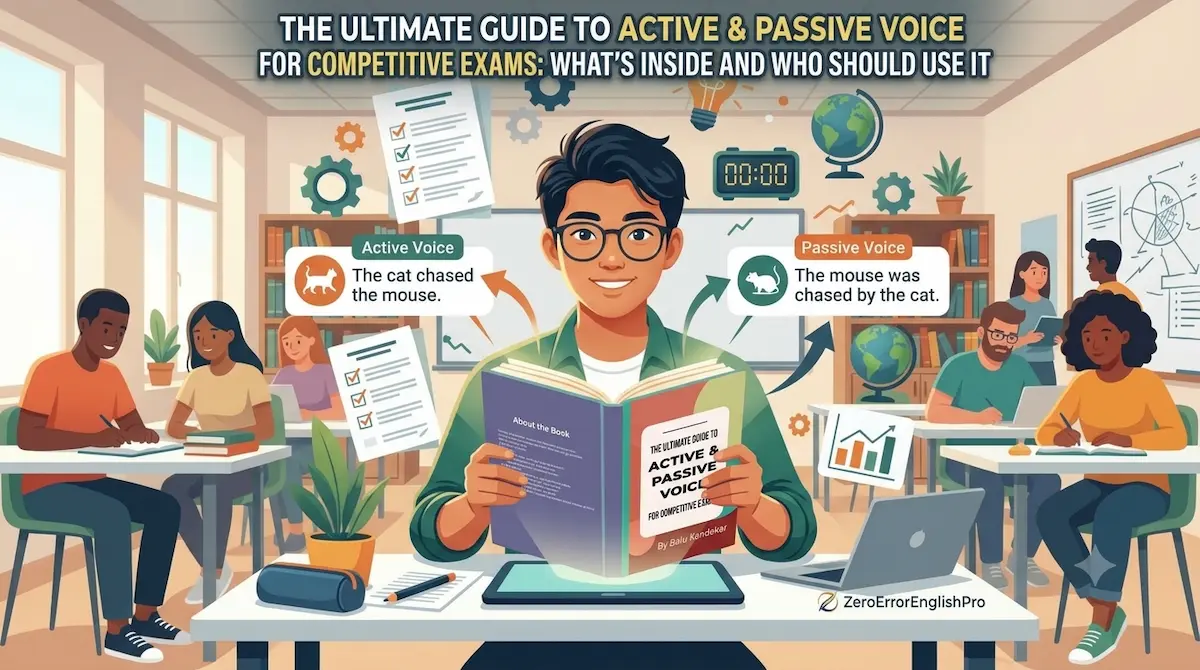
Why Active–Passive Voice Still Decides Ranks in 2026
Every year, SSC CGL, IBPS PO, SBI Clerk, Railway NTPC and State PSC papers contain at least four to six questions that hinge on Active and Passive Voice. The mechanical rule looks simple: turn the object into the subject, insert the correct form of “be,” and add the past participle. Yet aspirants who score 90+ in mocks still lose marks here. The reason is never the basic formula. Examiners test the edges—quasi-passive verbs, sensory constructions, modal passives, impersonal passives, and the verbs that simply refuse to form a passive at all.
This page is the complete orientation guide to the Ultimate Guide to Active & Passive Voice. It tells you exactly what is inside the full resource, who should prioritise it, how the zero-error method works, and why the usual “change the voice” drills leave gaps that cost 2.5 marks each. If you are preparing for any major Indian competitive exam in 2026–27, read this once, decide whether the full guide belongs in your stack, and then follow the concrete next steps at the end.
Core Governing Rule: Object of Active becomes Subject of Passive + appropriate form of BE + Past Participle of the main verb + (by + original subject as agent). If the active verb is intransitive, stative, or sensory-plus-adjective, passive is usually impossible.
In This Guide
- What Exactly Is Inside the Ultimate Guide
- Quick Facts Examiners Expect You to Know
- The Complete Tense-Wise Transformation Table
- Named Traps That Cost Marks Every Year
- The 5-Step Zero-Error Checking Method
- Who Should Focus on This Guide (and Who Can Skip)
- How to Practise So the Rules Stick
- Frequently Asked Questions
- Where to Go Next & Recommended Companions
What Exactly Is Inside the Ultimate Guide
The full Ultimate Guide is built as a single, exam-calibrated resource that moves from the core formula to the exact traps that appear in SSC, Banking and Railway papers. It is not a generic school grammar chapter. Every unit is sequenced so that a student who has already cleared the basics can still extract high-yield edge cases, while a beginner can start from zero and reach exam standard without switching books.
Unit 1 lays down the irreversible core formula and the three questions you must ask before you even touch the verb form. Unit 2 walks through all twelve tenses with side-by-side active–passive pairs and the precise auxiliary changes that examiners test. Unit 3 covers modals, semi-modals and causative constructions (have/get + object + past participle) that produce the bulk of “change the voice” questions in recent papers. Unit 4 isolates quasi-passive and sensory-verb exceptions—the sentences where passive is grammatically impossible. Unit 5 lists the intransitive and stative verbs that never form a true passive and shows how papers disguise them. Unit 6 finishes with impersonal passive, formal register and the reporting structures that appear in descriptive and precis tasks as well as objective questions.
Alongside the rules you get named traps, wrong–right–why tables, a one-page decision flowchart, and a spaced-revision checklist designed for the two weeks before the exam. The guide deliberately avoids fluff. Every example is either drawn from or modelled on previous-year patterns so that the transfer to the actual paper is immediate.
Ready to eliminate every Active–Passive trap?
The complete rule set, tense tables, quasi-passive exceptions and exam-style drills are organised for zero-error performance.
View All Grammar Guides →Quick Facts Examiners Expect You to Know
- Only transitive verbs (those that take a direct object) can form a true passive.
- The passive always needs a form of BE + past participle; any other structure is either wrong or quasi-passive.
- Sensory verbs (look, seem, smell, taste, feel, sound) followed by an adjective describe a state and almost never take a passive form.
- When the agent is unknown, unimportant or obvious, the “by + agent” phrase is omitted—this is the default in formal and scientific English.
- Modal + passive follows the pattern: modal + be + past participle (can be done, must be completed, should have been informed).
- Causative passive (have/get + object + past participle) is tested separately from ordinary passive and carries its own set of traps.
- In error-spotting, a passive form of an intransitive or stative verb is almost always the error.
The Complete Tense-Wise Transformation Table
Most students memorise only the present and past simple patterns. Examiners deliberately choose continuous, perfect and perfect-continuous forms because the auxiliary stack becomes longer and the chance of a wrong “be” form rises. The table below is the minimum set you must own cold.
| Tense | Active Pattern | Passive Pattern |
|---|---|---|
| Present Simple | V1 / V1+s | am/is/are + V3 |
| Present Continuous | am/is/are + V1-ing | am/is/are + being + V3 |
| Present Perfect | have/has + V3 | have/has + been + V3 |
| Past Simple | V2 | was/were + V3 |
| Past Continuous | was/were + V1-ing | was/were + being + V3 |
| Past Perfect | had + V3 | had + been + V3 |
| Future Simple | will + V1 | will + be + V3 |
| Future Perfect | will + have + V3 | will + have + been + V3 |
| Modal | modal + V1 | modal + be + V3 |
Notice that continuous passives insert “being” and perfect passives insert “been.” Mixing these two is one of the highest-frequency errors in recent SSC and Banking papers. The Ultimate Guide expands each row with three exam-style sentences and the exact wrong option that appears in the choices.
Named Traps That Cost Marks Every Year
Trap 1 – The Sensory-Adjective Illusion.
Wrong: The soup was tasted delicious by the guests.
Right: The soup tasted delicious to the guests.
Why: “Taste” here is a linking verb describing a quality, not an action performed on the soup. No passive exists.
Trap 2 – Intransitive Verb Forced into Passive.
Wrong: The train was arrived at the station late.
Right: The train arrived at the station late.
Why: “Arrive” takes no object; passive is structurally impossible.
Trap 3 – Missing “Being” in Continuous Passive.
Wrong: The road is repaired at the moment.
Right: The road is being repaired at the moment.
Why: Present continuous passive requires “is/are being + V3.”
Trap 4 – Wrong Auxiliary with Modal.
Wrong: The form must been submitted by Friday.
Right: The form must be submitted by Friday.
Why: Modal passive is always modal + be + past participle (or modal + have been + past participle for perfect).
Trap 5 – Unnecessary Agent.
Wrong: English is spoken by people in many countries by them.
Right: English is spoken in many countries.
Why: When the agent is generic or obvious, “by + agent” is omitted; including it creates redundancy that examiners mark as error.
Trap 6 – Quasi-Passive with “Get.”
Wrong: He was got selected for the post.
Right: He got selected for the post. / He was selected for the post.
Why: “Get” itself functions as a passive marker in informal style; stacking “was got” is non-standard and incorrect in exam English.
These six traps appear, in slightly varied wording, across the last eight years of SSC CGL Tier-1 and IBPS PO prelims. The Ultimate Guide lists fifteen further edge cases with the exact distractors used in official papers.
The 5-Step Zero-Error Checking Method
Whenever you face a “change the voice” or error-spotting item involving voice, run this sequence in under thirty seconds.
- Identify the main verb and decide whether it is transitive. If no object exists, passive is almost certainly wrong.
- Check for sensory or stative meaning. If the verb is followed by an adjective describing a state, reject passive.
- Locate the object of the active sentence. That noun phrase becomes the new subject.
- Select the correct BE form according to the tense and number of the new subject; insert “being” or “been” only when the tense demands it.
- Decide whether the agent is needed. Keep “by + agent” only when the doer is specific and important; otherwise drop it.
Practise the five steps on twenty mixed sentences every third day. After two weeks the sequence becomes automatic and the error rate on voice questions drops close to zero.
Stop losing marks on the same six traps.
Get the full tense tables, named-trap list and 5-step method in one place.
Explore the Complete Series →Who Should Focus on This Guide (and Who Can Skip)
Priority users
- SSC CGL / CHSL / CPO aspirants who still lose marks on voice or error-spotting items that contain passive structures.
- IBPS PO, SBI PO, Clerk and RRB candidates who need a reliable method for the English section under time pressure.
- Railway NTPC, Group-D and State PSC candidates whose papers recycle the same quasi-passive and modal-passive patterns.
- Anyone who has completed a basic grammar course but still feels uncertain when the sentence contains continuous or perfect passive forms.
- Students who prefer rule-driven, exam-pattern-calibrated material over lengthy theoretical chapters.
You can deprioritise this guide if
- You already score full marks on every voice question in recent mocks and can explain why a sensory verb cannot take passive.
- Your target exam does not test Active–Passive at all (rare for major Indian competitive exams).
- You are still struggling with basic tense identification; master tenses first, then return to voice.
For the large majority of aspirants targeting SSC, Banking or Railway in 2026, the guide is high-ROI. Voice questions are predictable once the traps are named and the five-step method is internalised.
How to Practise So the Rules Stick
Reading the rules once is not enough. Use the following spaced schedule:
- Day 1: Read the core formula and the tense table. Write five active sentences of your own and convert them.
- Day 3: Work through the named traps. For each trap, create one wrong and one right sentence.
- Day 5: Apply the 5-step method to twenty mixed previous-year questions without looking at the answers first.
- Day 8: Timed set of fifteen questions; aim for accuracy first, then speed.
- Day 12 and Day 18: Quick revision of the trap list and any sentences you previously got wrong.
Keep a single notebook page titled “Voice – Permanent Errors.” Every time you miss a question, write the wrong form, the correct form and the one-line reason. Review that page the night before the exam. This single habit removes the majority of repeated mistakes.
Frequently Asked Questions
Q: Can every active sentence be changed into passive?
A: No. Only sentences with a transitive verb that takes a direct object can form a true passive. Intransitive verbs, most stative verbs, and sensory verbs followed by an adjective cannot.
Q: Is “The book is belonging to me” ever correct?
A: Never in standard exam English. “Belong” is stative and does not form a progressive or passive in this sense. The correct form is “The book belongs to me.”
Q: When do I use “being” versus “been” in passive?
A: “Being” appears in continuous passives (is being repaired). “Been” appears in perfect passives (has been repaired). Mixing them is a frequent error.
Q: Do I always need “by + agent”?
A: No. Omit the agent when it is unknown, obvious or unimportant. Most formal and scientific passives drop the agent.
Q: How many voice questions can I expect in SSC CGL Tier-1?
A: Typically two to four direct or error-spotting items that turn on active–passive knowledge. In Banking prelims the number is similar; mains may add a few more in the form of sentence improvement.
Q: Is the guide useful for descriptive papers as well?
A: Yes. Impersonal passive and formal register are required in precis, essay and letter writing. Unit 6 of the full guide addresses exactly those structures.
Where to Go Next & Recommended Companions
Once the Active–Passive system is solid, strengthen the two areas that interact with it most often:
- Tenses – because the correct BE form depends on accurate tense identification.
- Subject-Verb Agreement – because the new subject in passive must still agree with the verb.
Both topics have dedicated ZeroErrorEnglishPro guides that use the same trap-naming and five-step style. After those, move to Reported Speech, where back-shifting and passive reporting verbs appear together.
Recommended next steps
1. Master the tense-wise table until you can produce every passive form without hesitation.
2. Drill the six named traps until you recognise them in under five seconds.
3. Apply the 5-step method on a fresh set of twenty previous-year questions.
4. Continue with the Subject-Verb Agreement and Tenses guides for complete coverage of the grammar section.
Build the complete zero-error system
Active–Passive is one high-yield module. Combine it with the full series for consistent accuracy across the English paper.
View All Grammar Guides →The Ultimate Guide to Active & Passive Voice for Competitive Exams
Move beyond the mechanical active-to-passive formula to confidently recognize when passive voice is grammatically impossible.