Subject-Verb Agreement: The 7 Traps SSC & Banking Examiners Bank On
Examiners never test simple sentences. Discover how they disguise plural intervening phrases, invert clauses, and manipulate proximity to cost you 2.5 marks — with the exact test that catches every trap.
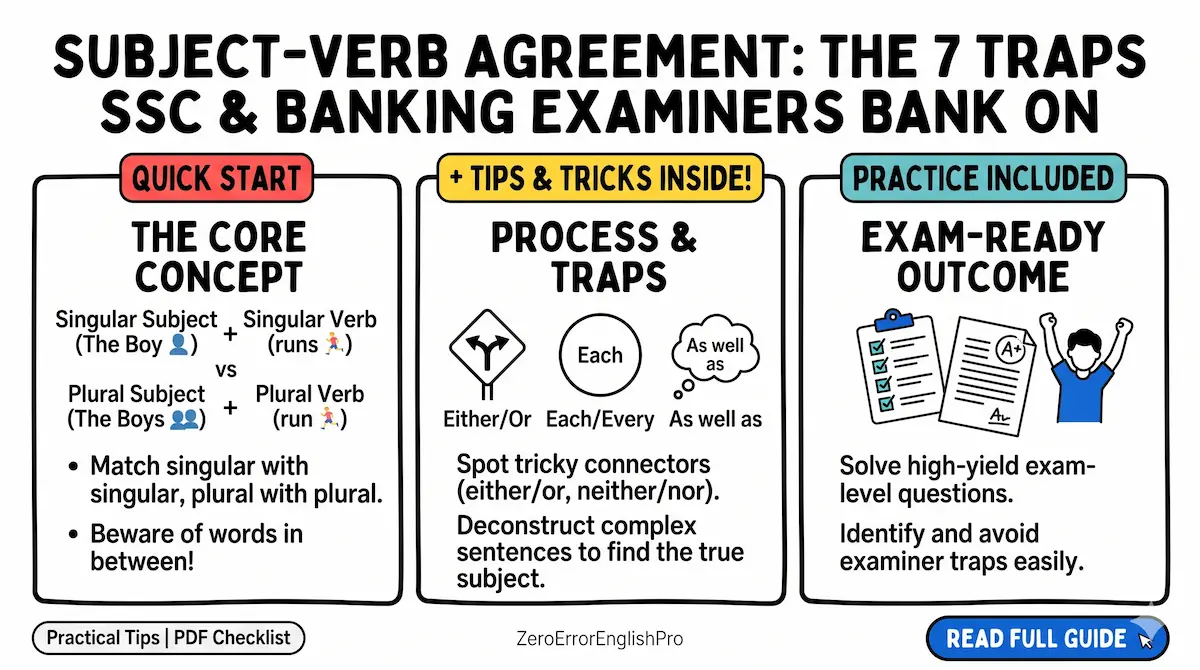
Why "The Team Are Playing Well" Still Feels Right — and Still Costs Marks
Every aspirant knows the rule: a singular subject takes a singular verb. Yet Subject-Verb Agreement questions still account for a disproportionate share of negative marks in SSC CGL and IBPS PO every single year. Not because the rule is hard — because examiners never test the rule in its simple form.
They bury the real subject under prepositional phrases, invert normal word order, and exploit words that sound plural but grammatically aren't. This guide walks through the 7 traps they recycle most, and gives you one test that catches all of them.
Quick answer: Find the true grammatical subject by mentally removing every prepositional phrase and parenthetical clause. The verb must agree with what's left — never with the nearest noun.
In This Guide
- Why Strong Students Still Fall for This
- 5 Mistakes That Are Costing You Marks
- The 6-Step Verification Method (With Real Exam Patterns)
- How Sneha Fixed This in One Week
- Expert Shortcuts Toppers Actually Use
- Final Takeaway
- Frequently Asked Questions
Why Strong Students Still Fall for This
Subject-verb agreement questions are designed to exploit proximity — your brain instinctively matches the verb to whichever noun sits closest to it, even when that noun isn't the real subject.
- You match the verb to the nearest noun, not the true subject. Long prepositional phrases sit between the subject and verb specifically to trigger this instinct.
- You treat "along with," "as well as," and "with" as coordinating conjunctions. They're prepositions — they never make a singular subject plural.
- You forget that "each," "every," "neither," and "either" are always singular. Even when followed by a plural "of" phrase.
- You misjudge collective nouns. "Team," "committee," "jury" take a singular verb when acting as one unit, plural when members act individually — context decides, not instinct.
- You struggle with inverted sentences. When a sentence starts with "there," "here," or a prepositional phrase, the subject comes after the verb — and matching gets harder.
I know exactly how this feels — you read a sentence, it sounds fine, and the error slips past. It's not a knowledge gap. It's a search problem: you're not finding the real subject before choosing the verb.
But here's what most people get wrong: they proofread for how the sentence sounds instead of explicitly isolating the subject first.
5 Mistakes That Are Costing You Marks
1. Being fooled by intervening prepositional phrases.
"With," "along with," "as well as," "accompanied by," "in addition to" are prepositions, not conjunctions — they never change the number of the subject.
2. Misjudging indefinite pronouns.
"Each," "every," "neither," "either," "one of" are grammatically singular, regardless of what plural noun phrase follows.
3. Getting collective nouns wrong.
A collective noun takes a singular verb when the group acts as one unit, and a plural verb when members act separately — the surrounding sentence tells you which.
4. Missing subject-verb inversion.
In "there is/are" and sentences beginning with a prepositional phrase, the real subject follows the verb — you must locate it before deciding singular or plural.
5. Assuming "and" always creates a plural subject.
Two nouns joined by "and" but referring to a single entity or idea ("Bread and butter is my breakfast") still take a singular verb.
Common Mistakes Students Make
ebookcharm — English Grammar Made Exam-Ready
If these felt familiar, the companion book below drills all 7 traps with exam-calibrated practice sets.
The 6-Step Verification Method (With Real Exam Patterns)
Step 1 — Mentally bracket and remove every prepositional phrase. "The captain (along with all the squad members) was awarded" — bracket it, then check what's left.
Step 2 — Identify the true subject. Whatever remains outside the brackets is your real subject.
SSC CGL Exam Pattern: "The quality of the products ____ excellent." → "products" is inside a prepositional phrase; the true subject is "quality" (singular).
Step 3 — Check for indefinite pronouns. Each, every, neither, either, one of — always singular, no exceptions.
Step 4 — Classify collective nouns by context. Acting as one unit → singular. Acting as individuals → plural.
IBPS PO Exam Pattern: "The jury ____ divided in their opinions." → individuals acting separately → plural ("are").
Step 5 — Check for inversion. If the sentence starts with "there," "here," or a prepositional phrase, find the subject after the verb before deciding number.
Step 6 — For "and"-joined subjects, ask if they describe one idea or two. One combined idea → singular. Two distinct things → plural.
Step-by-Step Strategy
Remove them mentally first.
SSC CGL Exam Pattern: "The quality of the products ____ excellent."
Each, every, neither, either, one of → always singular.
IBPS PO Exam Pattern: "The jury ____ divided in their opinions."
Find the real subject after the verb.
One idea → singular. Two things → plural.
ebookcharm — English Grammar Made Exam-Ready
How Sneha Fixed This in One Week
Sneha, an IBPS PO aspirant, kept losing marks specifically on long, prepositional-phrase-heavy sentences — she was accurate on short sentences but faltered as sentences got longer.
She started bracketing prepositional phrases explicitly on paper during practice, forcing herself to identify the bare subject before touching the verb. Within a week, her accuracy on subject-verb agreement questions — regardless of sentence length — became consistent.
You can do the same — here's how to start: take five long sentences from a newspaper editorial and bracket every prepositional phrase before choosing the verb.
Expert Shortcuts Toppers Actually Use
1. Read the sentence with the prepositional phrase mentally deleted. "The captain, along with the squad, was awarded" reads cleanly as "The captain was awarded" once you strip the middle.
2. Memorize the indefinite-pronoun list as a fixed set, not case by case. Each, every, either, neither, one of, anybody, everybody, nobody — treat all as singular by default.
3. For collective nouns, look for the next sentence's pronoun. If it says "their," the noun is being treated as plural individuals; if "its," singular unit.
4. Practice inverted sentences separately. "There," "here," and phrase-first sentences deserve their own practice set, since the instinct to match the nearest noun is strongest here.
5. When two singular nouns are joined by "and," ask if they're really one thing. "Slow and steady wins the race" — one idea, singular verb.
Final Takeaway
Subject-verb agreement errors survive advanced preparation because they're a search problem, not a knowledge problem. Bracket the noise, find the true subject, then decide the verb — every time, regardless of how long or inverted the sentence is.
Frequently Asked Questions
Q: Does "as well as" ever make a subject plural?
A: No. "As well as," like "along with" and "in addition to," is a preposition, not a coordinating conjunction — it never changes the verb's number.
Q: How do I know if a collective noun is singular or plural?
A: Check whether the group is acting as one unit (singular) or as separate individuals (plural) — the rest of the sentence, especially any pronoun used, usually signals which.
Q: Why is "there is many reasons" wrong?
A: "There" isn't the real subject — it's a placeholder. The actual subject ("reasons") comes after the verb, and it's plural, so "there are many reasons" is correct.
Spot the Error! The Ultimate Guide to Subject-Verb Agreement for Exam Success: Master Every Rule, Ace Every Test
Turn the single highest-yield, trap-ridden error-spotting section in competitive English into your highest-scoring guaranteed accuracy zone.