Sentences That Cannot Become Passive: Intransitive Verbs and Common Exceptions
Sentences that cannot be changed into passive voice: intransitive verbs, linking verbs, possession verbs, dual-nature verbs and a 3-second checklist.
The Question That Saves You From a Wrong Answer
By now you know the passive formula well: object becomes subject, verb becomes be + V3. There's a step before all of that, though, one that many aspirants skip entirely. Before converting anything, you have to check whether the sentence has an object at all. Skip this check, and you'll happily force a passive form onto a sentence that grammar simply doesn't allow.
This guide is about that check. You'll see exactly which kinds of verbs refuse passive voice, why "The train arrived late" can never become passive no matter how you rearrange it, the dual-nature verbs that behave differently depending on how they're used, and a short quiz-style method to decide in seconds. As with every post in this series, all examples are original practice sentences, not previous-year questions.
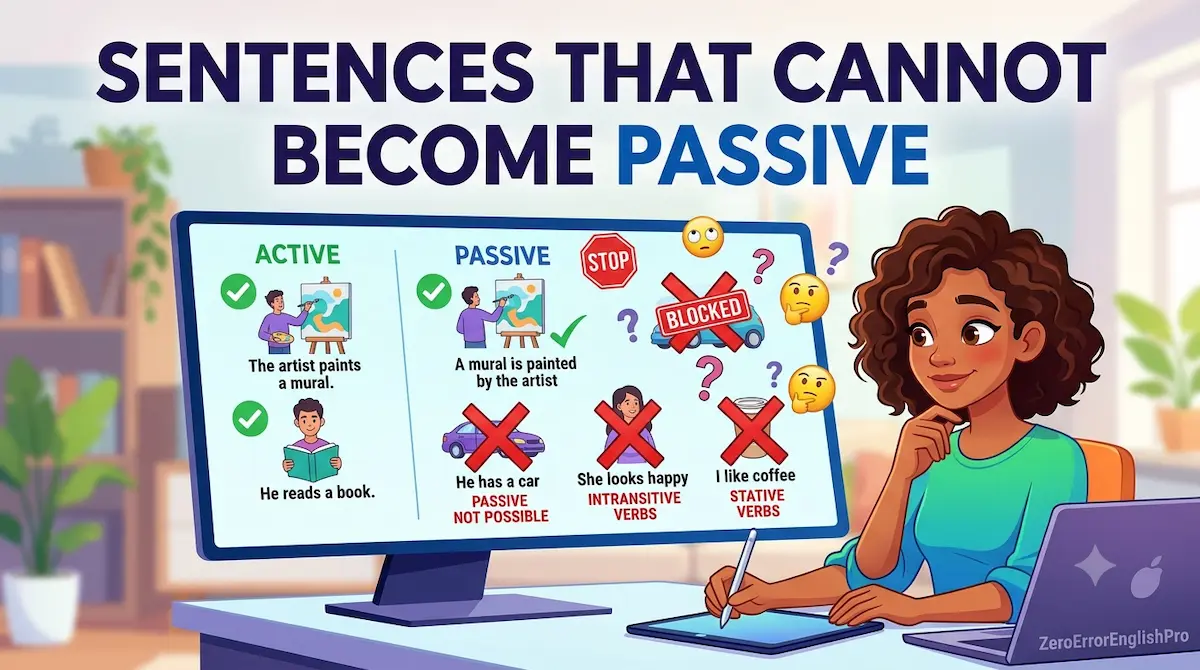
Quick answer: A sentence can only become passive if its verb is transitive and takes a direct object. Intransitive verbs (arrive, sleep, happen), linking verbs (be, seem, become), and verbs of possession or resemblance (have, own, resemble) normally block passive voice, because there's no object to promote into the new subject.
In This Guide
- Why passive voice needs an object
- Intransitive verbs: no object at all
- Linking verbs: a complement, not an object
- Verbs of possession and resemblance
- Dual-nature verbs: it depends on use
- Other structural blockers
- A 3-second checklist
- 6 common traps
- 10 practice sentences
- Quick revision
- Frequently asked questions
Transitive vs Intransitive, in Plain Terms
A transitive verb passes its action onto something else: someone writes a letter, reads a book, or repairs a car. An intransitive verb describes an action or state that begins and ends with the subject: someone arrives, sleeps, or laughs. Grammar books sometimes make this sound technical, but the underlying idea is ordinary: does the action land on something, or does it just happen?
Why Passive Voice Needs an Object
Passive voice works by promoting the object of an active sentence into the new subject: "Ravi wrote the letter" becomes "The letter was written by Ravi." The letter, the object, moves to the front. If a sentence has no object to begin with, there's nothing to promote, and the passive transformation simply has no material to work with.
This is why the single most useful question before converting any sentence is: what did the subject do it to? If you can answer with a noun or pronoun, you have an object, and passive voice is possible. If the answer is "nothing" or "nowhere in particular", the sentence is intransitive, and passive voice is not possible.
Intransitive Verbs: No Object At All
These verbs are common precisely because so much everyday speech is about states and events rather than actions performed on something: people arrive, things happen, seasons change. Recognising the list below on sight saves you from wasting time trying to force a conversion that was never possible.
Intransitive verbs describe an action or state that doesn't pass on to anything else. The action stays with the subject.
| Common intransitive verbs | Example (no object) |
|---|---|
| arrive, happen, occur | The train arrived late. |
| sleep, die, fall | The old man fell suddenly. |
| disappear, vanish, exist | The keys disappeared overnight. |
| laugh, cry, smile | The baby smiled at her mother. |
| sit, stand, rain | It rained heavily last night. |
None of these sentences has a direct object. "Late", "suddenly", "overnight" and "heavily" are adverbs describing how or when the action happened, not things the action was done to. Adverbs never become the subject of a passive sentence.
Test it yourself: "The train arrived late." Arrived what? There's no answer, because "arrive" doesn't act on anything. Compare this with "Ravi wrote a letter." Wrote what? A letter. That's your object.
Linking Verbs: A Complement, Not an Object
Linking verbs (also called copular verbs) connect the subject to a description or identity. They include be, become, seem, appear, look, feel, smell, taste and sound, when used in their linking sense. What follows them is a complement, which describes the subject, not an object that receives an action.
- "She is a doctor." (doctor describes she; it isn't acted upon)
- "He became angry." (angry describes his state)
- "The soup tastes delicious." (delicious describes the soup itself)
- "This seems unfair." (unfair describes the situation)
Because a complement only renames or describes the subject, it can't be promoted to a new subject in a passive sentence. "A doctor is being by her" is not a sentence in English. The same word, though, can sometimes act as a genuine transitive verb in a different sense: "She tasted the soup" (she performed an action on the soup) is transitive and can become "The soup was tasted by her." The distinction is whether the verb links back to the subject or acts outward on something else.
Verbs of Possession and Resemblance
A separate small group of verbs describes a state, ownership or similarity rather than an action, and these usually resist the passive even though they're followed by what looks like an object.
- Possession: have, own, possess, lack — "She has a car." Not: "A car is had by her."
- Resemblance: resemble, look like — "He resembles his father." Not: "His father is resembled by him."
- Fit and suit: suit, fit — "This dress suits her." Not: "She is suited by this dress."
- Measurement: cost, weigh, measure — "The book costs three hundred rupees." Not: "Three hundred rupees is cost by the book."
- Composition: contain, comprise, consist of — "The box contains old letters." Passive is technically possible ("Old letters are contained in the box") but sounds unnatural and is rarely used.
The common thread: these verbs describe a static relationship, not an action one party performs on another. Passive voice exists to shift focus onto the receiver of an action; when there's no action being done to anything, that shift has nothing to attach to.
Dual-Nature Verbs: It Depends on Use
Some common verbs are transitive in one sentence and intransitive in another, with the same spelling. Whether passive voice is possible depends entirely on how the verb is used in that specific sentence, not on the verb by itself.
| Verb | Intransitive (no passive) | Transitive (passive possible) |
|---|---|---|
| break | The glass broke. | He broke the glass. → The glass was broken by him. |
| open | The door opened slowly. | She opened the door. → The door was opened by her. |
| grow | The plant grew quickly. | Farmers grow wheat here. → Wheat is grown here by farmers. |
| run | She runs every morning. | He runs a small shop. → A small shop is run by him. |
| read | This novel reads well. | She read the novel. → The novel was read by her. |
The lesson here is that you can't judge a verb in isolation. "Break" isn't simply "a passive verb" or "not a passive verb"; you have to look at the specific sentence and ask whether it has an object in that instance.
A Worked Example With a Trickier Case
Try this one before moving on: "The medicine tastes bitter." Ask the test question: tastes what? "Bitter" isn't a thing the medicine did something to; it's a quality describing the medicine itself. That makes "taste" a linking verb here, not a transitive one, so this sentence has no passive form. Now compare: "The inspector tasted the medicine." Tasted what? The medicine. Here "taste" is transitive, an action the inspector performed, so it converts fine: "The medicine was tasted by the inspector." Same verb, same tense, completely different grammatical behaviour, because the sentence structure around it is different.
Other Structural Blockers
A few other sentence types resist passive voice for reasons beyond simple transitivity.
- Dummy "it" subjects: "It rained." "It is getting late." Here "it" isn't a real subject performing an action on an object; it's a placeholder required by English grammar. There's nothing to convert.
- Reflexive actions: "He hurt himself." Technically "himself" is an object, but since subject and object are the same person, a passive version ("He was hurt by himself") sounds unnatural and is essentially never used in standard writing.
- Idiomatic phrasal verbs without a true object: "She gave up." "The plan fell through." These phrasal combinations act as a single intransitive unit with no object to promote.
A 3-Second Checklist
Before converting any sentence, run through this in order:
- Ask "what/whom" after the verb. If there's a clear noun answer, you likely have an object.
- Check it isn't a complement. If the word after the verb describes the subject rather than receiving an action (after be, seem, become, look, taste), it's a complement, not an object.
- Check it isn't possession or resemblance. Have, own, resemble, suit, cost and similar verbs usually block passive even with an apparent object.
- If the verb has two uses, reread this specific sentence. Dual-nature verbs like break, open, grow and run need a fresh check every time.
6 Common Traps
Trap 1: Forcing passive onto an intransitive verb
IncorrectLate was arrived by the train.
CorrectThe train arrived late. (no passive form exists)
Why: "Arrive" has no object. "Late" is an adverb and can never become a subject.
Trap 2: Treating a complement as an object
IncorrectA doctor is been by her.
CorrectShe is a doctor. (no passive form exists)
Why: "Doctor" describes "she"; it doesn't receive an action from her.
Trap 3: Converting a possession verb
IncorrectA car is had by her.
CorrectShe has a car. (no passive form exists)
Why: "Have" describing possession is a state, not an action performed on the object.
Trap 4: Missing that a dual-nature verb is used intransitively here
IncorrectQuickly was grown by the plant.
CorrectThe plant grew quickly. (no passive form exists here)
Why: In this sentence, "grow" describes the plant's own development, with no object. Compare "Farmers grow wheat", where "grow" does have an object and passive is possible.
Trap 5: Converting a dummy "it" sentence
IncorrectRained was by it.
CorrectIt rained. (no passive form exists)
Why: "It" here is a grammatical placeholder, not a real subject performing an action on something.
Trap 6: Forcing a reflexive sentence into passive
IncorrectHimself was hurt by him.
CorrectHe hurt himself. (no natural passive form)
Why: When the subject and object are the same person, standard English keeps the sentence active rather than producing an awkward passive.
10 Practice Sentences
Decide whether each sentence CAN or CANNOT become passive. If it can, write the passive form. These are practice sentences (exam-pattern-based), not previous-year questions.
- The manager signed the contract.
- The children slept early.
- This bag weighs two kilograms.
- The chef cooked a delicious meal.
- She seems tired today.
- He resembles his elder brother.
- The company opened a new branch.
- The window broke during the storm.
- It snowed heavily last week.
- The teacher explained the concept clearly.
Show answers and explanations
- CAN. The contract was signed by the manager.
- CANNOT. "Sleep" is intransitive; "early" is an adverb, not an object.
- CANNOT. "Weigh" describing measurement is a state verb, not an action.
- CAN. A delicious meal was cooked by the chef.
- CANNOT. "Seems" is a linking verb; "tired" is a complement describing her.
- CANNOT. "Resemble" describes similarity, not an action performed.
- CAN. A new branch was opened by the company. ("Open" is used transitively here.)
- CANNOT. "Broke" here is intransitive; the window broke by itself, with no doer acting on it.
- CANNOT. "It" is a dummy subject with no real object.
- CAN. The concept was explained clearly by the teacher.
Why This Matters for Error Spotting
Exam setters know this distinction is a common blind spot, so they build error spotting questions around it: a sentence with a perfectly grammatical intransitive verb, written to look like a passive sentence is missing. Recognising when a sentence is correctly active, with no passive equivalent at all, is just as much a skill as converting the sentences that can change form. Treat "no error" as a genuine, frequent answer for sentences built on the verbs covered in this guide, not a rare exception.
Quick Revision
A sentence usually cannot become passive if:
- The verb is intransitive (arrive, sleep, happen, fall, disappear) and has no object.
- The verb is a linking verb (be, seem, become, look, taste) followed by a complement, not an object.
- The verb shows possession or resemblance (have, own, resemble, suit, cost).
- The subject is a dummy "it" with no real action performed on anything.
- The sentence is reflexive, with the subject and object being the same person.
Before converting anything, ask: what did the subject do it to? No clear answer means no passive.
Frequently Asked Questions
Q: What are the sentences that cannot be changed into passive voice?
A: Sentences with intransitive verbs (arrive, sleep, happen), linking verbs followed by a complement (be, seem, become), verbs of possession or resemblance (have, own, resemble, cost), dummy "it" subjects, and reflexive sentences generally cannot become passive.
Q: Why can't "she has a car" become passive?
A: "Have" here describes possession, a state, not an action performed on the car. Passive voice needs an action passed from a doer onto a receiver, which possession verbs don't express.
Q: Is "the glass broke" passive or active?
A: It's active, even though the glass didn't break itself on purpose. "Break" is being used intransitively here, with no doer named and no object, so there's nothing to convert. "The glass was broken by him" is a different, transitive sentence with its own active source: "He broke the glass."
Q: How can I quickly check if a sentence can become passive?
A: Ask "what" or "whom" right after the verb. If you get a clear noun answer that isn't just describing the subject, you likely have an object and passive voice is possible. No clear answer means the sentence is intransitive or uses a linking verb.
Q: Can linking verbs like "taste" or "look" ever be passive?
A: Only when they're used transitively, in a different sense. "The soup tastes delicious" is a linking use and has no passive form. "She tasted the soup" is a transitive use and does: "The soup was tasted by her." Check the specific sentence, not just the verb.
Q: Are all intransitive verbs completely fixed, or can some take an object in special cases?
A: A few intransitive verbs can take what's called a cognate object, a noun closely related to the verb itself, such as "She slept a peaceful sleep" or "He laughed a hearty laugh." These are rare and mostly literary; in ordinary and exam writing, treat the common intransitive verbs as having no object.
Q: Does "contain" ever appear in the passive in real writing?
A: Rarely. "The box contains old letters" is far more natural than "Old letters are contained in the box." Passive is grammatically possible with a few verbs in this composition group, but writers almost always prefer the active form for them.
Where to Go Next
Knowing when not to use passive voice is just as valuable as knowing how to build it. With the core pattern, the tense chart, modals and questions, and these exceptions all covered, you're ready to look at how these mistakes show up inside error spotting questions. Continue with active and passive voice errors in error spotting, or revisit passive voice with modals, questions and imperatives for a refresher.
The Ultimate Guide to Active & Passive Voice for Competitive Exams
Move beyond the mechanical active-to-passive formula to confidently recognize when passive voice is grammatically impossible.