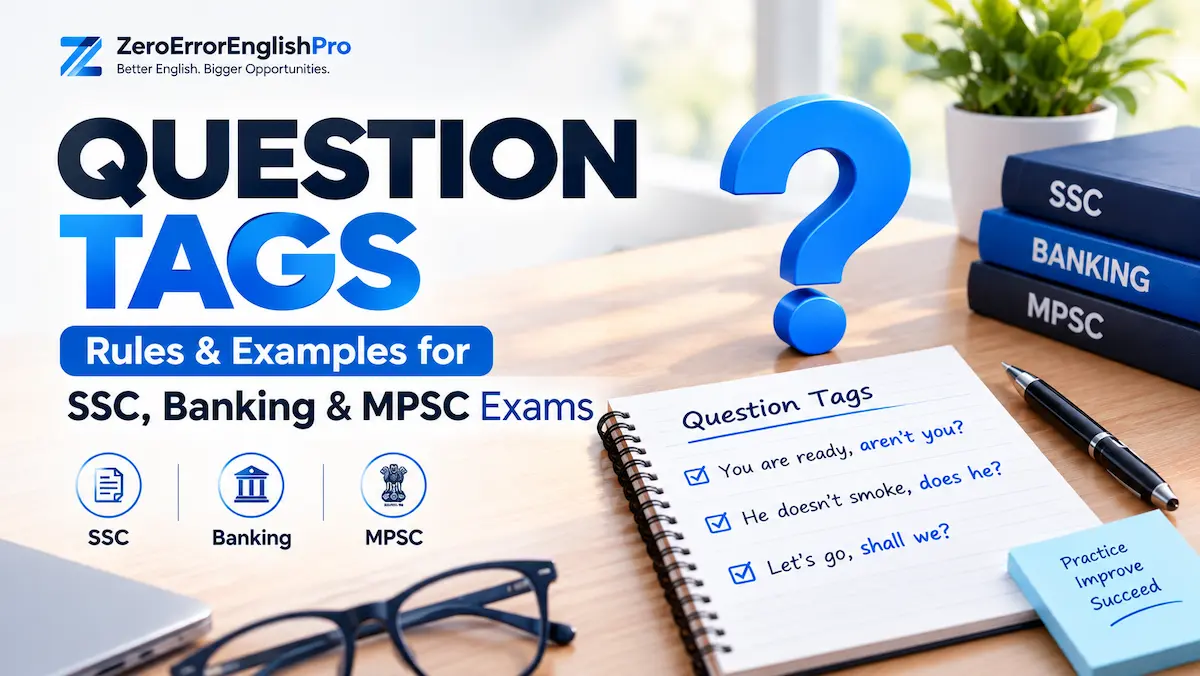
Question Tags Rules & Examples for SSC, Banking & MPSC Exams
Every question tag follows one flip-and-match rule — until negative words, imperatives, and tricky subjects break the pattern. Learn the exact traps SSC, Banking, and MPSC examiners repeat every year.
"Nobody Called, Did They?" — Why This Simple Rule Isn't So Simple
Question tags look like the easiest grammar topic on the paper — flip the polarity, match the verb, done. Then a sentence with "nobody," an imperative, or a compound clause shows up, and the simple flip-and-match rule suddenly isn't enough.
SSC, Banking, and MPSC exams treat question tags as a small, high-yield topic — a handful of fixed rules that, once mastered completely, become close to error-proof. The catch is that "completely" includes several exceptions most aspirants never study in depth.
This guide covers the core rule, the exceptions that repeat most often in exams, and a step-by-step method that handles every case, including the tricky ones.
Question tags are deceptively small — a two-or-three-word addition at the end of a sentence — but they pack in subject agreement, auxiliary-verb matching, and polarity logic all at once. That density is exactly why a topic that looks "easy" on day one still trips up aspirants close to exam day, especially once negative words and irregular subjects enter the picture.
Quick answer: A positive statement takes a negative tag; a negative statement takes a positive tag. The tag's verb matches the statement's auxiliary (or uses do/does/did for simple tenses), and the tag's subject is always a pronoun matching the statement's subject.
In This Guide
- Why Question Tags Feel Easy But Aren't
- 5 Mistakes That Are Costing You Marks
- The 6-Step Verification Method (With Real Exam Patterns)
- How Snehal Cracked This Before Her MPSC Prelims
- Expert Shortcuts Toppers Actually Use
- Final Takeaway
- Frequently Asked Questions
Why Question Tags Feel Easy But Aren't
- You apply the flip-and-match rule without checking for hidden negatives. Words like "nobody," "never," "hardly," and "seldom" make a sentence negative even without "not" appearing anywhere.
- You don't know the fixed exception for "I am." The grammatically "correct" tag ("am I not") is never used in practice — a special irregular form exists instead.
- You treat imperative sentences the same as statements. Commands and requests take a completely different tag pattern, usually "will you?" or "won't you?"
- You get confused by "let's." Its tag is fixed as "shall we?" regardless of the rest of the sentence's structure.
- You don't know which clause to match in compound or complex sentences. The tag typically agrees with the nearest or main clause, not just whichever subject you spot first.
- You forget that modal verbs get repeated in the tag, not replaced with do/does/did. "You can swim, can't you?" — the tag reuses "can," it doesn't default to a do-support form.
I know exactly how this feels — question tags seem so mechanical that a sentence with a genuine exception catches you completely off guard. It's not a difficulty problem. It's a coverage problem: most study material only teaches the basic rule, not its exceptions.
But here's what most people get wrong: they assume mastering the core rule is enough, when exams specifically target the exceptions to separate well-prepared candidates from the rest.
5 Mistakes That Are Costing You Marks
1. Missing hidden negative words.
"Nobody informed us, did they?" looks like a positive statement needing a negative tag, but "nobody" already makes it negative — so it needs a positive tag: "did they?"
2. Using "am I not" for "I am" statements.
The grammatically logical tag is never used in practice. "I am late, aren't I?" is the fixed, universally accepted form.
3. Using a statement-style tag on an imperative sentence.
"Close the door, do you?" is wrong. Imperatives take "will you?" (or "won't you?" for a more polite request, and "shall we?" specifically for "let's" sentences).
4. Mismatching the tag's subject pronoun.
The tag subject must be a pronoun that correctly refers back to the statement's subject — "The team performed well, didn't they?" not "didn't it?" when "team" is treated as individuals, or "didn't it?" when treated as a single unit — context decides.
5. Picking the wrong clause to match in a compound sentence.
"He is tired but he will finish the work, won't he?" — the tag matches the second (nearest) clause's subject and verb, not the first.
6. Dropping the modal verb and defaulting to do/does/did.
When the statement already contains a modal like can, will, should, or must, the tag must reuse that same modal — never switch to a do-support form.
Common Mistakes Students Make
ebookcharm — English Grammar Made Exam-Ready
These five traps — plus 55 more, and 200+ drilled MCQs — are covered in full in the companion book below.
The 6-Step Verification Method (With Real Exam Patterns)
Step 1 — Check for hidden negative words first, before anything else. Nobody, nothing, no one, never, hardly, scarcely, seldom, rarely, few, little — treat the statement as negative if any of these appear.
SSC CGL Exam Pattern: "She hardly speaks in meetings, ____?" → hidden negative → positive tag: "does she?"
Step 2 — Identify the statement's auxiliary verb (or supply do/does/did). The tag reuses this exact auxiliary.
Step 3 — Flip the polarity. Positive statement → negative tag. Negative statement (including hidden negatives) → positive tag.
Step 4 — Match the tag's subject to a pronoun referring back to the statement's subject.
MPSC Exam Pattern: "The committee has approved the proposal, ____?" → "hasn't it?" (treated as a single unit).
Step 5 — Check for special fixed forms. "I am" → "aren't I?" Imperatives → "will you?" "Let's" → "shall we?"
IBPS Clerk Exam Pattern: "Let's finish the report today, ____?" → "shall we?"
Step 6 — For compound or complex sentences, match the nearest (main) clause. Don't default to the first subject you see — identify which clause the tag logically attaches to.
Step-by-Step Strategy
SSC CGL: "She hardly speaks in meetings, ____?"
MPSC: "The committee has approved the proposal, ____?"
IBPS Clerk: "Let's finish the report today, ____?"
ebookcharm — English Grammar Made Exam-Ready
How Snehal Cracked This Before Her MPSC Prelims
Snehal treated question tags as a "quick, easy" topic and barely practiced beyond the basic flip-and-match rule — until her mock tests kept marking her wrong on sentences with "hardly," "seldom," and imperative forms she'd never specifically studied.
Going through her error log with a coach, the pattern became obvious within minutes: every single mistake fell into one of just three categories — hidden negatives, one of the three irregular fixed forms, or modal verbs dropped for do-support. She hadn't misunderstood the topic at all; she'd simply never been taught these specific exceptions as their own study unit.
She realized the gap wasn't understanding — it was coverage. She built a short list of the hidden-negative words and the special fixed forms (I am / imperatives / let's) and drilled exactly those categories for a week, since the basic rule was never actually her problem.
You can do the same — here's how to start: write down the six hidden-negative words and three special fixed-tag rules from this guide, and test yourself on ten mixed sentences today.
Expert Shortcuts Toppers Actually Use
1. Scan for hidden negatives before applying any other rule. This single check prevents the most common tag-polarity error.
2. Memorize the three irregular fixed forms as a set. "Aren't I," "will you" (imperatives), and "shall we" (let's) — these don't follow the standard flip-and-match logic at all.
3. For collective nouns, decide unity vs. individuality before choosing the tag pronoun. "The team has won, hasn't it?" (as a unit) vs. "The team have submitted their opinions, haven't they?" (as individuals).
4. In compound sentences, tag the clause closest to the comma. This simple positional rule resolves most "which clause do I match" confusion instantly.
5. Practice with MPSC and SSC previous-year papers specifically. Regional exam patterns sometimes favor particular tag categories more than others — practicing with real past papers calibrates your instincts to what you'll actually see.
6. Say the statement and tag together out loud during practice. Question tags are fundamentally a spoken-language feature — reading them aloud often catches errors your eyes skip over on a silent read-through.
Final Takeaway
Question tags aren't hard — they're under-studied. The core flip-and-match rule handles most sentences correctly, but hidden negatives, special fixed forms, and compound-sentence clause-matching are exactly where marks are lost. Cover those exceptions deliberately, and this becomes one of your most reliable scoring topics.
Treat this topic the way toppers do: not as a "quick five-minute revision" item, but as a small, finite rule set worth mastering completely, since every rule here is testable and every exception repeats across exam cycles.
Frequently Asked Questions
Q: What tag does "everyone" or "somebody" take?
A: Even though these subjects are grammatically singular, their tags almost always use "they" in modern standard English: "Everyone enjoyed the event, didn't they?"
Q: Is there a downloadable PDF of these rules?
A: This guide covers the complete rule set and the most-repeated exam traps. For a full printable reference with 186 rules and 200+ practice MCQs, see the companion book below.
Q: Do MPSC question tags follow different rules than SSC or Banking exams?
A: No — the underlying grammar rules are identical across SSC, Banking, and MPSC. What differs is which specific traps and sentence patterns each exam tends to favor, which is why practicing with each exam's own previous papers helps.
Q: What tag does a sentence with "never" take?
A: "Never" makes the statement negative, so it takes a positive tag: "He never arrives late, does he?"
Q: Does a sentence with no clear subject, like "It's raining," still need a matching pronoun tag?
A: Yes — dummy subjects like "it" and "there" still take a matching tag pronoun: "It's raining, isn't it?" and "There are five candidates, aren't there?"
Question Tags: Zero Errors: 186 Rules, 60 Traps & 200+ MCQs for SSC, IBPS & Railways
Turn a small, frequently underestimated topic into a guaranteed-accuracy scoring zone through exhaustive rule coverage.