Question Tags in Previous Year Papers: How SSC and Bank Examiners Actually Test This Topic
Examiners don't test question tags randomly — they repeat the same handful of formats and traps year after year. Here's the pattern, broken down by format and frequency, not just the rules.
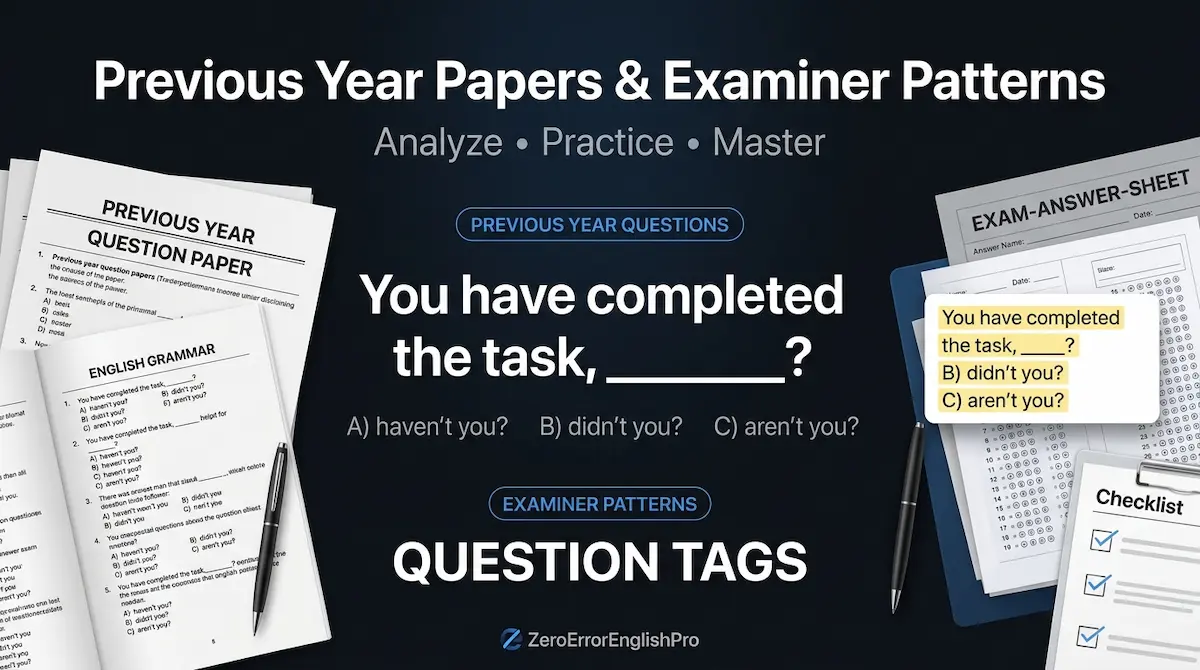
Examiners Don't Test Randomly — They Repeat a Playbook
Sit down with enough SSC and Banking papers side by side, and a question-tag section stops looking random. The same handful of question formats show up again and again. The same trap categories — hidden negatives, modal verbs, clause structure — get tested far more often than the rest of the rule book. Examiners aren't inventing new question types each year; they're reusing a small, stable playbook.
This guide breaks that playbook down — not the grammar rules themselves, which the site's other Question Tags guides already cover in depth, but the actual testing patterns: which formats show up, how often each trap category appears, and what that means for where your prep time is best spent.
A note on the examples below: rather than reproducing exact wording from specific papers, each example is labeled "Common Exam Pattern" and illustrates the kind of sentence that format and trap category typically produces — built to match the real testing style without claiming to be a verbatim reprint of any particular year's paper.
Quick answer: Question tags typically appear in three formats — direct fill-in-the-blank, embedded inside Error Spotting sentences, and as the target of Sentence Improvement corrections. Across all three, hidden negatives and clause-structure traps are tested more often than any other category.
In This Guide
- The 3 Formats Question Tags Actually Appear In
- 5 Trap Categories Examiners Repeat Most
- The 6-Step Method for Pattern-Based Preparation
- How Deepak Used Pattern Analysis Instead of Random Practice
- Expert Shortcuts Toppers Actually Use
- Final Takeaway
- Frequently Asked Questions
The 3 Formats Question Tags Actually Appear In
Format 1 — Direct fill-in-the-blank. A statement is given with a blank at the end, and you supply the tag directly. This is the most straightforward format and the one most practice books focus on almost exclusively.
Common Exam Pattern: "The consignment was dispatched yesterday, ____?"
Format 2 — Embedded inside Error Spotting. A full sentence is split into underlined parts (A, B, C), and the tag — already written in, but incorrectly — is one of the parts you must identify as wrong. This format is trickier because you're not writing a tag from scratch; you're evaluating one that's already there, often while your attention is split across the rest of the sentence too.
Common Exam Pattern: "Nobody attended the workshop (A) / conducted last week (B) / did they? (C) / No error (D)" — here the tag is actually correct, testing whether you can confirm a hidden negative was handled properly, not just spot when it's wrong.
Format 3 — Sentence Improvement. A full sentence with an incorrect tag is given, along with 3-4 rewritten options, and you choose the corrected version. This format tests the same underlying rule but adds a layer of comparing near-identical answer choices against each other.
Common Exam Pattern: "You must have informed her, isn't it?" with options replacing "isn't it" with "haven't you," "didn't you," and "mustn't you."
5 Trap Categories Examiners Repeat Most
Based on the recurring style across recent papers, these five categories show up disproportionately often compared to the full rule set — meaning they deserve more of your prep time than an even, rule-by-rule approach would give them.
1. Hidden negatives (nobody, never, hardly, scarcely) appear constantly, likely because they're easy to embed inside a longer sentence without drawing attention to themselves — exactly what an Error Spotting question needs.
2. Modal verb agreement (can, will, should, must) is tested heavily, especially the specific trap of dropping the modal for do-support in the tag, since it's a clean, unambiguous right-or-wrong check that's easy to grade at scale.
3. Multi-clause sentences (complex, compound, conditional) appear often in Sentence Improvement specifically, where the added length gives examiners room to build 3-4 plausible-sounding wrong options.
4. The three irregular fixed forms ("aren't I," imperative "will you," and "let's...shall we") appear less frequently than the categories above, but almost always as a single, isolated, high-confidence question — testing memorized exceptions rather than applied logic.
5. Tricky subject-pronoun matching (everyone/this/these) shows up as a secondary trap layered inside a question that's primarily testing something else, such as a hidden negative or a modal — a detail many aspirants catch on the primary trap while missing the secondary one.
These five categories map directly onto the drill sets in the companion book below, which is organized by exactly this kind of frequency-weighted priority rather than alphabetical rule order.
The 6-Step Method for Pattern-Based Preparation
Step 1 — Sort your practice questions by format, not just by rule. Keep a running count of how many fill-in-blank versus Error Spotting versus Sentence Improvement questions you've practiced, so you're not accidentally over-preparing for one format.
Step 2 — Weight your revision time by the five trap categories above, not evenly across all rules. Hidden negatives and modal agreement deserve noticeably more repetition than the three fixed forms, purely based on how often each appears.
Step 3 — Practice Error Spotting versions specifically, not just fill-in-blank. Evaluating a tag that's already written, embedded inside a longer sentence with other potential errors, is a different skill from producing one from scratch — and it's the format most practice books under-represent.
Step 4 — When practicing Sentence Improvement, deliberately compare all the wrong options, not just confirm the right one. Understanding why each distractor is wrong builds faster recognition than only ever confirming correct answers.
Step 5 — Track your own error log by trap category, across every format you practice. A personal pattern — say, consistently missing multi-clause questions regardless of format — is more useful than a generic study plan.
Step 6 — Revisit this five-category priority list every few weeks. As your accuracy improves in one area, shift relative practice time toward whichever category is now your actual weakest, rather than sticking to a fixed original plan.
How Deepak Used Pattern Analysis Instead of Random Practice
Deepak had worked through hundreds of question-tag practice questions from generic sources, yet his accuracy on actual SSC mock tests stayed inconsistent. The mismatch puzzled him — he clearly knew the rules, but mock-test performance didn't reflect that.
Looking at his mock-test errors specifically by format, the issue became clear: nearly all of his mistakes came from the Error Spotting format, where a tag was embedded inside a longer sentence, not from direct fill-in-blank questions, where his accuracy was already strong. He'd been practicing the format he was already good at, simply because it's the format most study material defaults to.
He shifted his practice specifically toward Error Spotting sentences with embedded tags, deliberately including some where the tag was actually correct, to build the discipline of confirming rather than assuming an error existed. Within two weeks, his mock-test accuracy on question-tag items caught up to match his rule knowledge.
You can do the same — here's how to start: sort your own recent mock-test errors by format (not by rule), and see whether one format is quietly responsible for most of your mistakes.
Expert Shortcuts Toppers Actually Use
1. Don't assume every embedded tag in an Error Spotting question is wrong. Some are deliberately correct, specifically to test whether you'll second-guess a right answer — confirming a tag is correct is as important a skill as catching one that's wrong.
2. In Sentence Improvement, eliminate options that fix the wrong problem first. If the actual error is a hidden negative, options that only address subject-verb matching can be eliminated immediately, regardless of how plausible they sound.
3. Weight your last-week revision by category frequency, not comfort. It's tempting to revise what already feels easy — deliberately spend more time on hidden negatives and modal agreement instead, since that's where the marks concentrate.
4. Practice under each format separately before mixing them. Build format-specific comfort first, then combine formats in a final mixed mock, mirroring how skill actually transfers.
5. Keep a short log of every trap category you get wrong, dated. A category that stops appearing in your error log over several weeks is genuinely mastered; one that keeps reappearing needs targeted, not general, revision.
Final Takeaway
Question tags aren't tested with even coverage across every possible rule — examiners lean heavily on a handful of formats and a handful of trap categories, repeated year after year. Preparing with that pattern in mind, rather than treating every rule as equally likely to appear, is what turns broad knowledge into exam-specific readiness.
Frequently Asked Questions
Q: Are the example sentences in this guide taken word-for-word from real exam papers?
A: No. Each is labeled "Common Exam Pattern" and built to illustrate the format and trap category accurately, without claiming to reproduce any specific paper's exact wording or year.
Q: Does this pattern hold across SSC, Banking, and MPSC equally?
A: The three formats and the general skew toward hidden negatives and modal agreement hold broadly across all three. Exact frequency can vary slightly by exam, which is why reviewing your own recent mock-test errors by format remains the most reliable personal guide.
Q: How is this different from the site's other Question Tags posts?
A: The other guides teach the rules themselves and give practice questions to test them. This one focuses specifically on how those rules get packaged into real exam formats — useful once you already know the rules and want to prepare strategically for how they're actually asked.
Question Tags: Zero Errors: 186 Rules, 60 Traps & 200+ MCQs for SSC, IBPS & Railways
Turn a small, frequently underestimated topic into a guaranteed-accuracy scoring zone through exhaustive rule coverage.