Question Tags for Complex, Compound, and Conditional Sentences Explained with Examples
Simple-sentence question tags are easy. Complex, compound, and conditional sentences follow a completely different rule for which clause gets tagged — learn it here with exam-calibrated examples.
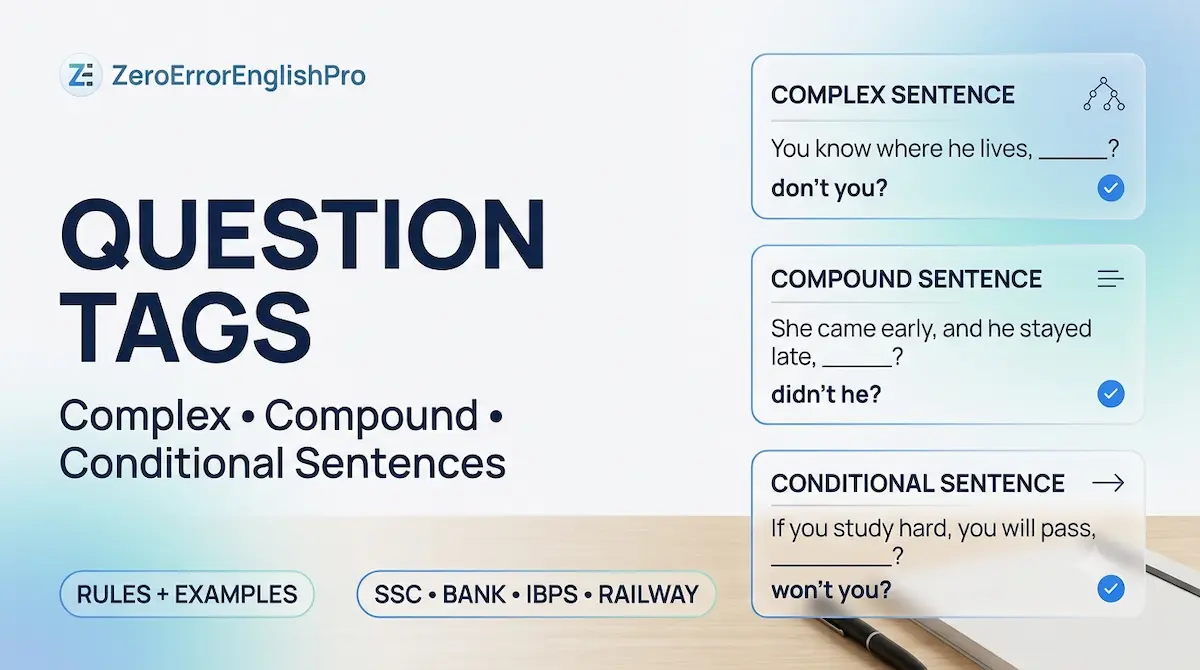
One Sentence, Three Clauses — Which One Gets the Tag?
"If you work hard, you will succeed, won't you?" Notice something? The tag doesn't attach to "if you work hard" — it attaches to "you will succeed." That's not a coincidence. It's a fixed rule most aspirants never learn explicitly, because most question-tag practice sticks to simple, one-clause sentences.
The moment a sentence has more than one clause — complex, compound, or conditional — the question of which clause actually gets the tag becomes the real test. Get the clause wrong, and even a perfectly formed tag is scored incorrect.
This guide breaks down exactly how question tags work across all three multi-clause sentence types, with exam-calibrated examples for each.
Quick answer: In complex sentences, tag the main (independent) clause, never the subordinate one. In compound sentences, tag the nearest (last) independent clause. In conditional sentences, never tag the "if" clause — always tag the main/result clause.
In This Guide
- Why Sentence Structure Changes the Rule
- A Closer Look at Each Sentence Type
- 5 Mistakes That Are Costing You Marks
- The 6-Step Method for Multi-Clause Sentences (With Real Exam Patterns)
- How Vivek Fixed This Before His Bank PO Mains
- Expert Shortcuts Toppers Actually Use
- Final Takeaway
- Frequently Asked Questions
Why Sentence Structure Changes the Rule
A simple sentence has exactly one subject and one verb, so there's only ever one possible clause to tag. Once a sentence has two or more clauses, the tag rule doesn't change in mechanics — flip the polarity, match the auxiliary — but it very much changes in which clause those mechanics apply to.
- You treat every clause in the sentence as equally "taggable." Only one clause — the main, independent one — actually receives the tag.
- You default to tagging whichever clause you read first. In both complex and compound sentences, the first clause is very often the wrong one to tag.
- You don't distinguish subordinate clauses from independent ones. A clause introduced by "because," "although," "if," "when," or "since" is subordinate and is never tagged directly.
- You assume conditional sentences work like simple statements. The "if" clause has its own internal subject and verb, but it never receives the tag — only the result clause does.
- You get thrown off when a compound sentence's two clauses have different subjects. Each clause needs its own correctly matched pronoun, and only the second (nearest) clause's subject determines the tag.
I know exactly how this feels — you can tag a short, single-clause sentence perfectly, and then a longer, structurally denser sentence makes you hesitate on something as basic as which part to even look at. It's not a rule you don't know. It's a target you haven't learned to identify.
But here's what most people get wrong: they apply the tag rule to the first clause they see, instead of first identifying which clause is actually the main one.
A Closer Look at Each Sentence Type
Complex sentences pair one main clause with one or more subordinate clauses. The subordinate clause can come first, last, or even in the middle, but its position never changes the rule: only the main clause gets tagged.
- "Although the market was volatile, investors remained confident, didn't they?" — main clause: "investors remained confident."
- "The officer who signed the order has retired, hasn't he?" — main clause: "the officer has retired" (the "who signed the order" portion is itself a subordinate relative clause).
Compound sentences join two or more independent clauses with "and," "but," or "or." Since each half could stand alone as its own sentence, English tag rules default to matching whichever clause sits closest to where the tag attaches.
- "The results were declared, and the students celebrated, didn't they?" — tag matches "the students celebrated."
- "You can call me, or I will call you, won't I?" — tag matches "I will call you," the second clause, even though the subjects differ across the two halves.
Conditional sentences pair an "if" clause with a main/result clause. Structurally, the if-clause is just another subordinate clause — it happens to express a condition rather than a reason or time, but the tagging rule treats it exactly the same way: never tag it directly.
- "If the interest rate drops, more people will apply for loans, won't they?" — tag matches the result clause.
- "Unless he apologizes, she won't forgive him, will she?" — "unless" clauses follow the same rule as "if" clauses; the main clause still takes the tag.
Seeing all three types laid out side by side makes the underlying pattern clear: no matter what connects the clauses — reason, contrast, condition, or simple addition — exactly one clause in the sentence is the "real" one for tagging purposes, and it's never the subordinate half.
5 Mistakes That Are Costing You Marks
1. Tagging the subordinate clause in a complex sentence.
"Because he was late, he missed the train, wasn't he?" incorrectly tags "he was late" in spirit — the tag must match "he missed the train," the main clause, which it does here, but students frequently flip this and produce a tag matching the wrong clause's tense or subject when the two clauses have different subjects.
2. Tagging the first clause instead of the nearest one in a compound sentence.
"She sang well, and everyone applauded, didn't she?" is wrong — the tag should match the second, nearer clause: "didn't they?"
3. Adding a tag directly onto the if-clause.
"If you finish early, don't you, you can leave?" is not a valid sentence structure at all — the if-clause never takes its own tag; only the full sentence's main clause does, placed at the very end.
4. Missing that "because," "since," "as," and "when" clauses are also subordinate.
Students often correctly identify "if" and "although" clauses as subordinate but forget that reason and time clauses follow the exact same non-tagging rule.
5. Mismatching the subject when compound clauses have different subjects.
"Ravi left early, but Sonia stayed, didn't he?" incorrectly matches Ravi's subject from the first clause instead of Sonia's, the actual subject of the clause nearest the tag.
6. Treating "unless" clauses differently from "if" clauses.
"Unless" already carries a negative meaning built in, but it's structurally still a subordinate, conditional-style clause — it follows the exact same non-tagging rule as "if," a distinction many aspirants miss since "unless" doesn't visually resemble "if."
Common Mistakes Students Make
ebookcharm — English Grammar Made Exam-Ready
These clause-placement traps, alongside the full rule set, are covered in depth in the companion book below.
The 6-Step Method for Multi-Clause Sentences (With Real Exam Patterns)
Step 1 — Identify the sentence type first. Simple, complex (main + subordinate), compound (two independent clauses joined by and/but/or), or conditional (if-clause + main clause).
Step 2 — For complex sentences, locate the main (independent) clause. It's the part of the sentence that could stand alone as a complete thought. Tag that one only.
SSC CGL Exam Pattern: "Because the flight was delayed, the passengers were frustrated, ____?" → main clause is "the passengers were frustrated" → "weren't they?"
Step 3 — For compound sentences, identify the clause nearest to where the tag will attach — almost always the last one.
IBPS PO Exam Pattern: "The team prepared thoroughly, and they still lost the match, ____?" → nearest clause: "they still lost" → "didn't they?"
Step 4 — For conditional sentences, locate the main/result clause and ignore the if-clause completely for tagging purposes.
MPSC Exam Pattern: "If the budget is approved, the project will begin next month, ____?" → main clause: "the project will begin" → "won't it?"
Step 5 — Confirm the subject of the clause you're tagging, not any other clause in the sentence. This matters most when different clauses have different subjects.
Step 6 — Apply the standard tag mechanics to that one identified clause. Flip the polarity, match the auxiliary (or modal), and check for any of the special fixed forms and hidden negatives covered in the core Question Tags guide.
Step-by-Step Strategy
Simple, complex, compound, or conditional.
SSC CGL: "Because the flight was delayed, the passengers were frustrated, ____?"
IBPS PO: "The team prepared thoroughly, and they still lost the match, ____?"
MPSC: "If the budget is approved, the project will begin next month, ____?"
ebookcharm — English Grammar Made Exam-Ready
Once clause identification feels automatic, pair this with the core Question Tags guide's hidden-negative and fixed-form rules for complete coverage — both are drilled together in the companion book below.
How Vivek Fixed This Before His Bank PO Mains
Vivek could tag simple sentences perfectly but consistently lost marks on longer, structurally complex sentences in his Bank PO mock tests. Reviewing his errors, a coach noticed he was tagging almost every multi-clause sentence based on whichever clause appeared first, regardless of the sentence's actual structure.
The turning point came when his coach asked him to read ten of his wrong answers aloud and explain, out loud, why he'd chosen that clause each time. Every single explanation came down to the same habit: "it was the first part of the sentence." Once he could name the pattern, fixing it stopped being abstract and became a concrete, repeatable check.
He started explicitly labeling each clause in practice sentences — "main," "subordinate," or "if-clause" — before attempting to write any tag. This forced a structural read before a grammatical one. Within ten days of daily practice, his instinct shifted from "which clause do I see first" to "which clause is actually independent," and his accuracy on multi-clause tag questions became consistent across mock test after mock test.
You can do the same — here's how to start: take three complex sentences, three compound sentences, and three conditional sentences from a newspaper editorial today, label each clause as main or subordinate, and write the correct tag for each.
Expert Shortcuts Toppers Actually Use
1. Ask "which part of this sentence could stand alone?" first. That's always the clause that gets tagged, regardless of sentence length or position.
2. In compound sentences, mentally cover everything before the last comma or conjunction. What remains is almost always the clause you need.
3. Build a fixed list of subordinating words that signal "don't tag this clause." Because, since, as, although, though, while, if, unless, when, before, after — seeing any of these should immediately redirect your attention to the rest of the sentence.
4. For conditional sentences, locate "if" first and mentally bracket everything up to its comma. The tag always belongs to what's outside that bracket.
5. When two clauses have different subjects, always use the second clause's subject — never mix them. Reading the sentence backward from the tag position can help confirm you've picked the right one.
6. Practice deliberately mixing all three structures in one session. Studying complex, compound, and conditional sentences separately builds recognition for each in isolation, but exams mix them freely — deliberately interleaved practice matches the actual test conditions far better.
Final Takeaway
Question tags in multi-clause sentences aren't a different topic from simple-sentence tags — they're the same mechanics applied to the correct target. Identify the sentence type, find the one clause that's genuinely independent, and tag that one. Everything else in the sentence is context, not a tagging candidate.
Once clause identification becomes automatic, multi-clause sentences stop feeling longer or harder — they simply become simple sentences with extra context attached, and you already know how to tag those.
Frequently Asked Questions
Q: Can a conditional sentence's if-clause ever get its own tag?
A: No. The if-clause is always subordinate in a conditional sentence, and subordinate clauses never receive a question tag — only the main, independent clause does.
Q: In a compound sentence with three clauses, which one gets tagged?
A: The clause nearest to the end of the sentence, immediately before where the tag would attach — not the first or middle clause.
Q: How is this different from the site's core Question Tags guide?
A: That guide covers hidden negatives, special fixed forms, and basic subject-verb matching for single-clause sentences. This guide focuses specifically on identifying the correct clause to tag in longer, multi-clause sentences — the two skills combine for complete mastery.
Q: Do "because" clauses follow the same non-tagging rule as "if" clauses?
A: Yes. Any subordinate clause — introduced by because, since, as, although, when, if, unless, or similar connectors — never receives the tag directly. Only the main clause does.
Q: What about sentences with three or more clauses mixing complex and compound structure?
A: Apply the same logic layer by layer — first eliminate every subordinate clause, then among the remaining independent clauses, tag the one nearest to the sentence's end.
Question Tags: Zero Errors: 186 Rules, 60 Traps & 200+ MCQs for SSC, IBPS & Railways
Turn a small, frequently underestimated topic into a guaranteed-accuracy scoring zone through exhaustive rule coverage.