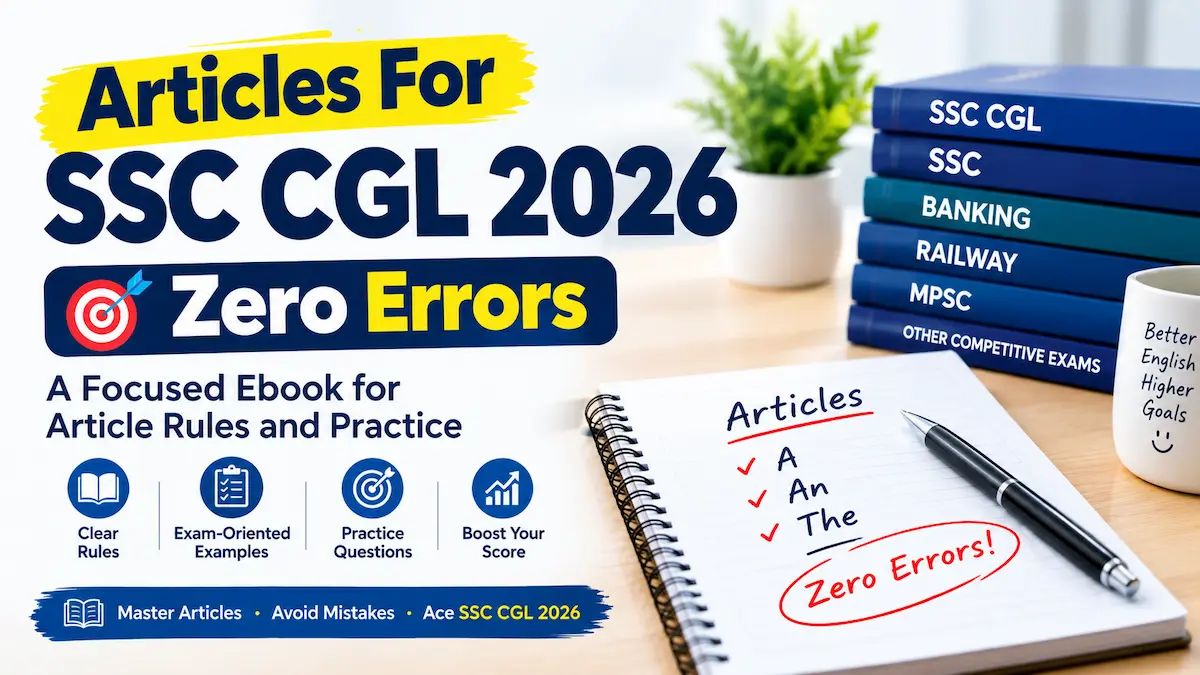
Articles For SSC CGL 2026 - Zero Errors: A Focused Ebook for Article Rules and Practice
Explore Articles For SSC CGL 2026 - Zero Errors: what the book covers, who it suits best, how to use it for daily revision and where to get it on Amazon.
You've Read the Rules. Now What?
If you've worked through the guides in this series, you already know the sound rule for a and an, when the goes before a noun, when no article is needed at all, and the traps that hide inside error spotting and sentence improvement questions. That's real progress. But reading six blog posts across several sittings isn't the same as having one organised resource you can revise from every single day until the exam.
That's the gap this page addresses. Below, you'll find why articles keep costing marks even after the rules are learned, what a genuinely useful articles resource should include, what's inside Articles For SSC CGL 2026 – Zero Errors, who it's built for, and how to use it well. If you'd rather test the free material first, every guide in this series is linked at the bottom.
Quick facts: Articles For SSC CGL 2026 – Zero Errors is a paperback, 228 pages, priced at $9.99. It focuses entirely on a, an, the and zero article for SSC CGL, Banking and Railway-style exams.
In This Guide
- Why articles cost marks even after reading the rules
- What a focused articles resource should give you
- What's inside the book
- How to use it: learn, practise, revise
- Who should get it, and who may not need it
- Try free first
- Frequently asked questions
Why Articles Cost Marks Even After Reading the Rules
Every rule in this series is genuinely simple on its own. The sound rule for a and an is one line. The, in most cases, is one idea: a known, specific noun. Zero article, at its core, is just "general idea, no article needed". So why do these small words still cost aspirants marks?
- The rules are scattered. Learning them across separate sessions, weeks apart, means the connections between them never fully form.
- Exceptions outnumber the main rule. Institutions, meals, transport phrases and fixed idioms each behave slightly differently, and there's no single memory trick that covers all of them.
- Recognition under pressure is a different skill from understanding. Knowing a rule when it's explained is not the same as spotting its violation inside an unfamiliar four-part sentence, under a countdown timer.
- Without repeated, spaced practice, the rules fade. A concept read once in a blog post, without follow-up practice a few days later, rarely survives to exam day.
None of this means the rules are hard. It means they need a structured system, not scattered reading, to actually stick.
A Familiar Scenario
Picture a mock test review. A student scores well overall, but loses three marks specifically on article-related questions: one missed superlative, one uncountable noun paired with "a", one institution phrase mixed up. Ask that student to explain the rule for each, and they can, immediately and correctly. The problem was never understanding. It was that the rule didn't surface fast enough, under time pressure, inside an unfamiliar sentence.
This is the exact gap a structured, repeatable resource is built to close: not teaching the rule for the first time, but drilling it until recognition becomes automatic rather than effortful.
What a Focused Articles Resource Should Give You
Before choosing any resource, whether it's this one or something else, it helps to know what to look for. A genuinely useful, exam-focused articles resource should include:
- Complete rules for a, an, the and zero article, explained with exam-relevant examples, not just textbook definitions.
- Coverage of the tricky exceptions: institutions, meals, transport, abbreviations, silent h words, and "y" or "w" sound cases.
- A clearly named list of common traps, each with a wrong example, a corrected example, and the reason.
- Practice questions across all three exam formats: fill in the blanks, error spotting and sentence improvement.
- A revision structure that can be repeated, not a one-time read.
- Content written specifically for exam patterns, not adapted from a general English course.
Use this checklist to evaluate any grammar resource, including this one. If it's missing more than one or two of these, it's likely to leave gaps that show up on exam day.
What's Inside the Book
Articles For SSC CGL 2026 – Zero Errors is built around this exact checklist. Rather than a general grammar chapter that mentions articles briefly, the entire 228-page paperback is dedicated to a, an, the and zero article, covered in enough depth for SSC CGL, Banking and Railway-style exams.
The book is organised around a few core components:
Complete Rule Coverage
Every rule covered across this blog series, a and an by sound, the by specificity, and zero article by general use, is built up from first principles in the book, with no assumed prior knowledge. Nothing is compressed into a single line and left unexplained.
30-Day Shortcuts
Rather than one long read, the material is broken into a structured, day-by-day revision path. This matters because a rule read once in a single sitting rarely survives to exam day; a rule revisited across a planned month is far more likely to stick.
100+ Named Traps
Each trap is shown with an incorrect example, the corrected version, and the reasoning behind the fix, the same wrong-right-why format used throughout this blog series, just at a much larger scale. Naming each trap makes it easier to recall under pressure than a generic rule statement.
Decision Trees
For genuinely tricky cases, institution phrases, sound-based exceptions, fixed idioms, the book provides a step-by-step way to decide rather than a rule you have to guess how to apply. This is the same logic behind the four-step checking method used across this blog series, expanded to cover more edge cases.
Practice Material
Practice spans all three exam formats covered in this series: fill in the blanks, error spotting and sentence improvement, so the skill you build transfers directly to how the exam actually tests articles.
If you'd like the precise chapter-by-chapter table of contents, that's available on the book's Amazon listing.
How This Book Connects to the Free Guides
If you've worked through this blog series, the book will feel familiar rather than repetitive. The same wrong-right-why format used for the eight traps in our complete articles guide, the ten mistakes in our error spotting guide, and the practice sets in our questions and practice guide is the same format the book builds on, just with 100+ traps instead of a handful, and a full 30-day structure instead of a single sitting.
Think of the blog series as a sample of the teaching style, and the book as the complete, organised version built for daily revision rather than a one-time read.
What a 30-Day Structure Typically Looks Like
The exact daily breakdown is laid out in the book itself, but the general rhythm follows the same learn-practise-revise pattern used throughout this blog series, stretched across four weeks instead of a handful of study sessions.
| Phase | Focus |
|---|---|
| Early days | Building the core rules for a, an, the and zero article from the ground up |
| Middle stretch | Working through named traps and decision trees for the trickier exceptions |
| Later days | Timed practice across fill in the blanks, error spotting and sentence improvement |
| Final days | Full revision passes and mixed practice to simulate exam conditions |
This kind of spaced structure is what turns a rule you've read once into a rule you recognise instantly, weeks later, under pressure.
How to Use It: Learn, Practise, Revise
A book like this works best with a simple three-stage rhythm, rather than being read once and set aside.
- Learn. Go through one rule group at a time, the way this blog series is structured: a and an, then the, then zero article. Don't move to the next until the current one feels automatic.
- Practise. Immediately after each section, attempt the matching practice questions. This is where the decision trees and named traps earn their place, turning passive reading into active recall.
- Revise. Use the 30-day structure to revisit earlier sections on a schedule, rather than only once. Spaced revision is what makes a rule survive to exam day, not a single read-through weeks in advance.
This mirrors the checking method and the error-log habit covered in our guides on article error spotting and articles questions and practice. The book simply gives that system a fixed structure and a full 30-day runway instead of a single practice session.
Why the Wrong-Right-Why Format Works
Most grammar resources state a rule and move on. This series, and the book it's built from, do something slightly different for every trap: show the incorrect sentence first, then the corrected version, then explain why. This matters because recognising an error is a different skill from reciting a rule. Exam questions rarely ask "what is the rule for the", they present a sentence and ask you to judge it. Practising against wrong examples, not just correct ones, trains the exact skill the exam tests.
Who Should Get It, and Who May Not Need It
This book is built for a specific stage of preparation, and it's worth being honest about who benefits most.
This book is likely to help you if:
- You've read the free guides in this series and want the same material organised into a structured, repeatable revision plan, rather than scattered across several blog posts.
- You keep making the same one or two article mistakes on mock tests and need a decision-tree approach rather than more general reading.
- You're preparing for SSC CGL, SSC CHSL, Banking, Railway or similar exams where the English section carries real weight and small, avoidable losses add up.
- You prefer working through a physical paperback for focused, screen-free revision, away from notifications and browser tabs.
- You want a full month of structured practice rather than assembling your own revision schedule from scattered sources.
This book may not be the right fit if:
- You're only beginning your English preparation and haven't yet covered basic sentence structure, since this book assumes some foundation in reading and writing English sentences.
- You need a resource covering all of English grammar in one place, rather than one focused entirely on articles; a general grammar book would serve that need better.
- You've already mastered articles fully and are scoring consistently well on them across multiple mock tests, in which case your revision time is likely better spent elsewhere.
If you're unsure which group you fall into, the free guides in this series are a good way to test that before deciding, since they use the same explanations and format as the book itself.
Paperback · 228 pages · $9.99
GET THE EBOOK ON AMAZONTry Free First
Every rule and trap mentioned on this page is covered, free, across this blog series. If you'd like to test the teaching style before deciding, start here:
- Articles in English Grammar for SSC CGL 2026: Complete Guide – the full overview of a, an, the and zero article.
- Articles Error Spotting for SSC CGL – ten common mistakes and a checking method.
- Articles Questions for SSC CGL – twenty practice MCQs with full explanations.
If these guides feel useful and you want the same material in a structured, revisable format with 100+ named traps and a 30-day plan, the paperback is available below.
Articles For SSC CGL 2026 – Zero Errors
GET THE EBOOK ON AMAZONA Note on Format and Pricing
Articles For SSC CGL 2026 – Zero Errors is currently available as a 228-page paperback, priced at $9.99. A physical paperback has a real advantage for focused revision: no notifications, no tab-switching, and a format that many aspirants find easier to annotate and flip through repeatedly during a 30-day cycle than scrolling a screen. If your preparation involves a lot of screen time already, from mock tests to video lectures, a paperback can be a deliberate break from that, reserved specifically for close, distraction-free grammar work.
Frequently Asked Questions
Q: Is a book only about articles actually useful for SSC CGL?
A: Yes, if articles are a topic you consistently lose marks on. A focused resource can go deeper into exceptions, traps and exam-format practice than a general grammar book has room for, since it isn't sharing space with dozens of other topics.
Q: What format is Articles For SSC CGL 2026 – Zero Errors available in?
A: It's available as a 228-page paperback priced at $9.99. Check the Amazon listing for current availability and any additional formats.
Q: Do I need to read the free blog guides before buying the book?
A: It's not required, but it's a useful way to check whether the explanation style and level of detail suit how you learn, before deciding on the paperback.
Q: Does the book include previous-year questions?
A: The book's practice material is built around SSC-style exam patterns. For the exact composition of previous-year versus practice questions, check the book's Amazon listing or description.
Q: Is this book suitable for Bank PO or Railway exams too?
A: Article rules are largely the same across SSC, Banking and Railway-style English sections, so the core content applies broadly. The examples and practice questions are framed with SSC CGL in mind.
Q: How is this different from a general English grammar book?
A: A general grammar book typically gives articles one chapter among many, alongside tenses, voice, clauses and everything else. This book gives articles its entire 228 pages, which allows for deeper coverage of exceptions, named traps and dedicated practice across all three exam formats than a shared chapter can realistically fit.
Q: Can this book be used alongside other grammar books in the Fast Track English Grammar series?
A: Yes. Since it focuses only on articles, it pairs well with other topic-specific books in the series for aspirants building a complete English preparation library one topic at a time.
Q: Will this book help with error spotting specifically, or only fill in the blanks?
A: The practice material covers all three formats this blog series covers: fill in the blanks, error spotting and sentence improvement, since SSC CGL tests articles across all of them.
Q: How long does it take to complete the book?
A: The book is structured around a 30-day plan, though the actual pace depends on how much time you can dedicate daily and how much prior practice you already have with articles.
Where to Go Next
Articles are a small part of the English syllabus by word count, but a consistent part of it by how often they're tested, across fill in the blanks, error spotting and sentence improvement alike. That combination, small and frequent, is exactly what makes them worth mastering properly rather than leaving to chance. Whichever path you choose, the free guides or the structured paperback, the goal is the same: stop losing marks on a topic that's genuinely learnable with the right structure. Revisit the complete articles guide any time you need a refresher on the fundamentals, or the error spotting guide when you want to sharpen recognition speed before your next mock test.
Articles For SSC CGL 2026 - Zero Errors
Eliminate one of the most frequently missed, easily fixable error categories from your Error Spotting score.