Active & Passive Voice: How to Handle Quasi-Passive & Sensory Verbs
Sensory verbs and quasi-passive constructions break the standard active-to-passive formula. Learn exactly when passive voice is grammatically impossible and how examiners exploit it.
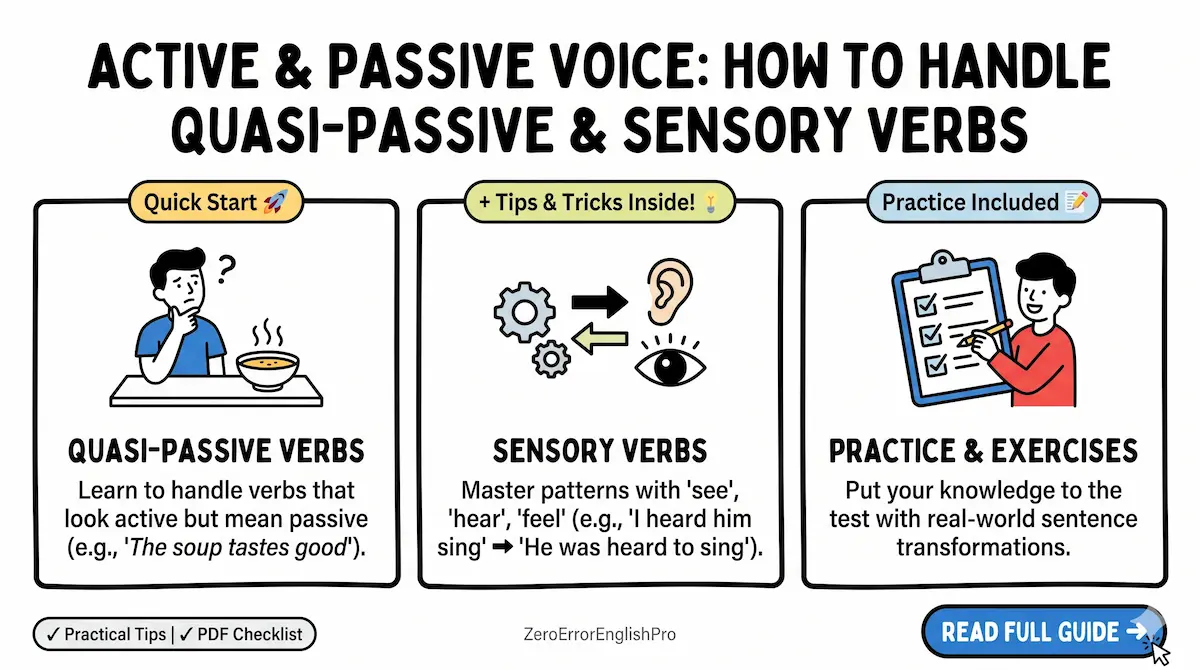
The Passive Sentence That Doesn't Exist
"The soup was tasted delicious by everyone." Try converting this back to make sense — you can't, because the original sentence should never have been passive in the first place. "Taste" here isn't describing an action being done to the soup; it's describing a quality the soup has. This is exactly the kind of quasi-passive trap SSC and Bank exams love.
Most students learn the mechanical active-to-passive formula and apply it everywhere. But several categories of verbs — sensory verbs, stative verbs, and certain quasi-passive constructions — simply don't follow that formula, and examiners build entire questions around forcing you to recognize when passive voice is grammatically impossible.
Quick answer: Sensory verbs like look, seem, appear, smell, taste, and feel followed by an adjective describe a state, not an action — they have no passive form. Only true action verbs with a direct object can be converted to passive voice.
In This Guide
- Why This Trips Up Advanced Learners
- 5 Mistakes That Are Costing You Marks
- The 6-Step Verification Method (With Real Exam Patterns)
- How Vikram Fixed This Before His Exam
- Expert Shortcuts Toppers Actually Use
- Final Takeaway
- Frequently Asked Questions
Why This Trips Up Advanced Learners
- You apply the active-to-passive formula to every sentence automatically. The formula assumes an action verb with a direct object — many verbs don't meet that condition.
- You mistake sensory verbs for action verbs. "Look," "seem," "appear," "smell," "taste," "feel," and "sound" often describe a state, not something being done.
- You don't check whether the verb has a genuine direct object. No direct object usually means no valid passive form.
- You confuse stative verbs (have, own, resemble, lack, cost, weigh, suit) with dynamic ones. Stative verbs describing possession or measurement generally resist passive conversion.
- You haven't practiced with quasi-passive constructions specifically — these look passive in structure but function statively, and standard exam prep skips them.
I know exactly how this feels — you're confident with straightforward active-passive conversion, and then a sentence with "seems" or "resembles" makes the whole exercise fall apart. It's not a knowledge gap. It's an unrecognized category of exception.
But here's what most people get wrong: they try to force every sentence into the standard formula instead of first checking if a valid passive form exists at all.
5 Mistakes That Are Costing You Marks
1. Converting sensory-verb-plus-adjective sentences to passive.
"The soup tastes delicious" describes a quality, not an action — no passive version exists.
2. Passivizing intransitive verbs.
Verbs with no direct object (arrive, happen, occur, exist, appear) cannot form a passive sentence at all.
3. Passivizing stative "possession" verbs.
"Have," "own," "possess," "lack," "resemble," "suit," "cost," "weigh" describe states, not actions performed on an object — they generally resist passive conversion.
4. Misreading a quasi-passive construction as a true passive.
"The book is well written" looks passive in structure but functions as a description of the book's quality, similar to an adjective.
5. Forgetting the direct-object check before attempting conversion.
If a verb has no direct object in the active sentence, there's nothing for the passive subject to become.
Common Mistakes Students Make
ebookcharm — English Grammar Made Exam-Ready
These five traps, along with a full list of sensory and stative verbs, are covered with drilled practice in the companion book below.
The 6-Step Verification Method (With Real Exam Patterns)
Step 1 — Identify the main verb.
Step 2 — Check if it's a sensory verb followed by an adjective. Look, seem, appear, smell, taste, feel, sound + adjective → no passive form exists.
SSC CGL Exam Pattern: "The plan seems reasonable." → cannot be passivized.
Step 3 — Check if the verb is intransitive. No direct object → no passive form is grammatically possible.
Step 4 — Check if it's a stative possession verb. Have, own, possess, lack, resemble, suit, cost, weigh — technically passivizable in rare cases, but sound unnatural and are typically avoided.
IBPS PO Exam Pattern: "This dress suits her." → no natural passive equivalent.
Step 5 — For quasi-passive-looking sentences, check if the "by" phrase can be logically restored. If restoring an agent sounds forced or unnecessary, the sentence is functioning descriptively, not as a true passive.
Step 6 — Only proceed with standard active-to-passive conversion once all five checks pass. Object becomes subject, verb becomes "be" + past participle, original subject becomes the "by" agent (optional).
Step-by-Step Strategy
SSC CGL Exam Pattern: "The plan seems reasonable."
IBPS PO Exam Pattern: "This dress suits her."
ebookcharm — English Grammar Made Exam-Ready
How Vikram Fixed This Before His Exam
Vikram was strong at mechanical active-to-passive conversion but kept losing marks specifically on questions involving sensory and stative verbs — he was applying the formula where it simply didn't apply.
He built a fixed list of sensory and stative verbs and trained himself to check every sentence against that list before attempting conversion. Within a week, his error rate on this specific category dropped to near zero.
You can do the same — here's how to start: write down ten sentences using look, seem, taste, smell, have, resemble, and cost, and check each one against the six steps above.
Expert Shortcuts Toppers Actually Use
1. Memorize the core sensory-verb list as one fixed group. Look, seem, appear, smell, taste, feel, sound — followed by an adjective, none of these passivize.
2. Always run the direct-object check before anything else. No object, no passive — this single check eliminates most wrong attempts instantly.
3. Treat "well written," "well made," "poorly designed" as descriptive phrases, not action passives. They function like adjectives, not like "was written by someone" statements.
4. Distinguish "resembles" (stative, no passive) from "was resembled" (never correct). Resemblance describes a relationship, not an action performed.
5. When a passive sounds unnatural even though it's technically formable, prefer the active version. Formal exam answer keys often favor the natural-sounding choice.
Final Takeaway
Not every active sentence has a valid passive counterpart. Before converting, check for sensory verbs, intransitive verbs, and stative possession verbs — these three categories quietly break the standard formula, and recognizing them is exactly what advanced-level questions test.
Frequently Asked Questions
Q: Can "look" ever be passivized?
A: Not when followed by an adjective describing appearance ("She looks tired"). "Look" can be passivized only in unrelated senses, such as "look for," which functions differently as a phrasal verb.
Q: Is "The cake was baked by her" a quasi-passive or a true passive?
A: That's a true passive — "bake" is a genuine action verb with a clear agent performing it on an object. Quasi-passive constructions involve verbs describing states or qualities, not real actions.
Q: Why do exams test verbs that "can't" be passivized instead of ones that can?
A: Because recognizing the exception requires deeper understanding than applying the mechanical formula — it's a more reliable way to separate strong candidates from those who memorized a rule without understanding it.
The Ultimate Guide to Active & Passive Voice for Competitive Exams
Move beyond the mechanical active-to-passive formula to confidently recognize when passive voice is grammatically impossible.