Active and Passive Voice for Competitive Exams: Complete Guide with Rules and Examples
Master Active and Passive Voice for SSC CGL, Banking and Railway exams. Complete rules, tense conversion tables, common traps, error spotting practice and a clear 30-day revision path.
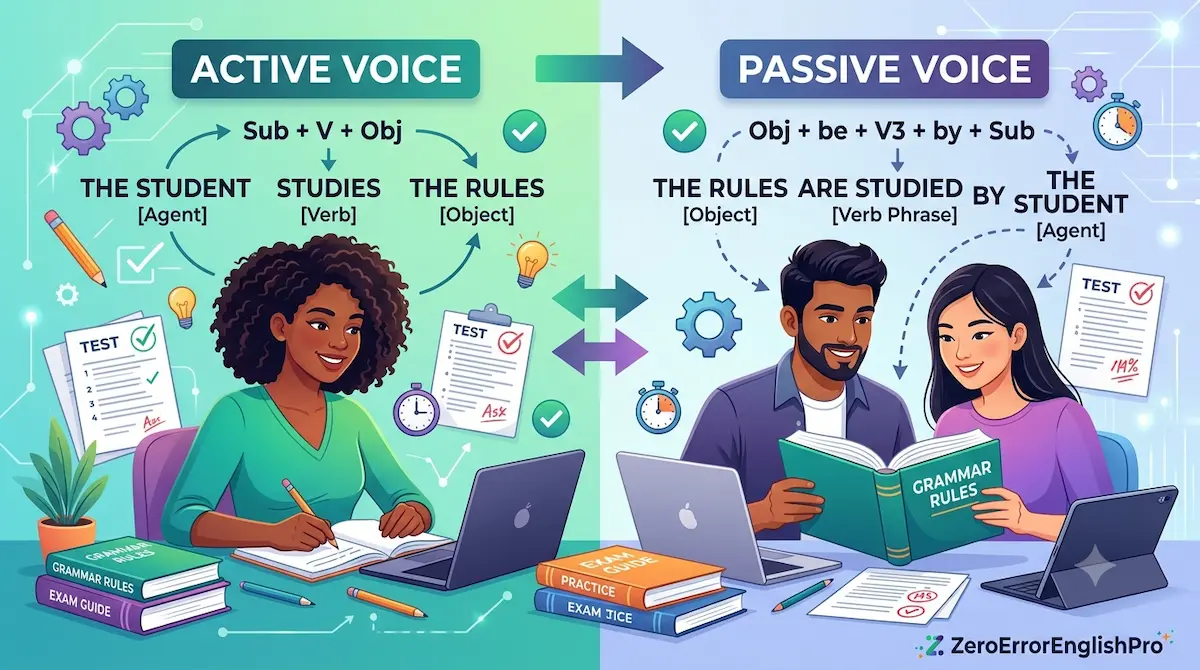
Why Active and Passive Voice Still Cost Marks
Almost every aspirant knows the basic definition: in Active Voice the subject does the action; in Passive Voice the subject receives the action. Yet in almost every SSC CGL, CHSL, Banking and Railway mock, 2–4 marks are lost only on voice questions. The reason is simple — the rules look easy when explained, but under time pressure the conversion of tense, the correct form of “be”, and the decision of whether to keep or drop the “by” phrase become automatic traps.
This Day 1 guide closes that gap. You will get the complete rule set, tense-by-tense conversion tables, the most common named traps, a clear decision method, and a practical way to practise so the skill becomes automatic rather than effortful.
Quick facts: Active and Passive Voice is tested in Error Spotting, Sentence Improvement and Fill in the Blanks across SSC CGL, Banking and Railway exams. Mastering the conversion rules and the most frequent traps usually recovers 3–5 marks that are otherwise lost every paper.
In This Guide
- Why voice questions keep costing marks
- Complete rules: Active → Passive conversion
- Tense-by-tense conversion table
- Special cases and named traps
- How to practise: the 4-step checking method
- Who should focus on this topic now
- Frequently asked questions
Why Voice Questions Keep Costing Marks
The core idea is simple. The difficulty appears only when three things have to happen at the same time:
- The object of the active sentence must become the subject of the passive sentence.
- The verb must change into the correct form of “be + V3” according to the original tense.
- The original subject is either dropped or placed after “by”, depending on whether it is important or known.
Under exam pressure most aspirants either change the tense incorrectly, forget the “being / been” forms, or keep an unnecessary “by” phrase. That is exactly what this guide is built to eliminate.
Complete Rules: Active → Passive Conversion
The basic formula never changes:
Object of Active + appropriate form of “be” + V3 (+ by + original subject)
Only transitive verbs (verbs that take an object) can be changed into Passive Voice. Intransitive verbs have no object, so they cannot form a passive sentence.
When to use Passive Voice in exams
- The doer is unknown or unimportant.
- The focus is on the action or the receiver of the action.
- The sentence sounds more formal or objective (common in official notices and reports).
Tense-by-Tense Conversion Table
| Tense | Active | Passive |
|---|---|---|
| Present Simple | writes / write | is / am / are written |
| Present Continuous | is writing | is / am / are being written |
| Present Perfect | has / have written | has / have been written |
| Past Simple | wrote | was / were written |
| Past Continuous | was writing | was / were being written |
| Past Perfect | had written | had been written |
| Future Simple | will write | will be written |
| Future Perfect | will have written | will have been written |
| Modals | can / may / must write | can / may / must be written |
Special Cases and Named Traps
These are the traps that appear most frequently in SSC and Banking papers:
- Trap 1 – Missing “being / been”: Present Continuous and Perfect forms are the most common error sources.
- Trap 2 – Unnecessary “by” phrase: When the doer is unknown or obvious, the “by” phrase should be dropped.
- Trap 3 – Wrong form of “be”: Matching the number and person of the new subject is mandatory.
- Trap 4 – Imperative sentences: “Open the door” → “Let the door be opened.”
- Trap 5 – Verbs with two objects: Either object can become the subject; both forms are usually accepted if grammar is correct.
- Trap 6 – “Who” questions: “Who wrote this?” → “By whom was this written?”
How to Practise: The 4-Step Checking Method
- Identify whether the verb is transitive and locate the object.
- Change the object into the new subject and put the correct form of “be + V3”.
- Decide whether the original subject needs “by” or can be dropped.
- Verify tense consistency and subject-verb agreement with the new subject.
Practise this sequence on 10–15 sentences every day for two weeks. The recognition speed improves dramatically once the steps become automatic.
Who Should Focus on This Topic Now
- You are preparing for SSC CGL, CHSL, Banking or Railway and still lose marks on voice questions.
- You know the basic rule but make mistakes under time pressure in mocks.
- You want a clear, structured method instead of scattered notes.
If you already score full marks on voice questions across multiple recent mocks, move your revision time to weaker areas.
Master Active & Passive Voice completely
VIEW ALL GRAMMAR GUIDESFrequently Asked Questions
Q: Can every sentence be changed into Passive Voice?
A: No. Only sentences with transitive verbs (verbs that take an object) can be changed. Intransitive verbs have no object, so Passive Voice is not possible.
Q: Is the “by” phrase always necessary?
A: No. When the doer is unknown, unimportant or obvious from context, the “by” phrase is usually omitted.
Q: Which tenses cause the most errors in exams?
A: Present Continuous, Present Perfect and Past Continuous. The “being” and “been” forms are frequently missed.
Q: How should I practise for Error Spotting?
A: Take any active sentence, convert it correctly, then deliberately create the common wrong versions and practise spotting them under time limit.
Q: Is Active and Passive Voice asked in Banking exams as well?
A: Yes. The same rules apply. Banking papers also test voice through Error Spotting and Sentence Improvement.
Where to Go Next
Active and Passive Voice is a high-frequency, high-accuracy topic. Once the conversion rules and the main traps are automatic, the marks become almost free. Revisit this page whenever you need a quick revision of the tense table or the 4-step method before a mock test.
Advanced Punctuation Mastery: A Complete Guide to Error-Free English for Competitive Aspirants
Turn punctuation from an overlooked afterthought into a precise, rule-governed writing skill that strengthens every sentence.