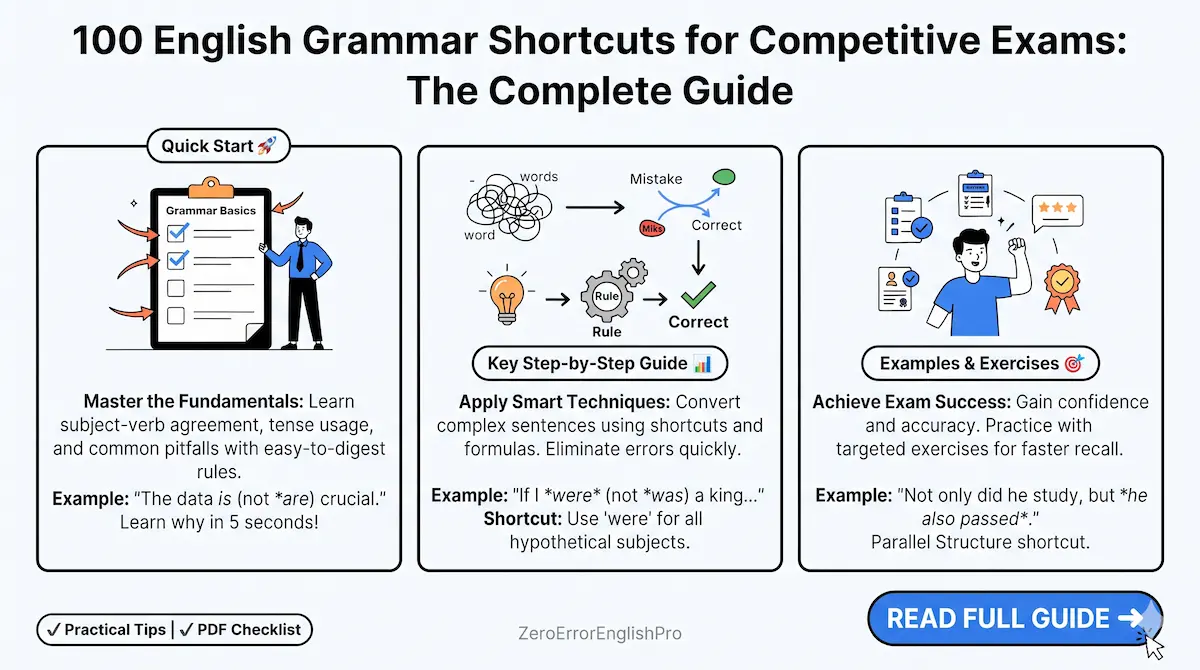
100 English Grammar Shortcuts for Competitive Exams: The Complete Guide
A complete guide to English grammar shortcuts for competitive exams: 12 shortcuts to use today, a 30-day plan and what is inside the 100-shortcut ebook.
Try this in ten seconds: (A) She gave me / (B) many advices / (C) before the exam. / (D) No error.
If you spotted it in a flash, you used a shortcut, even if you didn’t call it one. “Advice” is uncountable, so it can’t take many and it has no plural. If you needed a few seconds and a second read, that’s exactly the gap this guide is about.
Over the last six days, I’ve shown you how pattern-based shortcuts work in agreement, tenses, prepositions, articles and error spotting. This is the complete guide that ties them together. You’ll get the whole series on one page, twelve shortcuts you can start using today, an honest look at what’s inside my ebook of 100 shortcuts, and a 30-day way to use it. After 22 years of teaching, I’m convinced of one thing: exam grammar rewards recognition, not recitation.
Want all 100 shortcuts in one book?
100 English Grammar Shortcuts: Master Key Exam Grammar Shortcuts is available on Amazon as a Kindle edition. You can read a free sample on the Amazon page before you decide.
- What is a grammar shortcut?
- The 7-day series at a glance
- 12 shortcuts you can use today
- Why shortcuts work under exam pressure
- What’s inside the 100-shortcut book
- Who the book is for
- A 30-day plan
- How to use shortcuts in the exam hall
- Practice set with answers
- FAQ
- Your next step
- Related articles
What is a grammar shortcut?
A grammar shortcut is a short trigger that points you to a rule. It isn’t a replacement for the rule. It’s the thing that makes you remember the rule in two seconds instead of two minutes.
The rule: “The words after of are rarely the subject, so the verb agrees with the noun before of.”
The shortcut: “Of is a fence. Cut it.”
What happens in the exam: You see “The list of documents are,” your mind says “fence,” and you cut the of-phrase and fix the verb.
Every shortcut has three parts: a trigger (what you notice in the sentence), a hook (the short memory line) and a fix (what to do). Learn them as a trio, and recall becomes automatic.
A note on the examples in this post: every sentence is an original practice sentence on a common exam pattern. None of them is copied from a particular year’s paper, and I haven’t attached any year to them. The patterns are what repeat, and the patterns are what you should learn.
The 7-day series at a glance
Here’s the whole series in one table. Each post has its own routine, ten or more shortcuts and a practice set with answers.
| Day | Topic | Routine | Link |
|---|---|---|---|
| Day 1 | 25 error-spotting shortcuts | TRAPS: Tense, Right verb, Articles, Prepositions, Special patterns | Read it |
| Day 2 | Subject-verb agreement | CUT, FIND, MATCH | Read it |
| Day 3 | Tenses | LOOK, LABEL, LOCK | Read it |
| Day 4 | Fixed prepositions | WORD, PAIR, CHECK | Read it |
| Day 5 | Articles | SAY, SORT, SEE | Read it |
| Day 6 | Spotting errors fast | FAST: Find, Ask, Small words, Tally | Read it |
Read them in order if you’re new to shortcuts. If you already know one topic well, skip to the one that’s costing you marks.
12 shortcuts you can use today
You don’t have to buy or read anything to start. Here are twelve shortcuts from the series, one for each common error type. Learn three a day for four days.
Shortcut 1: Cut the OF-phrase
✓ The list of required documents is available.
Memory trick: “Of is a fence. Cut it.”
Shortcut 2: The near-neighbour rule
✓ Either the captain or his teammates have to submit the form.
Memory trick: “The nearest neighbour hears the verb.”
Shortcut 3: Finished time kills has and have
✓ I saw him yesterday.
Memory trick: “Yesterday and ago push has and have out of the room.”
Shortcut 4: Will stays home in the when-clause
✓ I will call you when he arrives.
Memory trick: “Will stays home in the when-clause.”
Shortcut 5: Fear, pride and fondness take OF
✓ He is afraid of snakes.
Memory trick: “Fear, pride and fondness are all OF.”
Shortcut 6: DERMA verbs need no coat
✓ We discussed the plan.
Memory trick: “DERMA is skin only. No coat, no preposition.” (Discuss, Enter, Reach, Marry, Attend)
Shortcut 7: Ears decide a or an
✓ He cleared an SSC exam.
Memory trick: “Say the letter, hear the sound.”
Shortcut 8: First a, then the
✓ I bought a book. The book was interesting.
Memory trick: “First a, then the.”
Shortcut 9: One needs one’s
✓ One should do one’s duty without fear.
Memory trick: “One needs one’s.”
Shortcut 10: Match the coaches
✓ She likes swimming and dancing.
Memory trick: “In a train, the coaches must match.”
Shortcut 11: Return has back inside it
✓ Please return the book.
Memory trick: “Return has back inside it.”
Shortcut 12: Although and but never share
✓ Although he was tired, he kept working.
Memory trick: “Although and but never share a sentence.”
Notice that none of these needed a long explanation. The hook carries the rule. That’s the whole idea behind the book of 100.
Why shortcuts work under exam pressure
Competitive exams give you seconds per question, not minutes. Under that clock, three things happen to your brain, and shortcuts are built to deal with each one.
Recall slows down. Long rules take time to retrieve. A short hook is faster to find.
Attention narrows. You stop checking small words. A routine like FAST tells your eyes where to go.
Confidence drops. When you can name the trick, you trust your answer, and you waste less time rereading.
There’s an honest limit, though. A shortcut is a trigger, not a replacement for understanding. If a hook fails on an odd sentence, go back to the rule. The best students learn the rule once and attach the hook to it, so they have both.
What’s inside the 100-shortcut book
Here’s what the Amazon listing for 100 English Grammar Shortcuts: Master Key Exam Grammar Shortcuts says the Kindle edition contains. I’m sharing it as the listing describes it, so you can judge whether it suits your preparation.
100 pattern-based shortcuts for the grammar areas that competitive exams test, with the focus on recognising patterns instead of memorising long rules.
The VPAC Error Scanning System, a method for scanning a sentence for errors.
Exam-specific strategies for SSC CGL, CHSL, IBPS PO, Clerk, RRB NTPC and UPSC CSAT.
200+ practice questions with solutions tagged by shortcut, so you can see which shortcut each answer uses.
Memory tricks and mnemonics and time management templates.
Bonus material: quick revision charts, an error pattern checklist, a time-allocation strategy for the English section and a section on common mistakes.
See it for yourself before you decide.
Open the book’s page on Amazon and tap Read sample. If the style suits you, you can have all 100 shortcuts on your phone or tablet through the Kindle app.
Who the book is for
No book suits everyone, and I’d rather you buy it for the right reasons.
It’s for you if you’re preparing for SSC, banking, railway, UPSC CSAT or similar exams, you understand basic grammar but lose marks to small errors, and you want short triggers and plenty of practice.
It’s not for you if you’re starting English from zero and need basic grammar taught slowly, or if you only want long theory chapters. In that case, build the basics first and come back to shortcuts.
I can’t promise a particular score, because results depend on your effort, your starting level and your exam. What I can say is that learning triggers beats re-reading rule lists, and the free posts in this series are the proof of method. If they help, the book will help more, because it gives you the full set in one place.
A 30-day plan
This is my suggested plan for using the book, not a schedule printed in it. Adjust it to your exam date.
Week 1: Agreement and tenses. Learn five shortcuts a day, say each hook aloud and solve ten mixed sentences.
Week 2: Prepositions and articles. Same routine. Keep an error log of every shortcut you miss.
Week 3: The rest of the grammar areas. Add one topic every two days, and revise last week’s error log before each session.
Week 4: Mixed practice and timing. Solve full sets against the clock, review every mistake by shortcut, and use the revision charts in the last three days.
The plan works because it repeats. Every session starts with the previous day’s error log, so mistakes don’t get a chance to settle.
How to use shortcuts in the exam hall
Run a routine, not a list. Use one scan, such as FAST, on every sentence instead of trying to recall rules one by one.
Name the shortcut. If you can say “That’s the near-neighbour rule,” you’re probably right.
Skip and return. If no shortcut fires in about twenty seconds, mark it and move on. A wrong guess costs time and marks.
Practice set: 8 error spotting questions
Find the part with the error, or choose (D) if there’s none. Try them before you read the answers.
- The list of documents (A) / are on (B) / the table. (C) / No error (D)
- I have seen (A) / him yesterday (B) / at the station. (C) / No error (D)
- We discussed (A) / about the plan (B) / yesterday. (C) / No error (D)
- He cleared (A) / a SSC exam (B) / last year. (C) / No error (D)
- I bought a book. (A) / A book (B) / was interesting. (C) / No error (D)
- One should do (A) / his duty (B) / without fear. (C) / No error (D)
- Although he was tired, (A) / but he (B) / kept working. (C) / No error (D)
- She gave me (A) / some advice (B) / before the exam. (C) / No error (D)
Answers
1. (A): the real subject is “list,” so use “is on.” (Shortcut 1)
2. (A): yesterday needs the simple past, so use “I saw.” (Shortcut 3)
3. (B): discuss needs no preposition, so use “the plan.” (Shortcut 6)
4. (B): S is pronounced “ess,” so use “an SSC exam.” (Shortcut 7)
5. (B): the second mention takes the, so use “The book.” (Shortcut 8)
6. (B): after one, keep using one’s, so use “one’s duty.” (Shortcut 9)
7. (B): although and but never share, so delete “but.” (Shortcut 12)
8. (D): no error. Advice is uncountable, and “some advice” is correct.
If you scored 7 or 8, you’re ready to move on to full sets. If you scored 4 to 6, revisit the shortcuts you missed. If you scored below 4, read the Day 2 to Day 5 posts first, and retake the set after two days.
Frequently asked questions
Is the book available on Kindle?
Yes. The listing shows the Kindle edition, and you can read it on the Kindle app on your phone, tablet or computer. You can also read a free sample on the Amazon page.
Which exams does the book cover?
The listing names SSC CGL, CHSL, MTS and other SSC exams, banking exams such as IBPS PO, Clerk and SBI PO, railway exams such as RRB NTPC and Group D, UPSC CSAT and several others. Check your own exam’s latest notification for its pattern.
Do shortcuts replace learning grammar rules?
No. A shortcut is a trigger that helps you recall a rule quickly. Learn the rule once, attach the hook to it and use the hook under time pressure.
How long will it take to finish the book?
It depends on your pace. A suggested plan is five shortcuts a day with ten practice sentences, which finishes in about a month, but you can go faster or slower.
Can I start with the free posts first?
Yes. The Day 1 to Day 6 posts in this series teach the same method on a smaller scale, with practice sets and answers. Many readers try them before deciding on the book.
Will the book guarantee a particular score?
No honest book can. Your result depends on your effort, your starting level and the exam. A good book gives you a method, and your practice does the rest.
Your next step
You now have the whole picture: the method, twelve shortcuts to use today and a plan for the next 30 days. The only thing left is to start, and the best time to start is today, before this page fades from your memory.
Step 1 (2 minutes): Open the Amazon page and read the free sample.
Step 2 (today): Get your copy if the style suits you, so all 100 shortcuts are on your phone.
Step 3 (tonight): Learn the first five shortcuts and solve ten sentences.
Step 4 (tomorrow): Start your error log, and repeat.
Start your 30-day plan today.
Get 100 English Grammar Shortcuts: Master Key Exam Grammar Shortcuts on Amazon and put every shortcut in your pocket.
The link, in case you want to copy it: https://link.amazon/B03rEYi9F
Which shortcut helped you most this week? Tell me in the comments, and I’ll explain it in more detail.
Related Articles
100 English Grammar Shortcuts: Master Key Exam Grammar Shortcuts
Compress months of grammar study into 100 instantly applicable shortcuts for rapid pre-exam revision.